
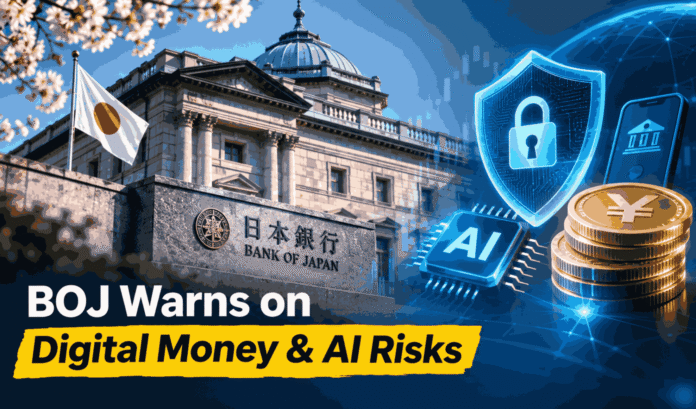
The growing adoption of digital money, tokenised financial assets and artificial intelligence is creating new challenges for financial regulators. The Bank of Japan (BOJ) has warned that policymakers must strengthen safeguards to protect financial stability, cybersecurity and public confidence as financial systems become increasingly digital.
Kazushige Kamiyama, Executive Director at the Bank of Japan, highlighted these concerns during a speech at an International Monetary Fund seminar on digital money and payments in Tokyo on Friday. He stressed that technological innovation could improve the way money and payments work, but such progress must be supported by reliable safeguards and institutions.
Digital money brings new financial challenges
Digital money, including stablecoins and tokenised deposits, is expected to become an increasingly important part of the financial ecosystem. These forms of money may operate alongside traditional banking systems, creating new opportunities for payments, transactions and financial services.
However, the BOJ believes their growing interaction could create complications for policymakers. Different digital payment systems and monetary instruments could become fragmented, making it harder to maintain consistency across financial markets.
Kamiyama warned that authorities must ensure the growing diversity of digital money does not undermine financial stability. Regulators will need to carefully monitor how these new instruments interact with traditional financial institutions and payment infrastructure.
The challenge is not simply encouraging innovation but ensuring that the expanding digital monetary ecosystem remains reliable, connected and resilient.
AI is increasing cybersecurity risks
Artificial intelligence is also creating new security concerns for financial institutions and regulators. While AI can improve efficiency, automate processes and support financial services, it may also increase the ability of malicious actors to identify and exploit weaknesses in digital systems.
Kamiyama said the growing use of AI requires financial institutions and authorities to strengthen their cybersecurity defences. As AI capabilities advance, security vulnerabilities could become easier to discover and exploit, potentially exposing financial infrastructure to more sophisticated cyber threats.
Financial institutions are increasingly relying on interconnected digital platforms, making cybersecurity a critical part of their operations. A security incident affecting one platform could potentially spread to other connected systems, increasing the risk of wider disruption.
The BOJ official stressed that security and resilience should be built into new financial platforms from the beginning rather than treated as an afterthought.
Tokenisation could amplify market risks
Tokenisation is another area attracting attention from policymakers. The process involves converting assets such as bonds, securities and deposits into digital tokens that can be traded and settled through programmable platforms.
The technology could make financial transactions faster, more efficient and potentially easier to manage across institutions. It may also open up new ways of trading and transferring financial assets.
However, tokenisation could introduce additional risks during periods of market stress. Kamiyama noted that new trading channels connecting institutions and markets could amplify market movements when financial conditions become unstable.
As tokenised assets become more widely used, regulators will need to understand how transactions across different platforms affect liquidity, market stability and the broader financial system.
The expansion of tokenised finance also raises questions about the legal status of digital transactions, particularly whether transferring a token automatically transfers the legal rights and obligations associated with the underlying asset.
Regulators must establish clear legal frameworks
The BOJ believes technological innovation alone will not be enough to make tokenised finance successful. Policymakers must establish clear legal frameworks that define how digital assets are recognised, transferred and regulated.
Legal clarity will be particularly important as tokenised assets move across platforms and institutions operating under different rules. Without clearly established rights and responsibilities, businesses and investors could face uncertainty when dealing with digital financial instruments.
Kamiyama called for stronger cooperation between public authorities and private sector institutions to address these challenges.
Central bank money, he added, will continue to serve as a fundamental anchor of trust in the monetary system. As new forms of digital money emerge, maintaining confidence in the financial system will remain a central priority for policymakers.
The BOJ’s message reflects a broader shift in financial regulation. Governments and central banks are increasingly moving beyond experimental digital finance projects and focusing on how these technologies can be integrated into existing financial systems without compromising stability, security or trust.
Follow TechBSB For More Updates