
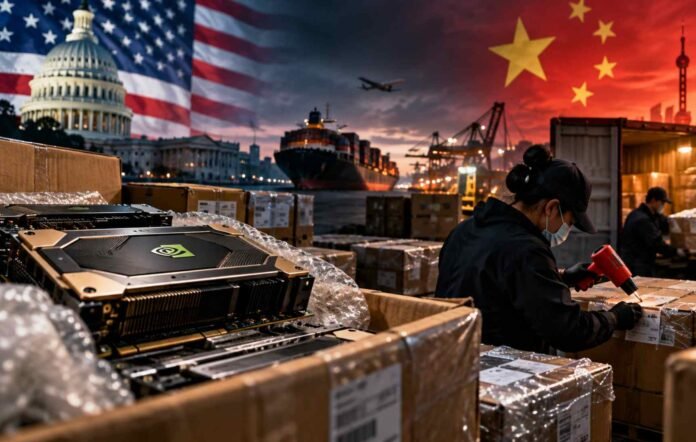
Nvidia’s artificial intelligence chips are still finding their way into China despite strict US export restrictions, exposing just how difficult it is to control the global flow of advanced hardware.
What began as a series of isolated smuggling cases has increasingly started to look like something much bigger. Investigations across several countries have uncovered companies, intermediaries and shipping routes allegedly being used to move restricted Nvidia processors through third countries before they eventually reach Chinese buyers.
The developments are putting renewed pressure on Nvidia and US officials to explain how advanced chips subject to export controls continue to appear inside China.
A global network is taking shape
One of the clearest examples came from a case investigated by US authorities earlier this year. A surveillance image released by prosecutors showed a woman inside a warehouse in Southeast Asia using a red hair dryer to remove serial number stickers from server packaging.
The unusual scene became a striking illustration of the lengths some operators are willing to go to hide the origin and identity of high value computing hardware.
Removing labels is only one part of the wider operation. Authorities have been tracking shipments that allegedly move through multiple countries, making it harder to establish where the hardware is ultimately headed.
The suspected routes have involved locations across Asia and other international trading hubs. In some cases, equipment appears to have been purchased legally before being redirected through intermediaries and resold into restricted markets.
That creates a difficult problem for regulators. A chip does not necessarily need to be smuggled directly from the United States into China to violate export restrictions. It can pass through several legitimate businesses and countries before reaching its final destination.
Why Nvidia chips remain so valuable
The demand is largely driven by the enormous value of advanced computing hardware.
Nvidia has become one of the most important suppliers of processors used to train and operate artificial intelligence systems. Its high performance accelerators are particularly valuable for large scale AI workloads, where huge amounts of computing power are required.
US export controls are designed to prevent some of the most advanced processors from reaching China because Washington considers cutting edge AI computing capacity to be strategically sensitive.
The restrictions have changed over time, with the US tightening rules and introducing limits on different classes of advanced chips and semiconductor equipment.
Yet demand has not disappeared.
Instead, the restrictions have created a powerful incentive for buyers and intermediaries to search for alternative supply routes. Where legitimate access becomes harder, unofficial channels can become more attractive.
That is helping fuel a shadow market for high end computing hardware.
The problem goes beyond one company
The cases emerging across Asia suggest that Nvidia is dealing with a problem that cannot be solved simply by tracking individual sales.
Once a chip leaves the manufacturer’s direct supply chain, visibility can quickly become limited. Hardware may be sold to a distributor, transferred to another company, shipped to a different country and eventually resold.
Each transaction can appear ordinary when viewed in isolation.
The bigger picture can be much harder to identify.
This is where officials are increasingly questioning whether Nvidia and its partners should have detected warning signs earlier. Investigators are examining unusual purchasing patterns, intermediary companies, shipping routes and other signals that could indicate an attempt to bypass restrictions.
For Nvidia, the issue is particularly sensitive. The company has to comply with US rules while also managing a huge international customer base and a complex network of distributors and partners.
The company has repeatedly had to adjust its products and sales strategy as Washington changes the rules governing advanced AI chips.
Export controls face a difficult test
The growing number of suspected smuggling cases highlights a fundamental weakness in export controls. Rules can restrict who is allowed to buy a particular technology, but enforcing those rules becomes considerably harder once products enter a global supply chain.
A server containing restricted processors can potentially travel through several jurisdictions before authorities identify its final destination.
That means enforcement increasingly depends on more than blocking direct sales. Governments need better visibility into distributors, resellers, shipping companies and end users.
The investigations also show why serial numbers and other identifying information matter. If hardware can be relabelled or its paperwork altered, tracing individual components becomes significantly more difficult.
The result is a cat and mouse game between regulators trying to close loopholes and businesses attempting to find new ways around them.
For Nvidia, the stakes extend beyond individual shipments. Any perception that its chips can routinely bypass US restrictions could increase regulatory scrutiny and create additional pressure on the company to strengthen controls across its supply chain.
At the same time, the continuing demand for Nvidia’s processors demonstrates just how valuable advanced AI computing has become.
The emergence of an international smuggling network is therefore about more than Nvidia. It is a sign of how strategically important AI hardware has become and how difficult it can be to control technology once it enters a global marketplace.
Follow TechBSB For More Updates