
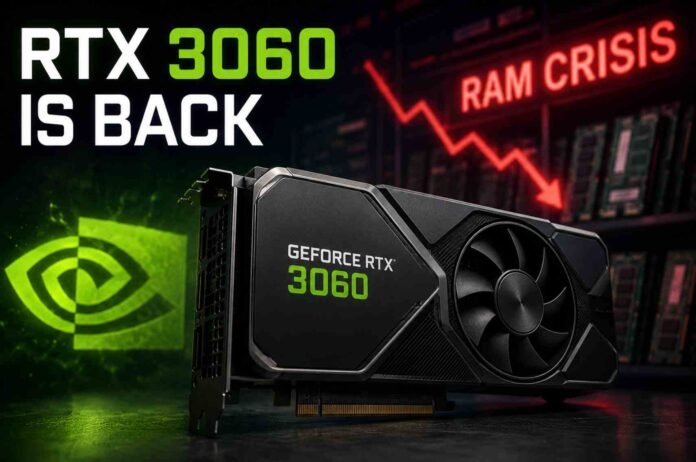
The Nvidia GeForce RTX 3060 is making an unexpected return to store shelves, and its comeback says more about today’s hardware market than the graphics card itself. Several board partners, including Asus, MSI, and Gigabyte, have quietly started offering fresh RTX 3060 stock again, even though the GPU originally launched back in 2021.
At first glance, reviving a five year old graphics card may seem unusual, especially when newer products like the RTX 5060 are already available. However, ongoing memory shortages and rising component costs have created a situation where older hardware has become a practical solution for manufacturers trying to fill gaps in the market.
The RTX 3060 remains one of the most widely used graphics cards among PC gamers, and its large 12GB memory buffer continues to make it attractive for gaming and AI related workloads. Even so, its return has sparked debate over whether buyers are actually getting good value at today’s prices.
RAM shortage is changing the graphics card market
The continued RAM crisis has affected much more than memory prices. Graphics cards, AI accelerators, servers, and consumer hardware all rely on memory chips, making supply constraints a problem across the entire technology industry.
With memory availability under pressure, manufacturers are facing higher production costs and tighter inventories. Rather than relying entirely on the latest GPU lineup, Nvidia’s partners appear to be turning back to proven products like the RTX 3060 to maintain stock levels and give retailers another option to sell.
Reports indicate that initial listings appeared around $339.99, slightly above the card’s original launch price. However, many models have already climbed much higher, with some listings exceeding $400.
That pricing immediately raises questions. While the RTX 3060 still delivers respectable gaming performance, buyers shopping in the same price range can often find newer generation graphics cards that offer stronger performance, better efficiency, and access to Nvidia’s latest software features.
Why the RTX 3060 is still one of Steam’s most popular GPUs
Despite its age, the RTX 3060 continues to dominate the Steam Hardware Survey. That isn’t simply because gamers refuse to upgrade. The card hit a sweet spot when it launched by combining solid performance with an unusually generous 12GB of VRAM.
Even today, that memory capacity remains valuable. Many modern PC games demand more video memory than previous generations, particularly at higher texture settings. The RTX 3060 handles 1080p gaming comfortably and can also deliver a good experience at 1440p when paired with Nvidia’s DLSS upscaling technology.
The extra VRAM has also given the card an unexpected second life outside gaming. AI enthusiasts running local language models, image generation software, and machine learning applications often prioritize larger memory capacity over raw gaming performance. In those scenarios, the RTX 3060 still holds practical value.
That combination of gaming capability and AI usefulness helps explain why demand has remained surprisingly steady years after its release.
Buyers remain divided over Nvidia’s decision
While additional GPU availability is welcome during ongoing supply challenges, many enthusiasts believe the RTX 3060 is difficult to recommend at current prices.
Online discussions have largely focused on value rather than performance. Few people argue that the graphics card is incapable. Instead, the concern is that newer alternatives sit in nearly the same price bracket while offering architectural improvements, better power efficiency, and newer technologies such as Multi Frame Generation.
For gamers building a brand new PC, spending over $400 on hardware from an older generation may not be the most sensible investment. On the other hand, buyers specifically looking for a 12GB graphics card without spending significantly more may still find the RTX 3060 appealing.
Ultimately, its return reflects the unusual state of today’s PC hardware market. Instead of older products disappearing as new generations arrive, supply issues and memory shortages are extending the lifespan of graphics cards that would normally have been retired.
A temporary comeback driven by market conditions
The RTX 3060’s return should not be viewed as a sign that Nvidia is reversing its product roadmap. Instead, it highlights how unpredictable the hardware market has become during an extended period of memory shortages.
As long as RAM supply remains constrained and pricing continues to fluctuate, manufacturers are likely to explore every viable option to keep graphics cards available. The RTX 3060 fits that strategy because it is already well established, widely trusted, and still capable of handling modern gaming workloads.
Whether consumers embrace the card again will largely depend on pricing. If retailers continue listing it close to newer generation alternatives, many buyers are likely to choose the latest GPUs instead. However, if prices become more competitive, the RTX 3060 could once again become an attractive option for gamers and AI users seeking ample VRAM without moving into a much higher price tier.
Follow TechBSB For More Updates