
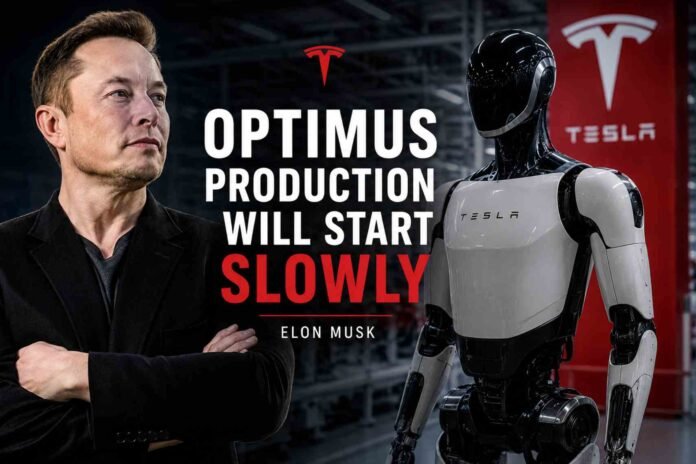
- Elon Musk says Tesla Optimus production will be extremely slow during its initial phase.
- Tesla is building a completely new manufacturing system instead of adapting existing vehicle production lines.
- Fremont will handle pilot production, while Giga Texas is being prepared for future high volume manufacturing.
- Tesla expects large scale Optimus production to ramp up around 2027 after refining the production process.
Excitement around Tesla’s Optimus humanoid robot continues to build, but Elon Musk has made it clear that expectations around production need to stay realistic. While some enthusiasts believe Tesla is already ahead of schedule, Musk says the company is entering a challenging phase where manufacturing will move at a cautious pace.
His latest comments reinforce a message he has repeated several times in recent months. Building a humanoid robot is fundamentally different from producing electric vehicles, and Tesla’s first priority is creating a reliable production system rather than chasing high output.
Musk dismisses speculation about an early production breakthrough
The discussion began after an X user suggested Tesla may have delayed the Optimus V3 demonstration because the company was further ahead than expected. According to the theory, Tesla wanted to avoid revealing too much about its latest robot before competitors could study its design. The post also predicted that Tesla would soon unveil a large number of fully functional robots while announcing that meaningful production had already started.
Musk quickly rejected that assumption.
He explained that Optimus production will be “extremely slow” in its early stages because every part of the manufacturing process is being developed from scratch. Unlike vehicle production, where Tesla already has years of manufacturing experience and established supply chains, Optimus requires an entirely new production ecosystem.
His response suggests Tesla is following a deliberate strategy instead of rushing the rollout. The company appears focused on solving manufacturing challenges before attempting large scale production.
Why producing Optimus is far more complicated than building cars
Tesla has repeatedly described Optimus as one of its most ambitious engineering projects. While the company has mastered electric vehicle production over the past decade, humanoid robots introduce an entirely different level of complexity.
According to Musk, Optimus consists of around 10,000 unique components that must work together seamlessly. Every actuator, sensor, electronic system, and mechanical joint has to meet strict reliability standards. Even a small issue with one component could slow production or affect the robot’s performance.
This explains why Tesla expects production to follow a familiar manufacturing pattern. Early output will remain limited while engineers refine assembly methods, identify bottlenecks, and improve manufacturing efficiency. Once those challenges are addressed, production can gradually accelerate.
The company is prioritizing quality and repeatability before aiming for higher volumes. That approach is common in advanced manufacturing, particularly when launching an entirely new product category.
Fremont becomes the launch site for Optimus manufacturing
Musk’s comments came shortly after he shared a photo with the Optimus production team inside Tesla’s Fremont factory. The image highlighted the company’s growing focus on humanoid robots alongside its electric vehicle business.
Tesla has reportedly repurposed parts of the Fremont facility, including production areas that were previously associated with the Model S and Model X, to support early Optimus assembly.
Pilot production is expected to begin during the summer, allowing Tesla to validate manufacturing processes before moving toward larger scale operations.
The company is also preparing for the next phase of expansion. A dedicated Optimus manufacturing facility is under construction at Giga Texas, where Tesla expects to handle much larger production volumes in the future.
Current projections indicate that mass production is unlikely before the summer of 2027. Looking further ahead, Tesla has outlined an ambitious long term goal of producing up to 10 million Optimus robots each year, although reaching that level will require significant advances in manufacturing, automation, and supply chain capacity.
For now, Musk’s latest remarks serve as a reminder that even with rapid progress in robotics, scaling production remains one of the industry’s biggest challenges. Tesla may be confident about the long term potential of Optimus, but the company appears determined to build a strong manufacturing foundation before attempting aggressive expansion.
Follow TechBSB For More Updates