
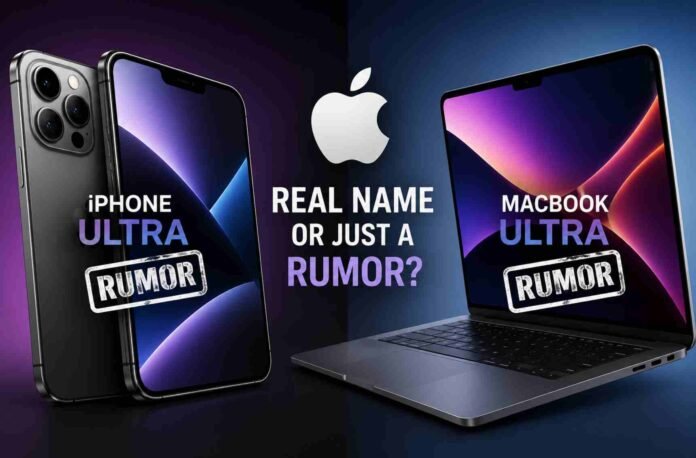
- Apple keeps product names secret much longer than hardware details.
- There is no reliable evidence that the foldable iPhone will be called iPhone Ultra.
- A MacBook Ultra would conflict with Apple’s current Apple Silicon naming strategy.
- Apple’s branding philosophy focuses on clarity and consistency rather than following industry trends.
Apple product rumors often get plenty of hardware details right months before launch. Display sizes, chip upgrades, camera improvements, and even industrial designs regularly leak through the supply chain. Yet there is one area where even the most trusted leakers frequently fall short, and that is product names.
Over the past year, reports have confidently claimed that Apple’s upcoming foldable iPhone will arrive as the iPhone Ultra, while others have suggested that a redesigned touchscreen MacBook Pro could debut under the MacBook Ultra branding. Both names sound believable at first glance, but they overlook one of Apple’s longest standing habits. The company treats branding differently from hardware, and history shows that guessing Apple’s final marketing name is far more difficult than predicting the product itself.
Apple keeps product names secret until the very end
Unlike hardware components, product names rarely appear throughout Apple’s manufacturing process. Suppliers can build displays, enclosures, batteries, and internal components without ever knowing what the finished product will be called.
Apple has become increasingly careful about protecting branding information. Internal parts usually avoid retail names, while packaging is produced very late in the manufacturing cycle. That means even accurate supply chain sources often know exactly what Apple is building but not how it will eventually be marketed.
Recent history offers several good examples.
The affordable MacBook that many expected finally arrived, but almost nobody predicted its official name would be MacBook Neo. There were no reliable reports pointing to that branding months in advance. Instead, the name surfaced only hours before Apple’s announcement after a regulatory filing accidentally revealed it.
A similar situation unfolded with Apple’s mixed reality headset. Before its unveiling at WWDC 2023, nearly every major rumor referred to it as Reality Pro. When Apple introduced the product as Vision Pro, it surprised both industry analysts and longtime Apple watchers. The hardware had leaked extensively, but the branding remained hidden until launch.
These examples highlight an important pattern. Apple can keep product names under wraps even when almost everything else has leaked.
Why the iPhone Ultra rumor deserves skepticism
That same lesson applies to the foldable iPhone.
Many recent reports simply assume Apple will call its first foldable device the iPhone Ultra. While the name is certainly possible, there is no solid evidence confirming it. In fact, some of the industry’s most reliable Apple analysts, including Mark Gurman and Ming Chi Kuo, continue referring to the device only as the foldable iPhone rather than assigning it a commercial name.
That cautious approach says a lot.
Apple has already shown how unreliable the Ultra prediction can be. Before the launch of the iPhone 15 lineup, rumors widely claimed Apple would replace the Pro Max with an iPhone 15 Ultra or introduce an even more premium flagship carrying that name. Neither happened.
The same prediction returned ahead of the iPhone 16 generation. Once again, the expected Ultra model never appeared.
After multiple failed predictions, the Ultra label has started to feel less like insider information and more like a convenient placeholder attached to every premium Apple device still in development.
There is also another reason to question the assumption. Samsung has built its flagship identity around the Ultra name for years. Apple rarely follows competitors when establishing product branding. Instead, it usually introduces names that fit its own ecosystem and marketing strategy rather than adopting industry trends.
A MacBook Ultra creates unnecessary confusion
The MacBook Ultra rumor faces an even bigger challenge.
Apple currently reserves the Ultra label for two very specific categories. The first is the Apple Watch Ultra, where the name represents durability and adventure focused features. The second is the Ultra class of Apple Silicon processors, which sit above Max chips and power desktop machines such as the Mac Studio.
That naming hierarchy is simple and easy to understand.
Introducing a MacBook Ultra would complicate that structure, especially if the laptop continued using Pro or Max processors rather than the far more powerful Ultra chip.
Current reports suggest Apple’s future MacBook Pro redesign may skip certain chip generations before eventually adopting newer M series processors. Even so, there is little indication that Ultra processors will move into laptops. Those chips remain designed for desktops because of their higher power requirements and cooling demands.
Calling a notebook MacBook Ultra while equipping it with a processor below the Ultra tier would blur Apple’s otherwise consistent product lineup. Customers could reasonably assume they were buying Apple’s most powerful silicon when that would not actually be the case.
Apple has spent years simplifying its product families through a clear progression. Standard models serve everyday users, Air focuses on portability, and Pro targets professionals. Adding an Ultra laptop without matching Ultra hardware would introduce unnecessary complexity into a lineup that has traditionally been easy to navigate.
Apple’s philosophy has always favored clarity over hype
None of this means Apple will never use the Ultra name again. The company has proven that branding evolves over time, and future leadership could introduce fresh marketing ideas.
However, Apple’s history suggests that names are carefully chosen to reinforce product positioning rather than simply make a device sound more premium.
Until Apple officially introduces its foldable iPhone or next generation MacBook, every reported name should be viewed as speculation instead of fact. Hardware leaks often have a strong track record, but branding remains one of the few secrets Apple consistently manages to keep until launch.
For now, the foldable iPhone and redesigned MacBook may be very real products, but calling them iPhone Ultra or MacBook Ultra says more about the rumor mill than it does about Apple’s actual plans.
Follow TechBSB For More Updates