
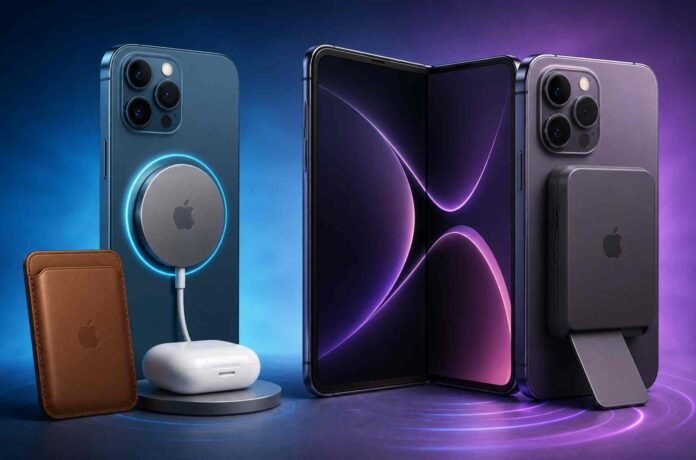
- MagSafe works brilliantly, but its accessory ecosystem has barely evolved since launch.
- AirPower represented a far more ambitious wireless charging vision that Apple failed to deliver.
- Most MagSafe products today remain limited to chargers, wallets, and simple mounts.
When Apple unveiled MagSafe alongside the iPhone 12 in 2020, it felt like the start of something much bigger than a charging feature. The company presented it as the foundation for an entirely new ecosystem of accessories, one that would transform how people used their iPhones every day.
And to be fair, MagSafe succeeded in many ways. It made wireless charging easier, improved alignment issues, and introduced a clean, reliable way to attach accessories to the back of an iPhone. Wallets, stands, battery packs, car mounts, and charging docks suddenly became more convenient.
But six years later, it is difficult to ignore a lingering feeling that MagSafe never truly evolved into the groundbreaking platform Apple originally hinted at.
The technology works well. The problem is that it stopped growing.
For all the excitement surrounding MagSafe during its launch period, the accessory ecosystem has remained surprisingly predictable. Most products still fall into the same familiar categories that appeared during the first year of release. Cases, chargers, wallets, grips, and basic mounts continue to dominate the space, with very little experimentation beyond those ideas.
Apple promised innovation. What users mostly received was refinement.
AirPower Was the Bigger Vision Apple Could Not Finish
Part of the reason MagSafe feels limited is because many Apple fans still remember what came before it.
Before MagSafe, Apple attempted something far more ambitious with AirPower. That charging mat was supposed to eliminate the frustration of precise placement entirely. You could place an iPhone, Apple Watch, or AirPods anywhere on the surface and the device would begin charging instantly.
It sounded like classic Apple magic.
Unfortunately, the engineering challenges became too severe. The overlapping internal charging coils generated excessive heat, making the product unsafe and unreliable. Apple eventually canceled AirPower publicly, an unusual and embarrassing moment for a company known for carefully controlled launches.
MagSafe emerged from the ashes of that failed project.
In many ways, it represented Apple choosing practicality over ambition. Instead of solving wireless charging through advanced internal engineering, Apple used magnets to simplify alignment. It was a smart compromise, but still a compromise.
That history matters because it explains why MagSafe often feels like a scaled down version of a much larger dream.
AirPower aimed to remove friction entirely. MagSafe simply reduced it.
The MagSafe Ecosystem Has Barely Changed
Apple described MagSafe as the beginning of a “robust and expanding ecosystem,” but the reality has been far less exciting.
The accessory market settled into a routine almost immediately. Even now, there are very few MagSafe products that genuinely surprise users or change how the iPhone is used.
Third party manufacturers have certainly embraced the technology, yet most ideas feel incremental rather than revolutionary. The accessories are useful, but not transformative.
That is the real disappointment.
MagSafe had the potential to become a modular platform for the iPhone, opening doors for gaming accessories, creative tools, productivity add ons, or adaptive hardware experiences. Instead, it became mostly a cleaner way to attach charging products.
Even Apple itself has done little to push the category forward. The company appears content letting MagSafe exist as a convenience feature rather than developing it into something central to the iPhone experience.
The Foldable iPhone Ultra Could Change Everything
That is why the rumored foldable iPhone Ultra feels so important.
A foldable device would introduce an entirely new form factor to Apple’s smartphone lineup. More importantly, it would create a much larger physical surface for accessories to interact with.
Current iPhones simply do not offer much room for experimentation. Accessory makers are limited by a narrow slab design that leaves little space beyond the charging ring itself.
A foldable iPhone changes that equation completely.
With a larger unfolded body, accessory companies could finally start exploring ideas that were impossible on traditional iPhones. Productivity attachments, expanded gaming accessories, modular battery systems, creative tools, portable controllers, and hybrid stands suddenly become much more practical.
The most exciting possibility is that developers may finally start thinking beyond simple charging accessories.
A foldable iPhone also creates new interaction opportunities. Accessories could potentially adapt depending on whether the device is folded or fully open. That alone could push MagSafe into a more intelligent and versatile direction.
Apple rarely gets the chance to reset an ecosystem from scratch. The iPhone Ultra could provide exactly that opportunity.
MagSafe does not need to be reinvented. It simply needs the ambition Apple originally promised.
And if a foldable iPhone finally pushes accessory makers to think bigger, MagSafe might at last become the revolutionary platform it was always supposed to be.
Follow TechBSB For More Updates