
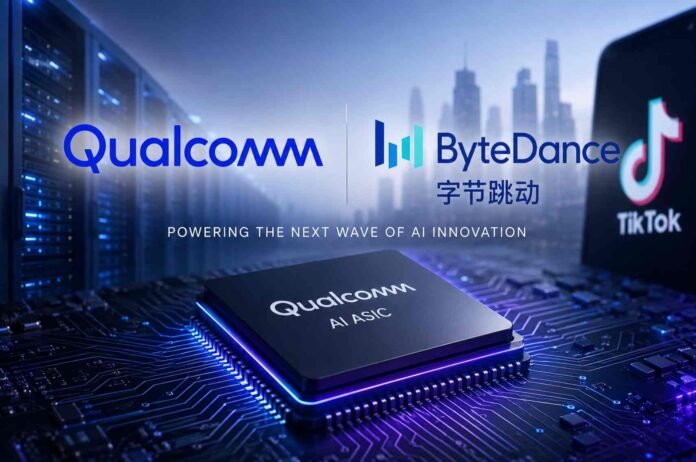
- Qualcomm reportedly signed an AI chip supply deal with ByteDance for data center infrastructure.
- ByteDance plans to buy millions of Qualcomm ASIC chips for AI agent software.
- The deal strengthens Qualcomm’s push beyond smartphones into AI infrastructure.
- The partnership comes amid growing US China tensions over advanced AI chip exports.
Qualcomm has secured a significant foothold in the fast growing AI infrastructure market after reportedly striking a deal with ByteDance, the Chinese tech giant behind TikTok. According to Bloomberg, the agreement will see Qualcomm supply AI focused chips for ByteDance data centers, giving the US chipmaker an important new customer outside its traditional smartphone business.
The reported partnership immediately lifted investor confidence. Qualcomm shares climbed nearly 5% following the news, signaling strong market optimism around the company’s expanding AI ambitions.
ByteDance is expected to purchase millions of Qualcomm’s application specific integrated circuits, better known as ASICs. These chips are designed for highly specialized computing tasks and are becoming increasingly important in artificial intelligence workloads, particularly for AI agents and inference systems.
The move could represent one of Qualcomm’s biggest steps yet toward becoming a larger player in AI infrastructure, an industry currently dominated by Nvidia.
Why this deal matters for Qualcomm
For years, Qualcomm has been known primarily for powering Android smartphones with its Snapdragon processors. But the AI boom has forced nearly every major semiconductor company to rethink its long term strategy.
Qualcomm CEO Cristiano Amon recently revealed the company is working across three major AI chip categories including CPUs, AI inference accelerators, and custom ASICs. This ByteDance partnership appears to validate that strategy.
Unlike general purpose GPUs, ASICs are tailored for specific workloads. They can deliver better efficiency, lower power consumption, and potentially lower costs for companies operating massive AI data centers. That makes them highly attractive for firms developing large scale AI services.
The reported deal also places Qualcomm in more direct competition with companies like Broadcom and Marvell, both of which have gained momentum in the custom AI chip market.
Perhaps more importantly, the ByteDance agreement could help Qualcomm diversify its revenue streams at a critical time. Smartphone growth has slowed globally, and chipmakers are increasingly chasing AI infrastructure opportunities where spending continues to explode.
ByteDance pushes deeper into AI development
ByteDance has been aggressively investing in artificial intelligence over the past few years. The company is building AI powered products across search, recommendation systems, content generation, and intelligent assistants.
According to the report, Qualcomm’s role may go beyond simply supplying chips. The company could also help ByteDance transform an internally designed processor into a production ready semiconductor.
That is a notable development because many large technology firms are now attempting to reduce reliance on external suppliers by creating custom silicon tailored to their own AI workloads.
Meta, Google, Amazon, and Microsoft have all accelerated in house chip development efforts. Chinese firms are following a similar path, especially as US export controls continue to tighten access to advanced AI hardware.
ByteDance appears to be balancing both strategies at once by developing internal chip technology while also partnering with experienced semiconductor companies that can help scale production faster.
The geopolitical challenge behind AI chips
The reported Qualcomm and ByteDance partnership arrives during an increasingly tense period for global semiconductor trade.
The United States has imposed multiple restrictions aimed at limiting China’s access to cutting edge AI chips. Nvidia, once dominant in China’s advanced AI hardware market, has faced growing export limitations that have complicated shipments to Chinese customers.
That has opened the door for alternative suppliers and custom chip partnerships.
Bloomberg noted that Qualcomm’s chips are expected to remain within legally permitted computing thresholds under current US regulations. If accurate, the arrangement would allow ByteDance to continue expanding its AI infrastructure without violating export controls.
Still, the broader situation remains delicate. Semiconductor companies are navigating a difficult landscape where commercial opportunity, national security concerns, and geopolitical pressure increasingly overlap.
For Qualcomm, however, the reported ByteDance agreement could mark the beginning of a much larger transition. The company has spent years searching for growth beyond smartphones, and AI infrastructure may finally provide the breakthrough it has been chasing.
If demand for custom AI silicon continues rising at its current pace, Qualcomm’s latest reported deal may end up being far more than a short term win. It could become a defining moment in the company’s transformation into a serious AI hardware competitor.
Follow TechBSB For More Updates