
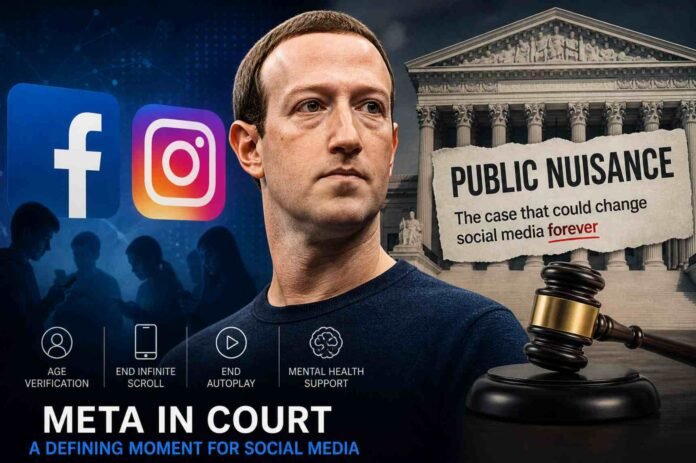
- New Mexico is trying to classify Facebook and Instagram as a public nuisance
- Lawsuit focuses on addictive design features, not just harmful content
- Proposed changes include age checks, algorithm limits, and major fines
- Outcome could reshape regulations for all social media platforms
There was a time when Facebook felt harmless. A place to reconnect with friends, share life updates, and maybe remember a birthday or two. Alongside it, Instagram brought a more visual, curated version of social life. Together, they reshaped how we communicate.
Now, decades later, that same ecosystem is being scrutinized in a way few could have predicted. A lawsuit led by the state of New Mexico is attempting something bold: to classify these platforms as a “public nuisance.” That label has historically been reserved for things like pollution, excessive noise, or unsafe public conditions. Applying it to social media marks a significant shift in how governments might regulate digital spaces.
How we got here
It is difficult to argue that platforms owned by Meta Platforms have not transformed society. What began as a college project under Mark Zuckerberg evolved into one of the most powerful communication systems in the world.
But growth came with tradeoffs. Features like infinite scrolling, autoplay videos, and algorithmic feeds were not accidental. They were engineered to maximize attention. The longer users stay, the more ads they see, and the more revenue the platform generates.
At first, these tools simply improved engagement. Over time, they became something else entirely. Critics argue they encourage compulsive use and blur the line between reality and manipulation. For younger users especially, the impact appears more pronounced. Teenagers and children often lack the experience to critically assess what they see, making them more vulnerable to misinformation, unrealistic comparisons, and addictive patterns.
Even adults are not immune. The spread of false narratives and conspiracy theories has shown how easily perception can be shaped when content is optimized for engagement rather than accuracy.
The legal turning point
The New Mexico case is not just about content. It is focused on design choices. The argument is that Meta knowingly built systems that encourage overuse, particularly among younger audiences, without adequate safeguards.
If the court agrees, the consequences could be sweeping. Proposed remedies include stricter age verification, removing features like infinite scroll and autoplay for minors, and redesigning recommendation algorithms. There is also a financial dimension, with the state seeking billions in damages to support youth mental health initiatives.
Meta, unsurprisingly, is pushing back. The company claims that implementing such changes at scale may not be technically or economically feasible. There is also a larger concern. If one state succeeds, others could follow, leading to massive cumulative penalties.
This is not just a legal battle. It is a test case that could redefine how responsibility is assigned in the digital age.
A label that could reshape the industry
Calling Facebook or Instagram a public nuisance is not a small step. It carries implications far beyond one company. If upheld, the decision could set a precedent for regulating other platforms that rely on similar engagement driven models.
At the same time, there is a risk of oversimplification. Social media is not purely harmful. It connects families across continents, supports communities, and gives individuals a voice they might not otherwise have. Many people still rely on these platforms for meaningful interactions.
The challenge lies in acknowledging both sides. The benefits are real, but so are the downsides. Regulation may be necessary, but labeling the entire system as a nuisance could create consequences that are difficult to reverse.
Where this leaves us
This case represents a broader shift in how society views technology. For years, innovation moved faster than regulation. Now, the gap is closing, and companies like Meta are being asked to take greater responsibility for the effects of their products.
Whether or not the court sides with New Mexico, one thing is clear. The era of unchecked social media growth is ending. What comes next will likely involve more oversight, more accountability, and a rethinking of how these platforms are designed.
Follow TechBSB For More Updates

