
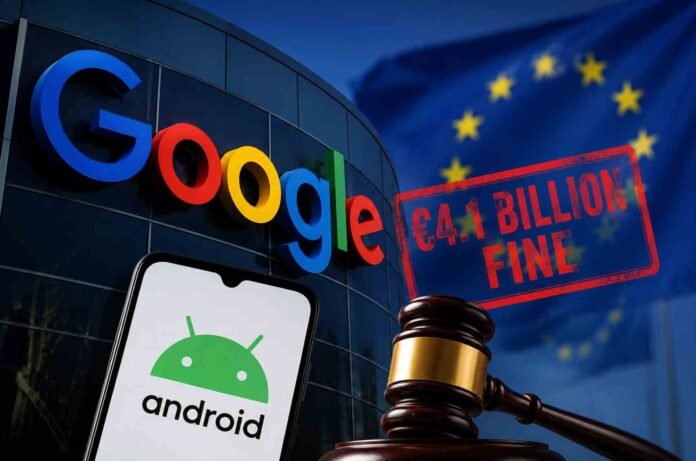
- Google lost its final appeal against the EU’s €4.1 billion Android antitrust fine.
- Europe’s highest court agreed Google abused its dominant position through Android licensing practices.
- Google says it changed its agreements in 2018 and remains committed to keeping Android open.
- The ruling strengthens the EU’s wider crackdown on Big Tech and could encourage more legal claims.
After nearly eight years of legal battles, Google has suffered a major setback in Europe as the company lost its final appeal against the European Union’s €4.1 billion antitrust fine. The ruling brings one of the bloc’s biggest competition cases to a close and reinforces the European Commission’s efforts to curb the market power of large technology companies.
The decision was delivered by Europe’s highest court, which upheld an earlier judgment confirming that Google abused its dominant position through its Android mobile operating system. Although the original penalty of €4.34 billion was reduced to €4.1 billion in 2022, the latest ruling means the revised fine will remain in place.
The case has become one of the most significant antitrust actions against a global technology company and could influence future regulatory action not only across Europe but in other markets as well.
Court backs EU findings on Android practices
The European Commission first imposed the record fine in 2018 after concluding that Google had used Android to strengthen the dominance of its search engine and browser. According to regulators, Google required smartphone manufacturers to pre install Google Search, the Chrome browser, and the Google Play Store as part of its licensing agreements.
The Commission also argued that these agreements discouraged manufacturers from developing or selling devices based on alternative versions of Android, limiting competition in the mobile software market.
Google challenged the decision, arguing that Android had increased consumer choice by providing an open and free operating system for device makers. The company maintained that its agreements helped create a consistent experience for users and developers while encouraging innovation across the Android ecosystem.
However, Europe’s highest court rejected Google’s arguments and agreed with the findings of the General Court, which had already reduced but upheld the original fine in 2022. Judges concluded that Google’s conduct amounted to an abuse of its dominant position in relation to Android and Google Search.
The ruling effectively closes Google’s legal options in this case and confirms one of the largest antitrust penalties ever imposed by the European Union.
Google says Android remains open and innovative
Following the judgment, Google defended its Android business model and stressed that it had already changed its commercial agreements after the European Commission’s original decision in 2018.
A company spokesperson said the court failed to fully recognize Google’s investments in keeping Android open, interoperable, and free for manufacturers and developers.
Google also noted that it had updated its licensing arrangements years ago to comply with European regulatory requirements and remains focused on delivering innovation for users, hardware partners, and app developers.
Despite the financial impact, the €4.1 billion penalty represents less than three percent of Alphabet’s annual profit. While the fine itself is unlikely to significantly affect Google’s financial position, the broader legal and regulatory consequences may prove more significant.
More regulatory challenges could be ahead
The Android case is only one of several competition disputes Google has faced in Europe over the past decade. Altogether, the company has accumulated close to €11 billion in EU antitrust fines covering multiple investigations into its business practices.
Earlier, Google also lost a separate appeal involving its shopping comparison service after regulators found the company unfairly favored its own platform over competitors in search results. That decision opened the door for several businesses across Europe to seek compensation through civil lawsuits.
The trend appears to be continuing. Just a day before the latest Android ruling, a Swedish court ordered Google to pay approximately $1.5 billion in damages to price comparison company PriceRunner, which is now owned by Klarna.
Looking ahead, Google could face additional regulatory pressure under the European Union’s Digital Markets Act. Authorities are already examining whether the company gives preferential treatment to its own products in search results and whether certain practices within the Google Play ecosystem comply with the bloc’s new digital competition rules.
The latest judgment is therefore about more than a single financial penalty. It reinforces Europe’s willingness to challenge the business practices of the world’s largest technology companies and signals that regulators remain committed to enforcing competition laws in digital markets. For Google, the legal battle over Android may have ended, but scrutiny of its business practices in Europe is far from over.
Follow TechBSB For More Updates