
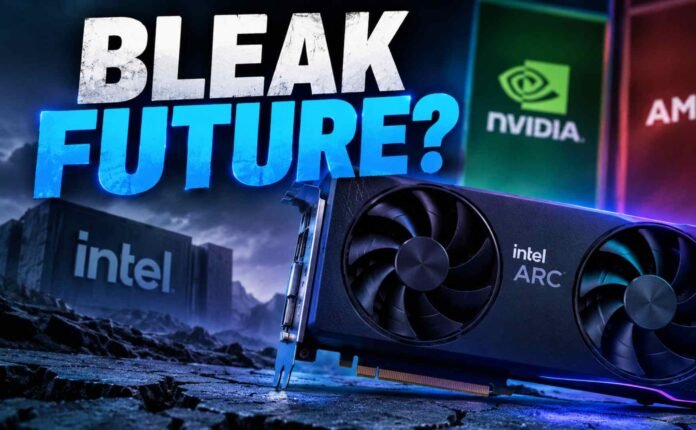
Intel Arc Graphics arrived with a clear objective: give PC gamers another option in a market dominated by Nvidia and AMD. After years of relying on integrated graphics and processors as its primary consumer products, Intel wanted to establish itself as a serious player in the discrete GPU space.
The first generation, Alchemist, had its fair share of problems. Driver inconsistencies, limited developer support and unpredictable performance in some games made the A series a difficult recommendation for certain users. However, the Arc A750 and A770 also demonstrated that Intel could deliver respectable gaming performance at competitive prices.
Battlemage changed the conversation.
The second generation brought substantial improvements in performance and driver maturity. The Arc B570 emerged as an appealing option for 1080p gaming, while the B580 attracted attention for its 1440p capabilities and relatively affordable launch price. For a brief period, Intel appeared to have found a formula that could challenge the established GPU manufacturers.
But a promising launch is only part of the battle. Intel now faces a more difficult question: how does it maintain that momentum when the next generation of gaming graphics cards remains uncertain?
Reports suggesting that the company has cancelled its planned Celestial discrete GPUs have raised concerns about the future of Arc. Meanwhile, Druid, the generation expected to follow Celestial, has become the subject of growing uncertainty.
For gamers, that leaves an uncomfortable possibility. Intel could continue developing graphics technology while stepping back from the dedicated gaming GPU market that helped establish the Arc brand.
What Happened to Intel’s Celestial Graphics Cards?
Intel originally presented Arc as a multigenerational graphics platform, with Alchemist, Battlemage, Celestial and Druid forming the foundation of its roadmap.
The first generation arrived in 2022, followed by Battlemage in late 2024. Intel subsequently outlined plans for Xe3P, associated with Celestial, in 2026 and Xe4, associated with Druid, in 2027.
Those timelines created expectations that Intel would continue releasing new discrete graphics cards at a relatively predictable pace.
However, recent reports have cast doubt on that plan. Hardware leaker Jaykihn claimed that Celestial had been cancelled and that Druid’s future was uncertain. These claims have not, in the material discussed here, been confirmed by an official Intel announcement.
The distinction matters. A rumoured cancellation is not the same as a confirmed decision to abandon a product line.
Nevertheless, Intel’s current product direction offers some clues about where its graphics technology is heading.
The company’s newer gaming handheld platforms use integrated graphics based on its Xe architecture. According to the article, Intel’s G3 and G3 Extreme platforms combine modern graphics technology with its latest processor designs, allowing the company to target compact gaming devices without requiring a separate graphics card.
There are also reports that Xe3P technology could appear in upcoming Nova Lake processors, potentially giving certain chips more capable integrated graphics.
That would allow Intel to continue developing its graphics architecture even if a dedicated Celestial gaming card never reaches consumers.
Intel has also discussed Xe3P in connection with its Crescent Island AI graphics hardware. This illustrates how the company’s graphics technology can serve markets beyond traditional PC gaming.
However, integrated graphics, AI accelerators and desktop gaming GPUs serve different purposes. Progress in one category does not automatically guarantee a competitive product in another.
Battlemage Is Losing Its Biggest Selling Point
Intel’s early Arc success depended heavily on value. The B570 and B580 were attractive because they offered capable gaming performance without demanding the kind of money associated with higher end graphics cards.
That advantage becomes harder to maintain when prices rise.
The article puts the Arc B580’s current price at around $330, compared with its original US launch price of $249.99. At that level, the card faces competition from newer Nvidia and AMD options that can deliver stronger performance in many games.
The Nvidia RTX 5060, for example, offers a different balance of memory capacity, bandwidth and processing hardware. AMD’s Radeon RX 9060 XT is another alternative for buyers comparing graphics cards in this price bracket.
The important point is that specifications alone do not determine gaming performance. Architecture, drivers, game optimisation, memory requirements and rendering features all influence how a graphics card performs in practice.
According to the testing discussed in the original article, the RTX 5060 and RX 9060 XT outperform the B580 in several tested games at 1080p. Results can vary depending on the game, settings and test configuration, but the comparison highlights the pressure Intel faces when its prices move beyond the budget segment.
The B580’s 12GB of memory remains a useful feature, particularly in games that demand more VRAM. However, additional memory does not automatically translate into higher frame rates.
For Intel, this creates a familiar problem. A product that was compelling at launch can become much less attractive when competitors improve and its own pricing moves upward.
If Arc is to remain relevant, Intel needs to ensure that its cards offer a clear reason to choose them, rather than relying on the appeal of being a third manufacturer.
Druid Could Determine the Future of Discrete Arc
If Celestial does not arrive as a dedicated gaming GPU, Druid becomes particularly important to Intel’s longer term plans.
The Xe4 generation has been associated with a possible 2027 launch, although the company’s actual plans remain unclear.
Intel executive Alex Katouzian has reportedly reiterated that GPUs remain an important part of the company’s PC product range. Such comments suggest that graphics technology continues to matter to Intel, but they do not confirm that a new generation of desktop gaming cards is on the way.
The distinction between maintaining GPU technology and selling discrete gaming cards is crucial.
Intel can develop graphics cores for processors, handhelds and AI products without necessarily committing to a complete range of desktop graphics cards. A dedicated gaming GPU requires additional investment in product design, memory, board partnerships, software support, distribution and long term driver maintenance.
That is a substantial commitment, particularly when the company is competing against established rivals with mature ecosystems.
If Druid does reach the gaming market, Intel will need more than a modest performance improvement to regain attention.
It will need a compelling combination of price, performance, memory capacity, power efficiency and software support. The article suggests that a hypothetical next generation of affordable Arc cards would need to offer competitive memory configurations and support features such as XeSS 3.
These are potential requirements rather than confirmed specifications for future products.
XeSS 3 Could Help, but It Cannot Solve Everything
Intel’s XeSS technology represents another part of its strategy.
Upscaling can improve performance by rendering a game at a lower internal resolution and reconstructing the image at a higher output resolution. Frame generation can create additional displayed frames, potentially making gameplay appear smoother.
Intel’s XeSS 3 Multi Frame Generation technology could therefore help improve the perceived smoothness of supported games.
However, frame generation is not a substitute for strong underlying performance. It does not eliminate the rendering workload, guarantee lower input latency or ensure that every game will benefit equally.
For budget graphics cards, that distinction is particularly important. Gamers still need reasonable native performance, stable drivers and broad compatibility before software features can meaningfully improve the overall experience.
Intel must also persuade developers and players to support and adopt its technologies. That takes time, consistent releases and a clear commitment to the platform.
How Intel Could Mount a Comeback
Intel still has several possible routes to a stronger position in the graphics market.
- Make affordability the priority
Arc built much of its reputation on delivering competitive performance at accessible prices. Intel could reinforce that identity by targeting mainstream gamers rather than attempting to compete immediately with Nvidia’s most expensive cards.
A genuinely affordable graphics card with sufficient memory and dependable 1080p or 1440p performance could appeal to buyers who do not need premium features.
The challenge is delivering that value without sacrificing product quality or long term support.
- Improve consistency across games
Intel’s progress since Alchemist demonstrates why software matters. Continued driver improvements, faster game updates and reliable support for major releases would help reduce uncertainty for potential buyers.
Gamers want to know that a card will work properly with the games they already own and the titles they plan to play next.
Consistency could be just as important as headline performance.
- Build a clear product roadmap
A predictable release strategy would give consumers and board partners greater confidence in Arc.
Intel does not necessarily need to release a new gaming GPU every year. However, communicating which products are coming, what markets they target and how long they will receive support would help customers make informed purchasing decisions.
Uncertainty surrounding Celestial and Druid makes that commitment particularly relevant.
- Treat integrated graphics as an opportunity, not a replacement
Intel’s work on handhelds and integrated graphics could provide valuable experience in power efficiency, graphics architecture and software optimisation.
Those developments may benefit future discrete GPUs, too.
But integrated graphics should not be mistaken for a direct replacement for desktop gaming cards. Enthusiasts and gamers seeking higher performance still have different requirements from users of compact handhelds or everyday laptops.
The Bottom Line: Intel Arc Needs a Clear Future
Intel Arc Graphics has already demonstrated that the company can produce competitive gaming hardware. Alchemist established the platform, while Battlemage showed meaningful progress in performance and value.
The current uncertainty is less about whether Intel can build a GPU and more about whether it intends to keep investing in dedicated gaming graphics.
Reports of Celestial’s cancellation and questions surrounding Druid have created doubts, but they do not amount to an official confirmation that Intel is leaving the market.
For now, Intel’s graphics ambitions appear to extend across several areas, including integrated graphics, handheld gaming and AI hardware. Whether that broader strategy will lead to another generation of affordable desktop Arc cards remains to be seen.
A comeback would require competitive pricing, dependable drivers, strong game support and a clear commitment to future products. Without those elements, even impressive graphics technology may struggle to win over gamers.
For consumers, the central issue is straightforward: Intel needs to show that Arc has a future beyond Battlemage. Until the company provides greater clarity, the prospect of a sustained three way competition with Nvidia and AMD remains uncertain.
Follow TechBSB For More Updates