
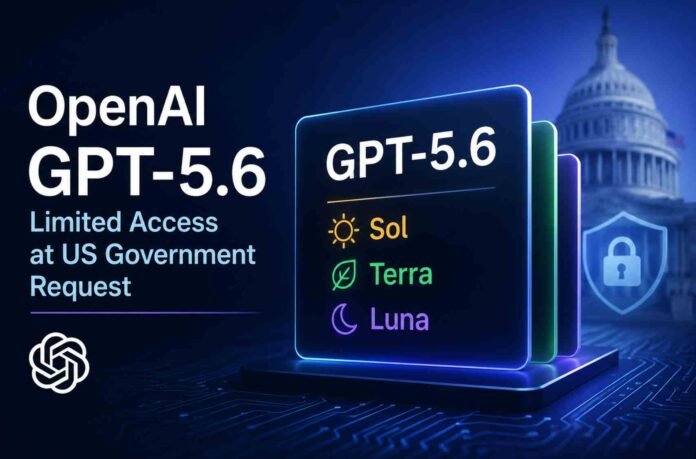
OpenAI has introduced its newest generation of artificial intelligence models, GPT 5.6 Sol, Terra and Luna. While the announcement marks another major step in the company’s AI roadmap, not everyone will be able to use the models immediately.
Instead of launching them for all users at once, OpenAI confirmed that the models will initially be available only to a select group of trusted partners. The decision follows a request from the US government, which wants AI developers to allow limited assessments of advanced models before broader public releases.
The company emphasized that this restriction is only temporary and that it intends to expand access over the coming weeks. OpenAI also made it clear that broad availability remains its long term objective despite the current rollout strategy.
According to the company, government officials were given an early preview of the new models along with details about their capabilities before Friday’s announcement.
OpenAI says broader access remains the goal
Although OpenAI agreed to the government’s request, the company stressed that it does not want this approach to become the standard process for future AI launches.
In its announcement, OpenAI explained that limiting access to a handful of organizations prevents developers, businesses, researchers and security professionals from benefiting from the latest technology. The company believes AI innovation moves fastest when advanced tools are available to a wider community rather than being restricted for extended periods.
OpenAI said it is working alongside the Trump administration to establish a structured process for evaluating advanced AI systems before they are released publicly. The company hopes the current rollout will help create a repeatable framework that can be used for future launches without causing lengthy delays.
Executives believe the temporary restriction offers the best balance between government oversight and making the technology available to users as quickly as possible.
Anthropic faces similar restrictions under export controls
OpenAI is not the only AI company dealing with increased government oversight.
Earlier this month, Anthropic announced that it had suspended access to two of its newest AI models after receiving an export control directive from the Trump administration. The company said discussions with government officials are ongoing but has not confirmed when those models will return.
The latest developments highlight a noticeable shift in how advanced AI technologies are being handled in the United States. Rather than introducing formal regulations immediately, the administration is encouraging AI developers to voluntarily submit their most capable models for review before public deployment.
This approach follows President Donald Trump’s recent executive order on artificial intelligence, which outlined the government’s intention to assess advanced AI capabilities while broader regulatory policies continue to evolve.
GPT 5.6 Sol leads OpenAI’s most advanced AI lineup
Among the three newly announced models, GPT 5.6 Sol stands at the top of the performance hierarchy. OpenAI describes it as the company’s most capable model to date, delivering stronger performance across software development, cybersecurity and biological research tasks.
The company highlighted significant improvements in coding assistance, allowing the model to generate more reliable software solutions while also helping developers identify and fix security vulnerabilities more effectively.
Cybersecurity was one of the primary areas examined during OpenAI’s internal testing. According to the company, GPT 5.6 Sol performs better at helping users strengthen security systems than carrying out complete offensive cyber operations.
OpenAI also stated that the model remains below its highest cybersecurity risk threshold. The company defines that threshold as an AI system capable of creating entirely new pathways for severe real world harm. Based on its evaluations, GPT 5.6 Sol does not meet that level of risk, allowing the company to move forward with a controlled release.
The introduction of Sol, Terra and Luna reflects OpenAI’s growing focus on offering different capability levels for various users and workloads. While Sol targets the highest performance requirements, Terra and Luna are expected to serve users seeking capable models with different performance and efficiency characteristics.
For now, access remains limited, but OpenAI maintains that the restriction is designed to be short lived. If the assessment process proceeds as planned, developers, businesses and consumers can expect wider availability of the GPT 5.6 family in the weeks ahead.
Follow TechBSB For More Updates