
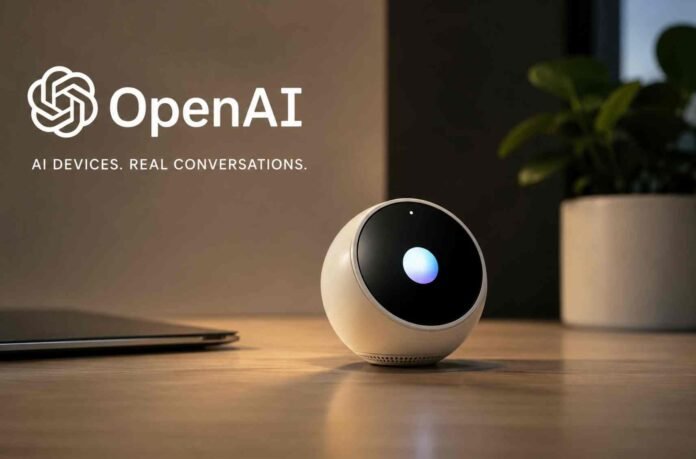
OpenAI has given its clearest indication yet that it is preparing to move beyond software and into dedicated consumer hardware. During a recent interview, OpenAI President Greg Brockman revealed that the company is working on a family of devices designed specifically for interacting with its artificial intelligence models.
While speculation has ranged from smart speakers to wearable gadgets, Brockman stopped short of confirming any specific product or release schedule. He only hinted that users should expect new devices sooner rather than later.
The comments reinforce OpenAI’s growing interest in creating hardware that is purpose built for AI experiences instead of relying entirely on smartphones and computers.
The company has already strengthened its hardware ambitions through its collaboration with legendary designer Jony Ive, fueling expectations that OpenAI wants to create a new category of AI first devices. However, Brockman avoided discussing rumored products and instead focused on the broader vision of making AI interactions feel more natural and intuitive.
Voice could become the new default interface
According to Brockman, the future of computing may rely far less on keyboards and touchscreens. He believes that speaking with AI will eventually become the preferred way for people to complete most digital tasks. Instead of typing prompts or navigating through menus, users could simply hold conversations with intelligent assistants that understand context and respond naturally.
That vision is not without challenges. One obvious concern is the practicality of talking to AI in public spaces or shared workplaces. Brockman acknowledged the issue and even pointed to the emergence of sound reducing wearable accessories as evidence that people are already looking for solutions. While he admitted these products may not become mainstream, he suggested they highlight growing interest in voice based AI interactions.
If OpenAI succeeds in making voice conversations faster, smarter, and more reliable, it could change how users interact with technology every day. Instead of opening multiple apps, future AI devices may act as a single conversational interface for work, entertainment, and daily tasks.
Privacy and trust remain major priorities
As OpenAI expands into hardware, privacy is expected to become one of its biggest challenges. Devices that rely heavily on voice interactions naturally raise concerns about how conversations are processed and stored. Brockman addressed these concerns by saying the company is working on stronger technical safeguards that provide verifiable and auditable privacy protections.
He specifically referenced improvements aimed at ensuring private conversations remain secure, including work around ChatGPT’s temporary chat features. Rather than asking users to simply trust company policies, OpenAI wants to build systems that can technically prove how user data is handled.
This approach could become an important selling point if OpenAI enters the competitive consumer hardware market. As AI devices become more personal and constantly available, users are likely to demand stronger transparency over how their information is used.
The road ahead for OpenAI hardware
Although OpenAI has not announced a launch date or revealed exactly what its first device will look like, Brockman’s comments suggest the company is thinking well beyond traditional AI chatbots. The goal appears to be creating products designed around conversational AI from the ground up rather than adapting existing gadgets.
The hardware market is highly competitive, with companies such as Apple, Google, and Amazon already offering voice enabled devices. OpenAI will need to prove that its products offer meaningful advantages rather than simply introducing another smart gadget. Industry observers also note that hardware development is significantly more complex than software, making execution just as important as innovation.
For now, OpenAI’s message is clear. The company believes AI should move beyond text boxes and become a more natural companion through dedicated devices that emphasize conversation, intelligence, and privacy. Whether those products can reshape consumer technology remains to be seen, but OpenAI is signaling that its ambitions extend far beyond ChatGPT.
Follow TechBSB For More Updates

