
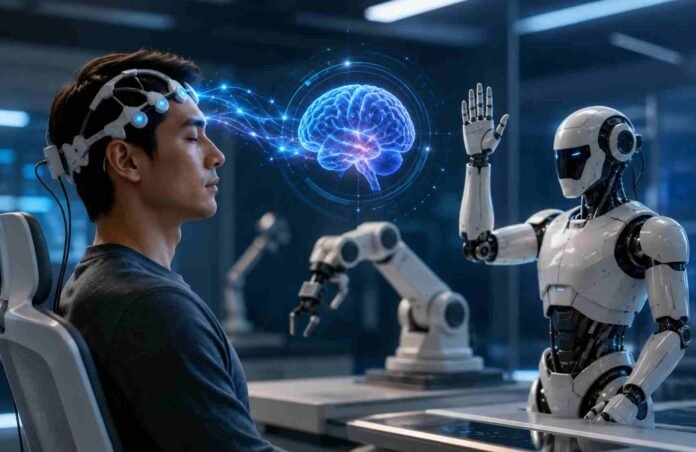
- BrainCo introduced a brain-controlled robot platform that uses non invasive EEG headsets to translate brain activity into robot commands.
- The AI-powered system can control robots, robotic arms, and connected devices through interpreted neural signals.
- Real-world usage will generate valuable training data that can improve AI accuracy and human robot interaction.
- The platform highlights the growing role of brain computer interfaces in the future of robotics and embodied AI.
Brain computer interfaces have been evolving for years, but most have remained confined to research labs, healthcare applications, or highly specialized environments.
Now, Chinese technology company BrainCo is pushing the concept closer to practical robotics with the unveiling of its Brain Controlled Robot AI Platform. Introduced at the World Artificial Intelligence Conference in Shanghai, the platform enables users to control robots, robotic arms, and other connected devices using only their thoughts.
The announcement highlights another step forward in the growing relationship between artificial intelligence, robotics, and brain computer interface technology.
Instead of relying on voice commands or handheld controllers, the system interprets electrical signals generated by the brain and converts them into actions that robots can understand. While the technology is still developing, BrainCo believes it could reshape the way humans interact with intelligent machines in the years ahead.
How the Brain Controlled Robot AI Platform works
At the center of BrainCo’s new platform is a non invasive electroencephalogram, or EEG, headset. Unlike invasive brain implants that require surgery, EEG devices sit on the user’s head and measure electrical activity produced by the brain. These signals are then processed by AI models trained to recognize different patterns associated with specific mental intentions.
The technology does not literally read thoughts. Instead, it identifies neural activity linked to imagined actions. During training, the system learns to associate particular brain signal patterns with commands. Once those relationships are established, the AI can translate a user’s intention into instructions that a connected robot can execute.
For example, a person can imagine picking up an object, and the robotic system may interpret that mental command as an instruction for a robotic arm to grasp a nearby cup. The same approach can also be extended to humanoid robots and other automated machines that require intuitive human input.
Because the platform depends on artificial intelligence to interpret brain signals, its accuracy improves as more data becomes available. This makes large scale real world usage particularly valuable for refining the technology over time.
Why training data could become the biggest advantage
One of the most significant aspects of BrainCo’s announcement is not just the interface itself but the data it will generate. High quality training data remains one of the biggest challenges for AI driven robotics. Every interaction between a human operator and a robot creates additional examples of how people intend to communicate with machines.
As more users interact with the platform, the AI models can continuously improve their ability to recognize subtle differences in brain activity. Better datasets may eventually produce faster responses, improved accuracy, and more natural control experiences.
BrainCo believes this continuous learning process will help overcome one of the major obstacles currently slowing the development of embodied AI. Robots have become increasingly capable of performing tasks independently, but understanding human intent remains a far more difficult challenge.
According to BrainCo executives, the next phase of robotics will focus less on what robots can accomplish alone and more on how effectively they collaborate with people. A reliable brain controlled interface could become an important part of that transition.
What this means for the future of robotics
The introduction of the Brain Controlled Robot AI Platform reflects a broader trend across the AI industry. Advances in large language models, computer vision, and robotic learning are rapidly expanding the capabilities of physical machines. Adding brain computer interfaces into that mix could make interactions even more intuitive.
Potential applications extend well beyond industrial robots. Assistive technologies for people with disabilities, healthcare equipment, smart manufacturing, warehouse automation, and even household robots could eventually benefit from thought based control systems. Removing the need for physical controllers or spoken commands may create new opportunities in situations where traditional interfaces are difficult or impossible to use.
The technology is still at an early stage, and several challenges remain before widespread adoption becomes a reality. EEG based systems generally offer lower signal precision than implanted brain interfaces, and maintaining accuracy across different users continues to be an engineering challenge. Privacy, data security, and ethical questions surrounding neural data collection will also become increasingly important as these platforms mature.
Even so, BrainCo’s latest demonstration signals growing confidence that non invasive brain computer interfaces are becoming practical enough for real world robotics. As AI models continue to improve and larger datasets become available, the connection between human intention and machine action is likely to become faster, more reliable, and increasingly seamless.
The unveiling of the platform at one of China’s largest AI events also reflects the country’s continued investment in advanced robotics and next generation human machine interaction. While commercial deployment will take time, BrainCo’s announcement offers a glimpse into a future where controlling robots could become as simple as thinking about the task.
Follow TechBSB For More Updates