
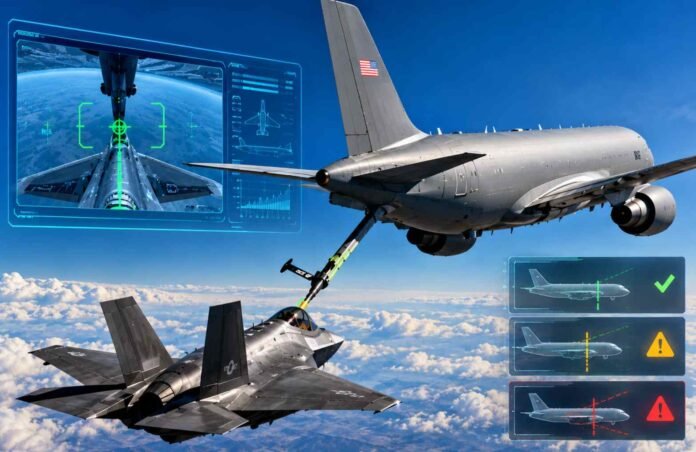
The US Air Force is exploring artificial intelligence to make aerial refuelling operations safer and improve how pilots and tanker crews are assessed during training. The proposed technology would analyse video footage captured by tanker aircraft cameras, identify potentially dangerous manoeuvres and provide detailed feedback on mistakes that might otherwise go unnoticed.
Aerial refuelling is one of the most demanding tasks in military aviation. It requires two aircraft to maintain precise speeds, positions and alignment while operating relatively close to each other. Even a small error in positioning or approach speed can create serious risks for both aircraft.
The proposed AI system aims to give instructors a more consistent way to evaluate these operations. Rather than relying primarily on human observations and manually reviewing recorded footage, the Air Force wants software that can automatically identify errors and highlight areas where crews need improvement.
AI could change how the Air Force evaluates aerial refuelling
The proposed system would use computer vision and machine learning to examine footage recorded by cameras installed on tanker aircraft. It would track the movements of both the tanker and the receiving aircraft throughout the refuelling process.
The software would pay particular attention to aircraft speed, relative positioning, approach velocity and alignment. These measurements would help determine whether pilots maintained the required flight conditions while approaching the tanker and connecting to its refuelling equipment.
The system would also monitor the movements of the refuelling boom. By comparing its position and movement against the receiver aircraft’s flight path, the software could identify deviations that might affect the safety or accuracy of fuel delivery.
This could prove particularly useful when reviewing complicated manoeuvres. Some mistakes happen within seconds and may be difficult for instructors to identify while observing an operation in real time.
Automated analysis could help pinpoint exactly when an error occurred, how the aircraft responded and whether the crew maintained the required separation and positioning.
The Air Force also wants the software to produce visual reports that make performance assessments easier to understand. These could include graphical overlays, colour coded performance maps and chronological displays showing important moments during a refuelling exercise.
Instead of receiving only a general assessment after a training mission, pilots and instructors could examine specific manoeuvres and understand where improvements are needed.
Why the US Air Force wants automated assessments
According to the military’s research solicitation, existing assessments rely considerably on instructor observations, crew evaluations and manual examination of recorded footage.
Although these methods remain important, they can produce inconsistent results. Different instructors may interpret the same manoeuvre differently, while brief positioning or alignment errors can be overlooked during a complicated operation.
The proposed AI technology is intended to address these limitations by introducing measurable performance indicators.
For example, instructors could use the software to examine whether a receiving aircraft approached too quickly, moved outside its intended position or struggled to maintain the correct alignment during fuel transfer.
The technology would not necessarily replace experienced instructors. Instead, it would provide additional information to support their assessments and help them deliver more precise feedback.
This could also make it easier to compare training sessions over time. Instructors would have access to recorded performance data, allowing them to identify recurring mistakes and monitor whether pilots are improving.
The project is being developed through the Small Business Innovation Research programme, which encourages companies to propose technological solutions for specific military requirements.
Interested developers have until November 25, 2026, to submit applications explaining how their proposed systems could meet the Air Force’s operational and training needs.
KC 46 Pegasus is the starting point for the project
The initial development effort will focus on the KC 46 Pegasus, the US Air Force’s aerial refuelling tanker equipped with camera technology that supports remote refuelling operations.
The aircraft uses a Remote Vision System that allows boom operators to control the refuelling equipment using camera feeds and specialised displays. Rather than relying entirely on a direct view from the aircraft, operators can monitor the receiving aircraft through this visual system.
However, the KC 46’s remote vision technology has experienced persistent technical difficulties. Military officials expect most of the outstanding problems to be resolved, but these challenges remain an important consideration for developers working on the proposed AI solution.
The Air Force wants companies to develop an operational prototype that can be integrated into existing training arrangements for at least one category of receiving aircraft.
Developers are also expected to consider interactive review environments. These would allow pilots and instructors to examine recorded refuelling manoeuvres from different viewing angles, making it easier to understand positioning errors and other operational problems.
There is also scope to connect the technology with existing flight simulators, virtual reality equipment and augmented reality training platforms.
Such integration could make training more practical by allowing crews to revisit difficult manoeuvres without having to repeat every exercise using actual aircraft.
AI could eventually support other military aviation operations
Although the initial project focuses on aerial refuelling, its potential applications could extend beyond tanker operations.
The research solicitation identifies opportunities to use automated performance assessments across other aviation activities within the Department of Defense.
A system capable of tracking aircraft movements, identifying deviations from expected flight conditions and generating detailed performance reports could have applications in several areas of military flight training.
For now, however, the immediate objective is to develop a working solution for aerial refuelling operations involving the KC 46 Pegasus.
If successful, the technology could give instructors more detailed information, help pilots understand their mistakes and make training assessments more consistent.
The wider goal is to use AI as an additional layer of analysis in a demanding aviation environment, where precision, coordination and reliable decision making are essential.
Follow TechBSB For More Updates