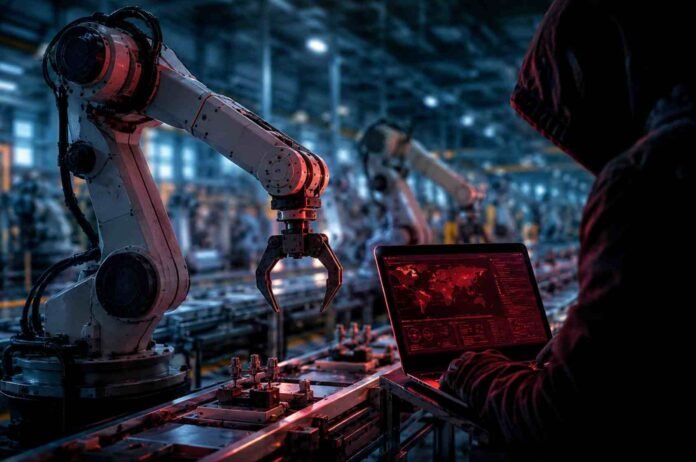
- Universal Robots PolyScope 5 contains a critical command injection vulnerability
- Attackers can remotely execute commands without authentication
- Weak network segmentation could expose factory robots to internal attacks
- Security experts warn compromised robots may create real physical safety risks
Industrial robots are once again under the cybersecurity spotlight after researchers uncovered a severe vulnerability in Universal Robots’ PolyScope 5 operating system. The flaw, identified as CVE 2026 8153, exposes collaborative robots to remote command execution attacks without requiring authentication, raising concerns about both factory disruption and worker safety.
The issue affects all versions of PolyScope 5 prior to version 5.25.1 and carries a critical CVSS severity score of 9.8. Security experts warn that attackers who gain access to the robot’s network environment could potentially take control of robotic systems, manipulate operations, or disrupt manufacturing processes entirely.
As factories increasingly rely on connected automation, the discovery highlights a growing reality for industrial environments. Robots are no longer isolated machines working behind safety cages. They are now network connected systems operating alongside humans, which means cybersecurity failures can quickly become physical safety risks.
Vulnerability Allows Remote Command Execution
According to researchers, the weakness exists within the Dashboard Server component used by Universal Robots systems. The server accepts user supplied input and passes it directly to the underlying operating system without properly filtering dangerous command elements.
That oversight creates a classic command injection vulnerability. An attacker capable of reaching the Dashboard Server port can craft malicious commands that execute with full system privileges on the robot controller.
The vulnerability was discovered by Vera Mens from Claroty Team82 and disclosed through coordinated channels involving CISA and CERT Coordination Center.
Security researchers say the exploit conditions are realistic in many manufacturing environments. While the robots are not intended to be directly exposed to the internet, attackers often do not need internet access to cause damage. A compromised workstation inside the same factory network may be enough to reach vulnerable robots if internal segmentation is weak or nonexistent.
That is what makes the flaw particularly concerning for operational technology environments, where legacy systems and flat networks are still common.
Outdated Robots Create a Growing Industrial Risk
Universal Robots has already issued a fix through PolyScope version 5.25.1, but the larger challenge is deployment. Many industrial facilities are notoriously slow when it comes to software updates because downtime can interrupt production schedules and cost significant amounts of money.
Unfortunately, delayed patching also gives attackers more time to exploit known weaknesses.
Cybersecurity experts have repeatedly warned that outdated operational technology systems are becoming attractive targets for ransomware groups and state backed actors. Industrial robots are now part of that attack surface.
The danger extends beyond stolen data or halted production lines. Collaborative robots are specifically designed to work near people. If an attacker manipulates robotic movements or operating instructions, the consequences could include physical injury to nearby workers.
Researchers stress that no public exploitation linked to this specific vulnerability has been reported so far. Still, the technical simplicity of the flaw means organizations should treat it with urgency.
Network Security Remains the First Line of Defense
Universal Robots emphasized that its systems are generally protected from direct internet exposure through corporate firewalls. However, that protection means little if attackers already have access to internal networks.
The company’s advisory made one point very clear. The security of the robot depends heavily on the security of the surrounding network infrastructure.
That includes proper segmentation between production systems and employee workstations, strict access controls, continuous monitoring, and disabling unnecessary network services whenever possible.
Manufacturers are increasingly adopting smart factory technologies, but many continue to underestimate the cybersecurity implications that come with connected automation. Every additional device on the network creates another potential entry point.
Security professionals argue that industrial cybersecurity can no longer be treated as secondary IT maintenance. Robots, programmable logic controllers, and other operational technology systems are now critical infrastructure components that require the same level of security attention as enterprise servers or cloud environments.
The Real Threat Is Human Driven, Not Machine Driven
Despite dramatic headlines surrounding robot takeovers and AI revolutions, experts say this incident is far from a science fiction scenario involving autonomous machines turning against humans.
The actual danger comes from traditional cybercriminal activity. Hackers exploit weak configurations, outdated software, and poor network security practices to gain unauthorized control over systems.
In this case, compromised robots would simply become another tool used by attackers to disrupt operations, damage equipment, or create safety hazards inside industrial environments.
Still, the discovery serves as another warning sign for manufacturers embracing Industry 4.0 technologies. As factories become smarter and more connected, cybersecurity failures will increasingly have real world consequences beyond stolen passwords and leaked files.
For industrial operators, the message is straightforward. Patch vulnerable systems quickly, secure internal networks aggressively, and treat robotic infrastructure as a high priority cybersecurity asset before attackers do it first.
Follow TechBSB For More Updates