
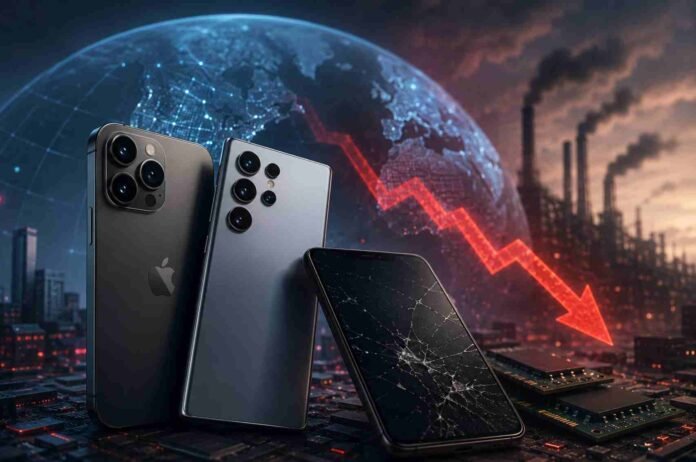
- Global smartphone shipments are forecast to fall 13.9% in 2026, reaching their lowest level since 2013.
- Rising memory prices, fueled by AI demand, are making budget smartphones increasingly difficult to produce.
- Apple and Samsung are expected to weather the downturn better than most rivals due to stronger supply chains.
- The refurbished smartphone market is set to grow as consumers look for more affordable alternatives.
The global smartphone industry could be heading toward one of its toughest years in more than a decade, with new forecasts suggesting shipments will fall to their lowest level since 2013.
After several years of recovery and steady momentum, manufacturers are now facing a combination of rising component costs, shrinking affordability, and changing consumer behavior.
According to the latest industry projections, worldwide smartphone shipments are expected to decline by 13.9% in 2026, dropping to around 1.08 billion units. The revised forecast paints an even more challenging picture than earlier estimates, highlighting the growing pressure facing smartphone brands across all major markets.
The sharp decline marks a significant reversal for an industry that had enjoyed nine consecutive quarters of growth before entering 2026. What was once seen as a stable recovery has quickly turned into a period of uncertainty.
AI Boom Creates Unexpected Pressure on Smartphone Market
At the center of the slowdown is an ongoing memory supply crunch. The rapid expansion of artificial intelligence infrastructure has dramatically increased demand for advanced memory components, particularly RAM. As technology companies continue investing heavily in AI servers and data centers, memory suppliers have shifted their attention toward higher margin opportunities.
The result is a tighter supply of memory components for smartphone makers and significantly higher prices across the board.
For manufacturers already operating on thin margins, especially in the budget segment, these rising costs have become increasingly difficult to absorb. Industry analysts now believe that smartphones priced below $150 may effectively disappear from certain markets because companies can no longer build and sell them profitably.
This development could have major consequences for emerging regions where affordable devices remain the primary gateway to digital connectivity. Brands that depend heavily on entry level smartphone sales are likely to face the greatest challenges as consumers become more price sensitive.
Apple and Samsung Better Positioned Than Rivals
While the broader market is expected to struggle, not every manufacturer faces the same level of risk.
Apple and Samsung are widely viewed as the companies best equipped to navigate the downturn. Both brands benefit from extensive supply chain relationships, stronger purchasing power, and greater control over key components. These advantages provide a level of protection against rising memory costs that many competitors simply do not have.
As a result, iPhone shipments are expected to remain relatively stable throughout 2026, with growth potentially returning in the following year. Samsung is also forecast to outperform the wider industry despite facing a modest decline in shipments.
Their ability to maintain premium pricing while preserving profitability could help them strengthen their positions during a period when smaller rivals are forced to make difficult compromises.
Huawei has also shown signs of resilience. The company managed to post modest growth during the first quarter of the year, helped by a strategy focused on maintaining stable pricing while expanding market share. In a market where consumers are increasingly cautious about spending, price stability has become a powerful competitive advantage.
Budget Focused Brands Feel the Pressure
Not every manufacturer has been able to adapt as effectively.
Among the major smartphone brands, Xiaomi experienced one of the steepest shipment declines during the opening months of the year. The company has traditionally relied on delivering strong specifications at competitive prices, a strategy that becomes more challenging when component costs rise rapidly.
Brands operating in similar segments face a difficult balancing act. Passing higher costs to consumers risks weakening demand, while absorbing those costs can significantly reduce profitability.
This pressure is likely to accelerate consolidation within the industry, with stronger companies gaining market share while weaker players struggle to remain competitive.
Refurbished Phones Emerge as the Unexpected Winner
One segment expected to benefit from the turmoil is the refurbished smartphone market.
As new device prices continue to climb, many consumers are turning to certified pre owned smartphones as a practical alternative. Industry forecasts suggest refurbished device sales could grow by 13% this year, reflecting a broader shift toward value focused purchasing decisions.
For buyers, refurbished phones offer access to premium devices at significantly lower prices. For the industry, they provide an increasingly important channel as affordability becomes a bigger concern.
Looking ahead, analysts do not expect a meaningful recovery in the smartphone market until 2028. By that time, the competitive landscape could look very different, with some manufacturers emerging stronger and others struggling to survive the prolonged downturn.
The years ahead may ultimately be defined not by innovation alone, but by which companies can successfully manage rising costs while continuing to deliver value to consumers.
Follow TechBSB For More Updates