
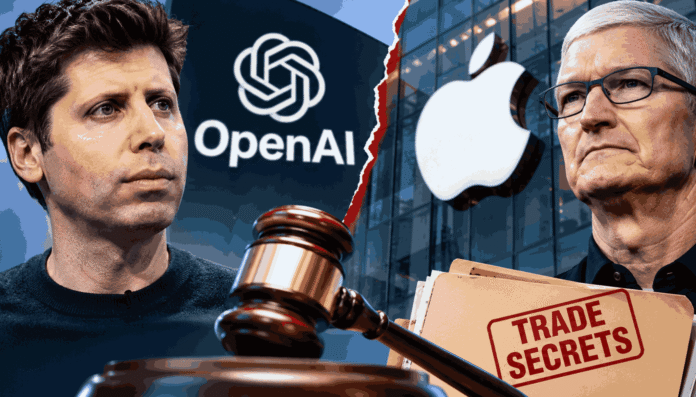
The legal battle between Apple and OpenAI is getting increasingly complicated. After Apple accused OpenAI of misappropriating confidential information through former employees, OpenAI has now filed counterclaims of its own, accusing Apple of allegedly taking its trade secrets and attempting to limit competition in the AI hardware market.
The dispute, which initially focused on employees moving between the two companies and the alleged misuse of confidential information, is now expanding into a wider fight over business practices, supplier relationships and the future of AI-powered devices.
OpenAI’s latest filing reportedly argues that Apple is not simply protecting its intellectual property but is also using its considerable influence over the supply chain to make it harder for competing companies to develop and launch products.
OpenAI claims Apple took confidential hardware information
OpenAI’s counterclaims reportedly centre on an employee who previously worked at Apple, joined OpenAI and later returned to Apple after spending around six months at the AI company.
According to OpenAI, an internal investigation conducted after Apple’s lawsuit allegedly uncovered evidence that the former employee transferred confidential information relating to one of OpenAI’s hardware projects. The company claims that the information was accessed and moved through personal accounts.
The alleged material reportedly included product images, engineering documents, supplier information, manufacturing details and specifications concerning cosmetic finishes and sealants.
OpenAI had previously raised similar allegations in a court filing in October. Its latest counterclaims appear to take those allegations further, formally challenging Apple’s conduct and seeking to establish that the company itself may have been involved in the alleged misuse of confidential information.
However, these allegations remain disputed and have not been established as facts by a court.
Apple accused of putting pressure on suppliers
OpenAI is also raising concerns about Apple’s influence over companies that manufacture components and provide services to both businesses.
As OpenAI prepares to develop and potentially sell its own AI hardware, it claims Apple has been pressuring suppliers that also work with OpenAI. According to the counterclaims, Apple allegedly used its market position and commercial influence to discourage suppliers from supporting OpenAI’s projects.
The company describes the alleged conduct as an attempt to restrict competition rather than simply protect Apple’s own manufacturing capacity.
Apple has long maintained extensive relationships with manufacturers and suppliers across the global electronics industry. Securing production capacity, managing component availability and maintaining supply chain stability are central to its business model.
OpenAI, however, argues that Apple’s alleged actions go beyond ordinary commercial practices. It claims the company is using its size and resources to obstruct potential competitors in the emerging AI device market.
If these claims become a central part of the litigation, the dispute could raise broader questions about how powerful technology companies manage shared suppliers when new competitors enter the market.
OpenAI pushes back against Apple’s original lawsuit
Apple’s original lawsuit reportedly accused former employees Tang Tan and Chang Liu of taking confidential information concerning unreleased technologies, processes and products when they left Apple and joined OpenAI.
Apple argued that the information was deliberately taken and potentially used by OpenAI. The company sought legal intervention to prevent the alleged misuse of its confidential material.
OpenAI has strongly disputed Apple’s allegations, arguing that the situation involving retained files was more complicated than Apple’s claims suggested. It previously pointed to an email mixup involving Apple’s legal representatives and argued that some employees may have retained files without deliberately intending to take or use them.
OpenAI has also questioned Apple’s handling of its confidential information, suggesting that the company’s own practices may have contributed to the circumstances surrounding the alleged information transfers.
The dispute has now developed into a two sided legal battle, with both companies accusing the other of improper conduct involving confidential information.
Apple, however, has rejected OpenAI’s counterclaims. In a statement, an Apple spokesperson said the lawsuit concerns the deliberate theft, access and use of confidential information relating to Apple’s unreleased technologies, processes and products.
Apple also described OpenAI’s counterclaims as an attempt to distract from its original lawsuit, adding that OpenAI had already been ordered to stop using Apple’s confidential information.
What happens next?
The legal fight could have consequences beyond the two companies, particularly as OpenAI moves towards developing AI hardware products of its own.
Apple has already sought court intervention over the alleged misuse of its trade secrets, and the proceedings have involved requests for access to documents and arguments over the scope of potential restrictions.
OpenAI has previously indicated that it would not use the Apple information at the centre of the dispute. The court’s decisions on the competing claims could determine how both companies handle confidential information, employee movement and their relationships with suppliers.
For now, neither side appears ready to back down. What began as a dispute over employees and confidential files is turning into a much broader legal confrontation between two major players in the technology industry.
Follow TechBSB For More Updates