
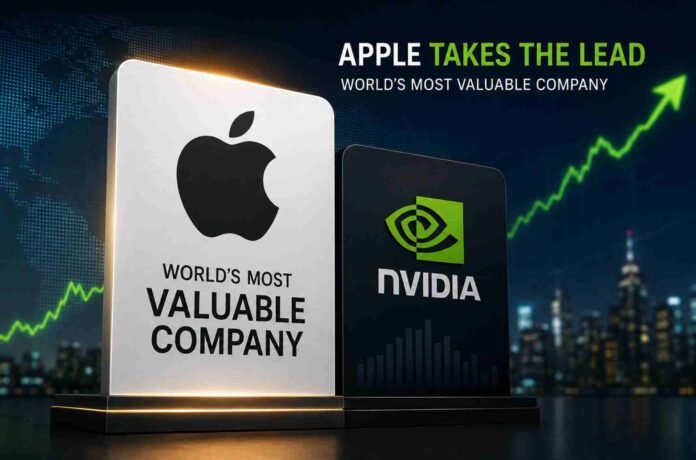
- Apple has overtaken Nvidia to become the world’s most valuable company with a market value of about $4.88 trillion.
- Investors are shifting focus from AI chip makers to companies that can generate long term AI driven revenue.
- Apple’s upgraded Siri and ecosystem based AI strategy have improved confidence despite its slower start in AI.
- The milestone comes as Tim Cook prepares to hand leadership to John Ternus, marking a significant moment for Apple’s future.
Apple has reclaimed the title of the world’s most valuable company, moving ahead of Nvidia after a strong run in investor confidence. The change marks an important moment in the technology sector, where market leadership is increasingly being shaped by long term business strength rather than excitement around AI infrastructure alone.
At the latest market close, Apple was valued at around $4.88 trillion, edging past Nvidia, which slipped to roughly $4.86 trillion after its shares fell by about 3.5 percent. Nvidia had held the top position since June 2025, driven by soaring demand for its AI chips. Apple’s return to the top is its first since April 2025 and reflects changing expectations about where the next phase of AI growth will come from.
While Nvidia remains one of the biggest winners of the artificial intelligence boom, investors are beginning to look beyond companies that build AI hardware and are paying closer attention to businesses that can turn AI into long lasting consumer and service revenue.
Apple Is Winning on Confidence Instead of AI Hype
For much of the past two years, Apple was criticized for moving more slowly than rivals in the AI race. Unlike competitors that poured billions into building large language models and AI infrastructure, Apple took a more measured approach.
That cautious strategy is now being viewed in a different light.
Many investors believe Apple is better positioned to generate consistent earnings because it can integrate AI across its existing ecosystem instead of relying on expensive infrastructure investments. Rather than competing directly in the race to build the biggest AI models, Apple is expected to focus on using artificial intelligence to improve the everyday experience across the iPhone, iPad, Mac, Apple Watch, and its growing services business.
This approach reduces pressure on capital spending while creating opportunities for higher value hardware upgrades, subscription growth, and stronger customer loyalty. Investors increasingly see these advantages as more sustainable than depending entirely on AI infrastructure demand.
Apple’s shares have also outperformed the rest of the Magnificent Seven technology companies this year, adding further momentum to its market valuation.
Siri and Apple’s AI Strategy Are Starting to Gain Attention
A major reason behind improving investor sentiment is Apple’s renewed focus on artificial intelligence.
The company recently introduced a significantly upgraded version of Siri after months of delays. The refreshed assistant is designed to become more intelligent, more conversational, and better integrated with apps and personal information stored on Apple devices.
Although Apple entered the AI race later than many of its competitors, analysts believe the company has one important advantage that few others can match.
Millions of iPhones already contain years of personal information, preferences, photos, messages, calendars, and other user data. If Apple can responsibly use this information while maintaining its strong privacy standards, Siri could deliver highly personalized assistance that competitors may struggle to replicate.
The biggest challenge remains balancing smarter AI features with Apple’s long standing commitment to user privacy. Unlocking the value of personal data without compromising security will be central to the company’s long term AI strategy.
Leadership Transition Adds Another Dimension
Apple’s return to the top also arrives during an important leadership transition.
Chief Executive Officer Tim Cook is preparing to hand over leadership to hardware chief John Ternus later this year. The company’s improved market position could influence how Cook’s final chapter as CEO is remembered.
During Cook’s tenure, Apple expanded far beyond the iPhone by building a massive services business, strengthening its ecosystem, and maintaining steady financial performance. Critics questioned whether Apple had fallen behind in artificial intelligence, but the recent improvement in investor confidence suggests the market now sees the company’s patient strategy more favorably.
The transition to new leadership comes at a time when expectations for Apple’s AI roadmap are rising. Investors will be watching closely to see how the company transforms its software, devices, and services over the coming years.
What Apple’s Return to the Top Means
Apple overtaking Nvidia does not necessarily signal the end of Nvidia’s dominance in AI hardware. Demand for advanced AI chips remains exceptionally strong, and Nvidia continues to play a central role in powering artificial intelligence across cloud providers and enterprise customers.
However, the latest market reshuffle highlights a broader shift in investor thinking.
The next stage of the AI revolution may not be determined only by companies building the technology. Increasingly, attention is turning toward businesses that can successfully integrate AI into products that billions of people use every day while generating reliable profits.
Apple appears well positioned to benefit from that trend. Its vast installed user base, tightly connected ecosystem, premium hardware, and expanding services business provide multiple ways to monetize artificial intelligence without taking on the same level of infrastructure costs as some competitors.
Follow TechBSB For More Updates