
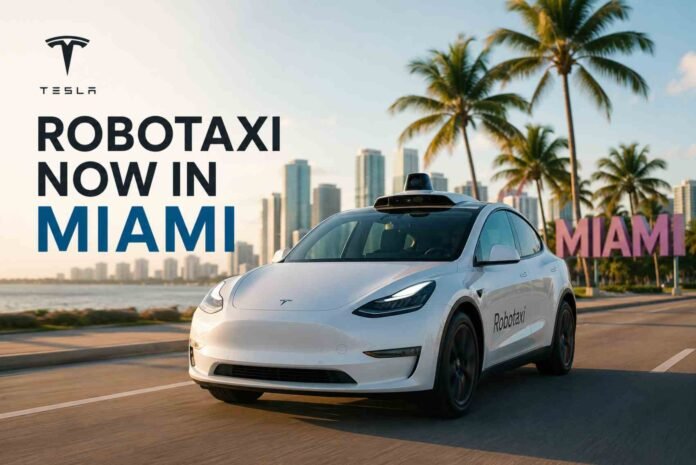
- Tesla has launched its robotaxi service in Miami, expanding beyond its earlier rollout in Austin.
- The move supports Elon Musk’s strategy to grow Tesla’s AI and autonomous transportation business.
- Tesla faces growing competition from Waymo and Zoox in the autonomous ride hailing market.
- The expansion comes after Tesla reported better than expected second quarter vehicle deliveries.
Tesla has officially expanded its robotaxi service to Miami, taking another important step in its plan to build a nationwide autonomous ride hailing network. The latest rollout comes just weeks after the company introduced its robotaxi operations in Austin, Texas, signaling that Tesla is moving faster with its self driving ambitions despite growing competition in the autonomous mobility market.
The announcement was made through Tesla’s official robotaxi account on X, where the company confirmed that the service is now available in Miami. While Tesla has not shared detailed information about the size of the fleet or service coverage in the city, the expansion reflects CEO Elon Musk’s broader strategy of transforming Tesla from an electric vehicle manufacturer into a company focused on artificial intelligence and robotics.
Tesla Continues Its Self Driving Expansion Strategy
The Miami launch follows Tesla’s robotaxi debut in Austin, which went live in June. That launch marked the beginning of the company’s commercial autonomous ride hailing operations, using Tesla vehicles equipped with its latest Full Self Driving technology.
Tesla has repeatedly stated that robotaxis represent a major part of its future business. Rather than relying only on electric vehicle sales, the company is investing heavily in software driven transportation services that could eventually allow Tesla owners to earn income by adding their vehicles to a shared autonomous network.
The expansion into Miami suggests that Tesla is steadily moving toward that long term vision. Earlier this year, the company also revealed plans to introduce robotaxi services in Dallas and Houston, making it clear that it intends to scale the platform across multiple US cities.
Although Tesla describes the service as autonomous, previous deployments have included safety personnel inside the vehicles during the early stages of testing and public operations. This approach allows the company to monitor performance while collecting real world driving data before wider deployment.
Competition in the Robotaxi Market Is Growing
Tesla is entering an increasingly competitive autonomous transportation industry. Several technology companies have already invested billions of dollars to establish leadership in robotaxi services across major US cities.
Alphabet’s Waymo has steadily expanded its commercial autonomous ride hailing business and remains one of the most established players in the sector. Amazon owned Zoox is also accelerating its development efforts as it prepares to scale its own purpose built autonomous vehicles.
Unlike many competitors that use multiple sensors including lidar and radar, Tesla continues to rely primarily on cameras and artificial intelligence powered vision systems. Elon Musk has consistently argued that this approach is more scalable and cost effective for mass deployment, although it has also sparked debate among industry experts.
Elon Musk Sees AI Driving Tesla’s Future Growth
Tesla’s robotaxi rollout is closely linked to Elon Musk’s vision of the company’s future. In recent years, Musk has repeatedly emphasized that Tesla should be viewed as an artificial intelligence and robotics company rather than simply an electric vehicle manufacturer.
In May, Musk said he expects fully self driving vehicles operating without human safety monitors to become more common across the United States later this year. Achieving that goal will depend not only on technological progress but also on regulatory approvals and public acceptance.
The Miami expansion serves as another milestone in Tesla’s effort to prove that its autonomous driving technology is ready for broader commercial use. Each new city provides additional driving scenarios and valuable operational data that can help improve the company’s software.
Tesla’s autonomous ambitions have become even more important as the global electric vehicle market becomes increasingly competitive. By creating new software based revenue opportunities, the company hopes to reduce its dependence on vehicle sales alone.
Strong Vehicle Deliveries Add Momentum
The robotaxi announcement arrived shortly after Tesla reported stronger than expected second quarter vehicle deliveries. The company exceeded Wall Street expectations, supported by improving sales in Europe and renewed demand for its electric vehicles.
The stronger delivery numbers offered investors some reassurance after several quarters of mixed performance. Combined with the expansion of robotaxi operations, Tesla is attempting to show that both its core automotive business and its artificial intelligence initiatives continue to move forward.
Whether the robotaxi business eventually becomes one of Tesla’s biggest revenue drivers remains uncertain. The company still faces technical challenges, regulatory scrutiny, and fierce competition from established autonomous driving rivals.
However, by bringing its service to Miami, Tesla has demonstrated that it is continuing to execute its long term strategy of expanding autonomous transportation across the United States. As more cities are added and the technology matures, the coming months will likely play a significant role in determining whether Tesla can establish itself as a leader in the next generation of mobility.
Follow TechBSB For More Updates