
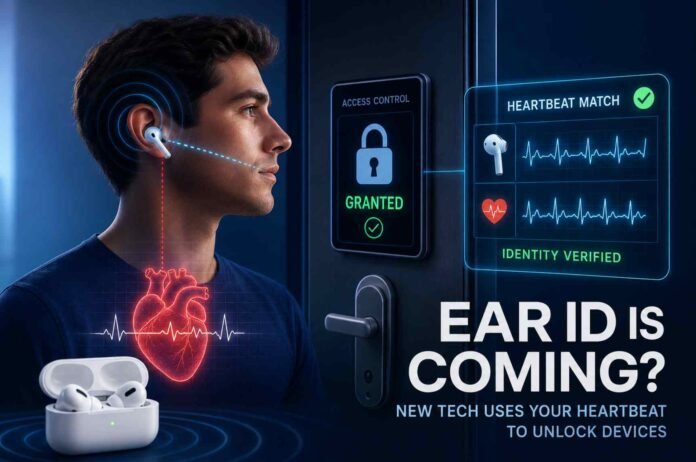
- Chinese researchers created AccLock, a system that uses earbuds to identify users through heartbeat patterns.
- The technology works using accelerometers already found in many wireless earbuds.
- AirPods and custom earbuds were successfully tested during research experiments.
- Ear based authentication could eventually unlock phones, PCs, and smart home devices automatically.
Touch ID changed how we unlocked phones. Face ID made authentication almost invisible. Now researchers believe the next step could come from something much smaller sitting inside your ears.
A group of researchers from several universities in China has introduced a new authentication system called AccLock. The technology turns wireless earbuds into identity verification tools by analyzing a person’s heartbeat patterns. In simple terms, your AirPods or similar earbuds could someday recognize you the same way your fingerprint or face does today.
What makes the idea especially interesting is that it does not require expensive medical grade hardware. Instead, it relies on accelerometers already found inside many modern earbuds.
The concept may sound futuristic, but it fits perfectly into the growing push toward seamless and passive security systems. Rather than typing passwords or scanning your face repeatedly, your earbuds could continuously confirm your identity while you wear them.
How AccLock Actually Works
The technology focuses on tiny vibrations created by blood flow and heart movement inside the human body. Those subtle signals travel through tissues and can be picked up by accelerometers placed inside earbuds.
Accelerometers are already widely used in wireless earbuds for features like gesture controls, head tracking, motion detection, and spatial audio. Researchers discovered these sensors are sensitive enough to capture heartbeat related micro vibrations from inside the ear canal.
Using machine learning models, the system studies those heartbeat signatures and compares them against stored biometric profiles. If the heartbeat pattern matches the authorized user, the connected device unlocks automatically.
According to the researchers, earbuds make ideal candidates for this kind of authentication because they remain in close contact with the body during everyday use. Unlike smartwatches or phones that people constantly remove or reposition, earbuds stay relatively fixed while being worn.
During testing, researchers reportedly used Apple AirPods alongside custom made earbuds, proving the idea could potentially work with existing consumer hardware.
Why This Could Matter for Future Devices
The biggest advantage of Ear ID technology is convenience. Current biometric systems still require active participation from users. You need to look at your phone, touch a sensor, or enter a passcode.
AccLock aims to remove those extra steps entirely.
Imagine opening your laptop and having it unlock instantly because your earbuds recognize your heartbeat. Smart home systems could also use the same authentication method to open doors, approve payments, or access secure accounts without requiring additional verification.
Another important benefit is continuous authentication. Face ID or fingerprint systems only verify identity once. Ear based authentication could theoretically keep checking throughout usage, making it harder for unauthorized users to gain access after a device is unlocked.
Security experts have long searched for passive authentication methods that operate quietly in the background. Ear based biometric tracking may become one of the more practical solutions because it builds on hardware many people already own.
Apple and the Future of Smart AirPods
While AccLock remains a research project for now, the timing feels notable given Apple’s increasing focus on health and wearable technology.
AirPods have already evolved far beyond basic audio accessories. Recent generations include features like adaptive audio, hearing assistance, spatial audio, and advanced motion tracking. Reports have also suggested Apple is exploring future AirPods equipped with cameras and expanded health monitoring features.
The new research adds another possible direction for the product category.
Importantly, AccLock does not depend on dedicated heart rate sensors like those found in smartwatches. That could make implementation easier and cheaper if companies decide to adopt the idea commercially.
There are still obvious hurdles. Heartbeat detection accuracy could vary during movement, workouts, or noisy environments. Privacy concerns would also become a major discussion point if earbuds start collecting biometric identity data continuously.
Even so, the research highlights how wearable technology is gradually shifting from convenience gadgets into intelligent personal security tools.
For now, unlocking devices with your ears may sound unusual. But then again, facial recognition once sounded futuristic too.
Follow TechBSB For More Updates