
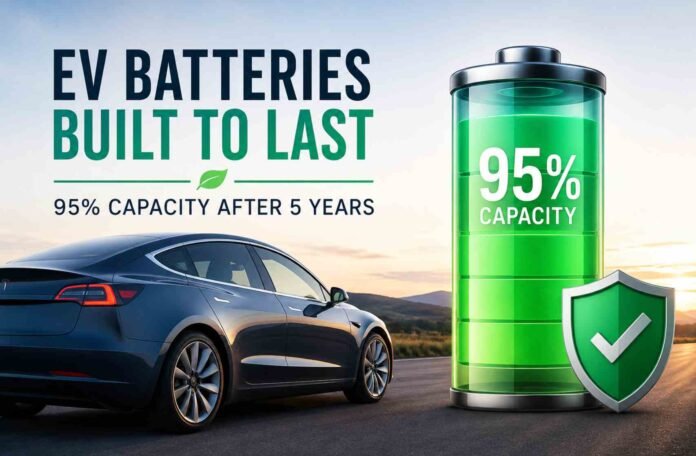
- Most electric vehicles retain around 95% of their original battery capacity after five years.
- Battery replacement rates have dropped to just 0.3% for newer EVs built from 2022 onward.
- Regular fast charging has less impact on battery health than many drivers previously believed.
- Standardized battery health certificates could improve confidence in the used EV market.
For years, one of the biggest concerns surrounding electric vehicles has been battery life. Many buyers feared that EV batteries would lose a significant amount of their capacity within a few years, leading to expensive replacements and reduced driving range. However, fresh data from battery analytics company Recurrent paints a far more encouraging picture.
According to the latest findings, the average electric vehicle retains approximately 95% of its original battery capacity after five years of use. The results highlight how rapidly battery technology has evolved and suggest that modern EVs are proving far more durable than many early predictions suggested.
The findings also reinforce growing confidence that today’s electric cars can remain practical for years without suffering major declines in everyday usability.
Battery Technology Has Improved Faster Than Expected
Early electric vehicles were built during a period when battery longevity remained largely untested. Automakers knew degradation would occur over time, but there was little real world data to predict exactly how quickly battery performance would decline.
That picture has changed dramatically.
Advances in battery chemistry, smarter thermal management systems, and increasingly sophisticated software have all played an important role in extending battery life. Modern battery packs are now better protected from excessive heat, charging stress, and daily wear, allowing them to maintain their original capacity for much longer.
Recurrent’s latest research reflects these improvements. Instead of seeing substantial range losses after several years, most owners continue to enjoy nearly the same driving range they experienced when their vehicles were new.
The data also highlights another encouraging trend. Battery replacement rates have fallen sharply over the past decade.
Vehicles produced between 2011 and 2016 experienced battery replacement rates of roughly one in twelve. For EVs built from 2022 onwards, that figure has dropped to just 0.3%, demonstrating how much reliability has improved as manufacturers refined battery technology.
Fast Charging Has Less Impact Than Many Buyers Assume
Fast charging has often been blamed for accelerating battery degradation, with many owners worrying that frequent use of rapid public chargers could significantly shorten battery life.
While repeated high power DC charging can increase battery wear compared with slower home charging, the latest evidence suggests the impact is smaller than many expected.
Research cited alongside Recurrent’s findings indicates that electric vehicles regularly using fast chargers still retain close to 90% of their original battery capacity after several years on the road.
That means drivers who frequently rely on public charging networks are unlikely to experience dramatic losses in driving range under normal ownership conditions.
Real world examples also support these findings. Some high mileage electric vehicles continue to deliver impressive range despite covering hundreds of thousands of miles. One example cited in recent reporting involved a five year old Tesla Model 3 that had travelled more than 247,000 miles while still offering an estimated driving range only slightly below its original official figure.
Such cases demonstrate how today’s battery systems are capable of handling extensive daily use without requiring replacement.
Used EV Buyers Still Want Greater Transparency
Although battery performance continues to exceed expectations, consumer confidence has not fully caught up with the technology.
Many buyers remain concerned about the potential cost of replacing an EV battery, particularly when shopping for a used electric vehicle. Questions about remaining battery capacity often influence purchasing decisions more than any other aspect of an older EV.
This is why many experts believe battery health certificates could become one of the most important developments for the used electric vehicle market.
Independent battery assessments would allow buyers to understand exactly how much capacity remains before making a purchase. Rather than relying solely on age or mileage, shoppers could evaluate the actual condition of the battery and estimate how it may affect real world driving range.
Some dealerships have already started offering independently verified battery diagnostics through specialist testing services. However, industry experts continue to push for a standardized battery health certification system that could be used across all manufacturers and dealerships.
Surveys conducted within the automotive industry also show strong support for such a move. Most used car dealers believe battery health reports should become a standard part of every used EV sale, helping improve buyer confidence while supporting stronger resale values.
Stronger Battery Performance Could Boost EV Adoption
Battery durability has long been one of the biggest barriers preventing many drivers from switching to electric vehicles. As more long term data becomes available, many of those concerns are beginning to lose credibility.
Modern electric vehicle batteries are lasting longer than expected, replacement rates continue to decline, and even heavily used vehicles are maintaining impressive levels of performance. These improvements not only reduce ownership costs but also strengthen confidence in the growing used EV market.
The next major step will likely involve making battery health information as accessible as mileage or service history. If buyers can easily verify the condition of an EV battery before purchase, it could remove one of the final obstacles slowing wider adoption of electric vehicles.
Follow TechBSB For More Updates