
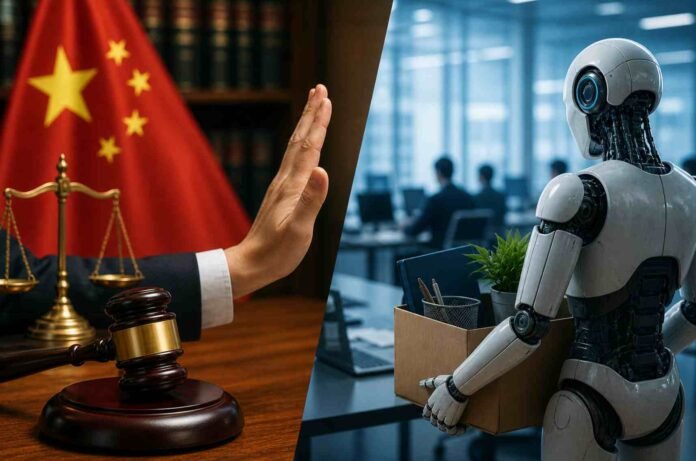
- China court rules AI alone is not a valid reason for firing employees
- Employers must provide stronger legal justification for layoffs
- Workers are expected to adapt and upgrade their skills
- Decision could influence global labor policies on AI
China has taken a notable step in shaping how artificial intelligence fits into the modern workplace. In a recent ruling, a court in Hangzhou made it clear that companies cannot justify firing employees simply because AI or automation can perform their roles.
The decision reflects growing concern about how quickly emerging technologies are reshaping employment, and whether existing labor protections are strong enough to keep pace.
At the center of the ruling is a long standing legal principle in Chinese labor law. Employers can terminate contracts if there is a major change in objective circumstances. However, the court determined that introducing AI systems does not meet that threshold on its own. In other words, replacing a human with software is not automatically a valid legal reason to end someone’s employment.
This case is especially significant given Hangzhou’s reputation as one of China’s leading AI hubs. The city is home to major tech firms and ongoing innovation, making it a fitting backdrop for a decision that could influence how companies nationwide approach automation.
Employers must justify more than efficiency gains
The ruling sends a clear message to businesses. Efficiency alone is not enough. While AI can streamline operations and reduce costs, companies are still expected to follow established labor protections. If they intend to lay off workers, they must provide legally sound reasons that go beyond the availability of automated alternatives.
The court also addressed another common practice. Some employers attempt to reassign workers to lower paying roles after introducing automation.
According to the ruling, this approach is equally problematic if it unfairly disadvantages employees. Companies are expected to act responsibly and ensure that workers are treated fairly during transitions driven by new technologies.
The case itself involved a tech worker who was dismissed and did not receive compensation deemed appropriate under the law. While the individual dispute triggered the legal review, the broader implications extend well beyond a single employee. It highlights how courts may increasingly scrutinize the way companies implement AI in their workforce strategies.
Workers share responsibility in an AI shaped future
Interestingly, the decision does not place all responsibility on employers. The court emphasized that employees must also adapt to changing work environments.
This dual responsibility reflects a more balanced view of technological change. While companies must not exploit automation to sidestep labor obligations, workers cannot ignore the shift either. Continuous learning and upskilling are becoming essential, not optional.
Experts involved in the case noted that technological progress cannot operate outside a legal framework. Innovation may be inevitable, but it must coexist with protections that prevent unfair treatment of workers. This perspective suggests that China is trying to manage AI’s impact without slowing its adoption.
A signal for global labor policies
China’s move could have ripple effects far beyond its borders. Governments worldwide are grappling with similar questions about automation, job displacement, and worker rights. While approaches vary, there is growing recognition that legal systems need to evolve alongside technological change.
In Europe, for example, regulatory efforts are already underway to address AI’s role in employment. China’s ruling adds another dimension to the global conversation, showing that courts as well as lawmakers can play a key role in defining boundaries.
For businesses, the takeaway is clear. AI adoption cannot be treated purely as a technical upgrade. It carries legal and social responsibilities that must be carefully managed. For workers, the message is equally direct. Staying competitive in an AI driven economy requires ongoing effort and adaptability.
Follow TechBSB For More Updates