
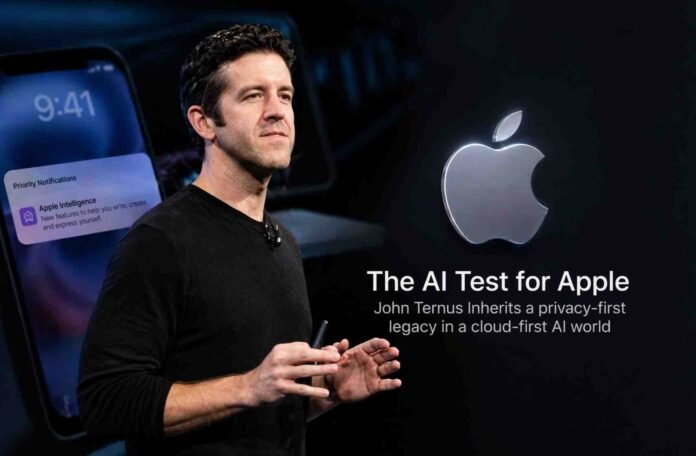
- Apple’s privacy-first AI approach is being tested by cloud-driven generative AI
- John Ternus’ leadership may reshape Apple’s AI and hardware integration strategy
- Siri and Apple’s AI ecosystem need major upgrades to stay competitive
- Health tech and creator tools could become key AI growth areas
For years, Apple has followed a familiar rhythm: take its time, refine relentlessly, and enter markets with products that feel complete rather than experimental. That formula worked for the iPhone, wearables, and services. But artificial intelligence, particularly the generative wave, is proving to be a different kind of challenge.
The company now finds itself in a position it rarely occupies. Instead of leading the conversation, it is reacting to it. Rivals have embraced cloud-heavy AI models, built on vast datasets and continuous learning loops. Apple, by contrast, has stayed committed to its privacy-first, on-device approach. That philosophy has earned user trust, but it may also be limiting how quickly the company can scale in an AI-driven world.
This shift comes at a crucial leadership moment. John Ternus is set to take over from Tim Cook, marking more than just a change at the top. It signals a potential reset in how Apple approaches its next big technological chapter.
The tension between privacy and performance
At the heart of Apple’s AI strategy is a principle it has defended for years: keep user data on the device whenever possible. This local-first model aligns with its broader stance on privacy, a cornerstone of its brand identity.
Generative AI complicates that stance. Building powerful language models requires massive datasets, cloud infrastructure, and constant iteration. Competitors have leaned heavily into this model, gaining a clear advantage in capability and speed. Apple’s reluctance to centralise user data means it has had to move more cautiously.
The result is a growing tension. On one side is privacy, a non-negotiable for Apple. On the other is performance, where AI systems are advancing at a rapid pace. Bridging that gap will likely define the company’s next phase.
Industry observers suggest incremental updates will not be enough. Apple needs a clearer vision that blends its minimalist design philosophy with genuinely useful AI features. The goal is not to overwhelm users with capabilities, but to make everyday interactions smoother and more intuitive.
Hardware strength meets AI ambition
Ternus brings deep hardware expertise, having overseen the development of core products like the iPhone, iPad, and Mac. That background could become a key advantage. Apple has always excelled at integrating hardware and software tightly, and AI could be the next layer in that integration.
One promising area is health technology. Apple already has a foothold through devices like the Apple Watch. Expanding into new form factors, such as rings or ambient devices, combined with AI-driven insights, could open new possibilities. The company’s reputation for handling sensitive data responsibly gives it an edge in this space.
Another area that needs attention is Apple’s intelligence layer, particularly Siri. When Siri launched, it felt like a glimpse into the future of computing. Today, it struggles to keep up with modern AI assistants that can reason, generate content, and adapt to context. Revamping Siri into a more capable, conversational system is no longer optional. It is essential.
Apple also faces a strategic question around partnerships. While collaborating with external AI providers may offer a short-term boost, relying on them for core capabilities could dilute Apple’s control over its ecosystem. Building its own integrated AI layer across devices remains the more sustainable path.
The road ahead in an AI first era
Despite the pressure, Apple’s position is far from weak. Its ecosystem, hardware expertise, and loyal user base give it a strong foundation. The challenge lies in aligning those strengths with the realities of an AI-first world.
There are opportunities beyond consumer features. AI tools for creators and small businesses could become a meaningful growth area. Apple has long supported creators, and adding intelligent tools for content generation, editing, and management could expand that role significantly.
At the same time, it is important to recognise that consumers still prioritise core device qualities like design, performance, and reliability. AI, for many, remains an enhancement rather than the primary reason to buy a device. Apple seems aware of this, choosing to integrate AI quietly rather than position it as the sole selling point.
All eyes will now turn to upcoming announcements, especially at its developer events, where Apple is expected to outline its next steps. Whether it can redefine what “definitive” looks like in the AI era will depend on how well it balances its legacy with the demands of the future.
Follow TechBSB For More Updates