
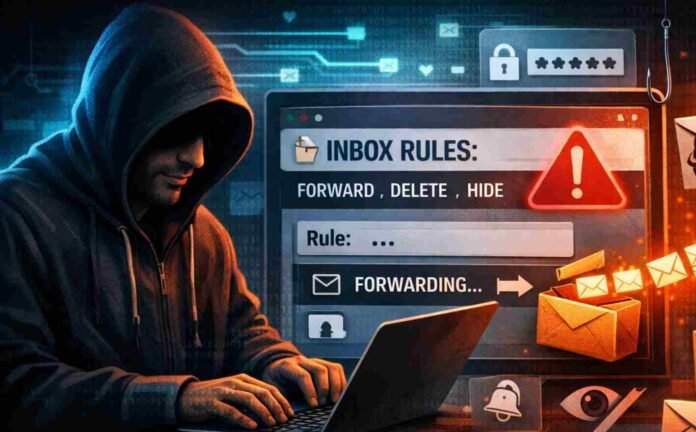
- Hackers are abusing inbox rules to control email accounts silently
- Malicious rules can hide alerts, forward data, and mark emails as read
- These rules can persist even after a password change
- Regularly checking inbox rules can help detect compromise early
Cybercriminals don’t always rely on complex malware or sophisticated exploits to break into accounts. Sometimes, they use tools that are already built into everyday platforms. A recent report from cybersecurity researchers highlights how something as ordinary as email inbox rules is being weaponized in real-world attacks.
Inbox rules are designed to help users organize messages by automatically sorting, flagging, or forwarding emails. But attackers have found ways to turn this convenience into a powerful persistence mechanism that keeps them inside compromised accounts long after the initial breach.
A Silent but Effective Persistence Technique
According to recent findings, attackers are increasingly relying on inbox rules to maintain control over email accounts without raising suspicion. Once they gain access, often through phishing or credential theft, they immediately set up automated rules that manipulate incoming messages.
These rules can quietly delete security alerts, mark important emails as read, or forward sensitive information to external addresses. In some cases, attackers create these rules within seconds of logging into the account, demonstrating just how central this tactic has become.
What makes this approach particularly dangerous is its subtlety. Unlike traditional attacks that trigger alerts or cause visible disruptions, malicious inbox rules operate in the background. Victims may continue using their email as usual, unaware that critical messages are being filtered out or redirected.
Why Password Changes Alone Aren’t Enough
One of the most concerning aspects of this tactic is its ability to survive basic security responses. Many users assume that changing their password is enough to regain control after a breach. Unfortunately, that is not always the case.
If malicious inbox rules remain in place, attackers can continue to monitor or manipulate communications even after credentials are updated. For example, they can still receive forwarded emails containing sensitive data or intercept verification codes used for two factor authentication.
This means that a compromised account can remain vulnerable despite what appears to be a successful recovery. It also gives attackers an opportunity to escalate their access or impersonate the victim in ongoing conversations.
Who Is Being Targeted
The report highlights that these attacks are not random. Certain groups are more likely to be targeted due to the value of the information they handle.
Enterprise users are among the primary targets, especially those working in finance, executive roles, or customer facing positions. These individuals often deal with sensitive communications, making their accounts attractive for business email compromise scams.
Educational institutions are also at risk. Student and faculty accounts, particularly those that are inactive or poorly monitored, can serve as easy entry points for attackers looking to expand their reach.
How to Spot Suspicious Activity
Despite how stealthy these attacks can be, there are still ways to detect them. Inbox rules must be named, and attackers often use minimal or unusual naming conventions to avoid attention.
Common examples include rules named with a single character such as a dot, comma, or ellipsis. These can easily blend into the background unless someone is actively checking for them.
Regularly reviewing inbox settings and rule configurations can help identify anything out of place. It is a simple step, but one that can make a significant difference in catching a breach early.
Follow TechBSB For More Updates