
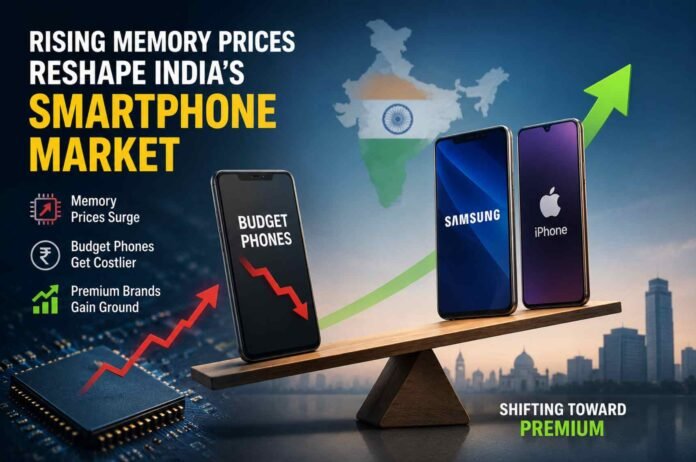
- Memory prices have surged sharply, making very cheap smartphones harder for manufacturers to produce profitably.
- Chinese brands such as Vivo, OPPO, Xiaomi and Realme are seeing shipment declines as budget phone prices rise.
- Samsung and Apple are gaining market share as Indian consumers increasingly spend more on smartphones.
- Higher prices and easier financing could accelerate India’s move from budget phones toward mid range and premium devices.
India’s smartphone market is entering a very different phase as soaring memory chip prices put pressure on the low cost business model that helped Chinese brands build a strong position in the country.
The biggest change is happening at the affordable end of the market. Phones that once sold for less than $150 are becoming increasingly difficult to produce at the same price. Industry analysts now expect some new Chinese smartphones that previously targeted the sub $150 segment to move into the $200 to $250 range.
That is a major shift in a market where affordability has traditionally been one of the most important buying factors.
Counterpoint Research says prices in the sub $150 smartphone category have already increased by as much as 40 percent. Memory prices have reportedly quadrupled since September 2025, creating another layer of pressure for manufacturers that operate with tight margins.
The result is an unusual situation. Smartphone shipments in India are falling, but the average amount consumers spend on phones is rising.
IDC reported that smartphone shipments reached 64.2 million units in the first half of 2026, down 7.9 percent compared with the same period last year. At the same time, the average selling price climbed 14.4 percent to a record $315. Smartphone revenue still managed to increase by 3.6 percent.
In simple terms, fewer phones are being sold, but the phones being sold are more expensive.
Chinese brands feel the pressure
The change is particularly significant for Vivo, OPPO, Xiaomi and Realme, all of which have built substantial businesses around competitive pricing and feature packed devices.
IDC data for the quarter ending in June shows Vivo shipments falling 13.9 percent year over year. OPPO declined 8.5 percent, Xiaomi dropped 10 percent and Realme suffered a 14.2 percent decline. OnePlus, which has a stronger focus on higher priced devices, performed better, with shipments falling just 2.5 percent.
The pattern suggests that the memory shortage is not affecting every part of the smartphone market equally. Consumers shopping at the bottom of the market have fewer affordable options, while buyers looking at more expensive devices appear to be more willing to absorb price increases.
That could accelerate a long running shift in India toward higher priced smartphones.
There is another problem for Chinese manufacturers. Unlike Samsung, they generally do not have the same level of control over memory component supply. Chinese smartphone companies rely on suppliers including MediaTek, SK Hynix and Samsung for important components, leaving them more exposed when memory costs rise.
Samsung has an important advantage here because its wider business includes memory production. That gives the company greater control over supply and potentially more room to manage component costs.
Samsung is already competing closely with Vivo in India’s $200 to $300 smartphone segment. As prices rise across the market, that advantage could become even more important.
Apple and Samsung are gaining ground
While Chinese brands are dealing with falling shipments, Samsung and Apple are moving in the opposite direction.
IDC says Samsung shipments increased 0.4 percent in the quarter ending in June, while Apple shipments rose 0.7 percent. Samsung’s market share increased by almost 200 basis points and Apple’s share increased by around 100 basis points.
Vivo, meanwhile, lost around 60 basis points of share according to IDC. Counterpoint’s figures indicate an even larger decline for Vivo, putting its share down by roughly 140 basis points.
The result is a narrowing gap between Vivo and Samsung, which could make the competition for India’s smartphone leadership much more interesting.
Apple is benefiting from the continued willingness of Indian consumers to spend more on premium devices. The iPhone 17 has reportedly remained the best selling individual smartphone model in India for two consecutive quarters.
Samsung has a different advantage. Its portfolio covers a much broader price range, starting around $200 and extending beyond $800. That allows it to compete for customers who are moving up from entry level phones without requiring them to make the much larger jump to an iPhone.
Installment financing is also making expensive smartphones easier for Indian consumers to afford. As monthly payment options become more common, the psychological barrier around buying a more expensive phone becomes smaller.
This combination of higher component costs, financing and stronger premium demand could fundamentally change the way India’s smartphone market is structured.
The tablet market is facing its own squeeze
The memory shortage is not limited to smartphones. Tablet manufacturers are also dealing with higher component costs and weaker demand.
IDC’s latest worldwide tablet data shows shipments reached 33.61 million units in the second quarter of 2026. That represents a 5.2 percent decline from the previous quarter and a 12.3 percent fall from the same period last year.
Samsung increased prices across its Galaxy Tab range in April, with some models becoming between $40 and $280 more expensive. Lenovo also increased prices across several product families, while Apple raised prices across its tablet lineup in June, with several models increasing by more than 20 percent.
However, tablets have one important difference from smartphones. Memory represents a smaller portion of the total bill of materials, giving manufacturers somewhat more flexibility when costs increase.
The market is also becoming more concentrated. Apple, Samsung, Lenovo, Huawei and Xiaomi together accounted for 79.8 percent of worldwide tablet shipments in the second quarter, up from 77.9 percent in the first quarter.
Lenovo was one of the strongest performers among major vendors, with shipments increasing 26.2 percent year over year. Huawei and OPPO also recorded growth.
That shows the current downturn is not simply about component prices. Product positioning, brand strength and the usefulness of a device are becoming increasingly important as consumers decide whether a higher price is justified.
What happens next for India’s phone buyers?
The biggest question is whether India’s smartphone market can continue moving toward premium devices while entry level prices rise.
For Chinese manufacturers, the old formula of packing more features into a very cheap phone is becoming harder to maintain. Companies may have to accept lower margins, reduce specifications, raise prices or shift their attention toward more profitable segments.
Some brands have already turned to suppliers such as UNISOC and ChangXin Memory Technologies to manage memory costs and maintain product availability. But that may only provide temporary relief.
ChangXin is also expanding capacity while increasingly focusing on China’s artificial intelligence and data centre markets. If more memory production is directed toward higher value applications, smartphone manufacturers could face continued pressure.
For consumers, the immediate consequence is straightforward. The cheapest smartphones are likely to become less attractive as prices rise, while the gap between budget and mid range devices becomes smaller.
That could push buyers toward better financed premium phones, especially if brands such as Samsung and Apple continue offering strong trade in programs and installment options.
The Indian smartphone market is therefore not simply becoming more expensive. It is becoming more concentrated around brands that have stronger supply chains, better purchasing power and a more convincing premium proposition.
The era of the ultra cheap smartphone may not disappear overnight, but the economics behind it are clearly changing.
Follow TechBSB For More Updates