
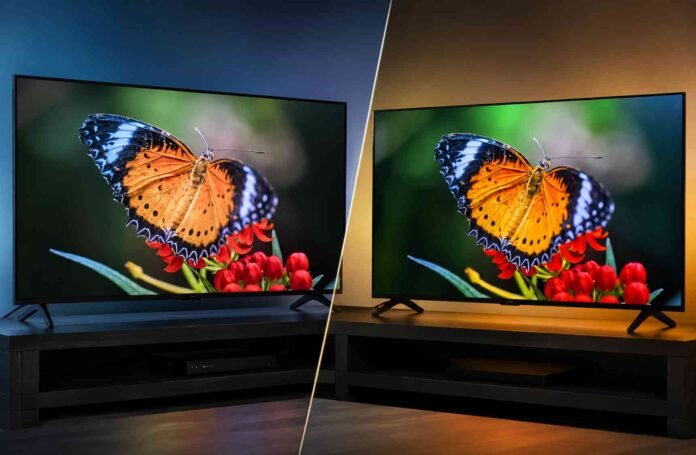
Hisense made waves when it introduced RGB Mini LED technology, positioning it as the next major evolution in TV display performance. The technology promised brighter images, richer colors, improved viewing angles, and more precise backlight control. Initially, it seemed destined for premium flagship televisions, far beyond the reach of mainstream buyers.
That assumption did not last long.
The arrival of the Hisense UR8 has brought RGB Mini LED technology into a much more accessible price bracket. At nearly the same price as Samsung’s QN80H, a conventional Mini LED TV, the UR8 offers a rare opportunity to compare next generation RGB technology against a mature and highly refined Mini LED display.
After extensive side by side testing, one thing became clear. RGB Mini LED is undeniably impressive, but it is not yet the complete game changer many expected.
Color Performance: More Natural Than Spectacular
One of the biggest selling points of RGB Mini LED is enhanced color reproduction. By using separate red, green, and blue light sources, the technology is designed to deliver greater color purity and wider color volume.
In practice, however, the results were more nuanced.
Testing with vibrant content such as Wicked and La La Land revealed an unexpected outcome. While the Hisense UR8 produced natural and convincing colors, the Samsung QN80H consistently delivered more vibrant and eye catching images. Bright pink flowers, colorful costumes, and richly saturated backgrounds appeared to have greater visual impact on Samsung’s traditional Mini LED screen.
The UR8 favored realism and restraint, often presenting colors in a more balanced and accurate manner. Some viewers may appreciate this approach, especially those who prefer a cinematic presentation. However, in scenes specifically designed to showcase vivid colors, the expected RGB advantage was not always obvious.
Switching the UR8 to a more aggressive picture preset increased color intensity, but it also pushed images closer to looking artificial. As a result, the TV felt best in its more natural picture modes, even if that meant sacrificing some visual excitement.
Contrast and Black Levels: A Mixed Picture
Contrast is where things became particularly interesting.
Samsung’s QN80H produced deeper looking blacks and stronger perceived contrast straight out of the box. Dark scenes from films such as The Batman benefited from punchier highlights and more convincing shadow depth. Bright light sources stood out dramatically against darker backgrounds, creating a more dynamic image overall.
The UR8 initially struggled in comparison. Dark areas often appeared slightly washed out, with blacks leaning toward gray rather than true black. Fortunately, a small adjustment to the brightness setting dramatically improved performance. Lowering brightness by a single step resulted in deeper blacks and noticeably stronger contrast.
Even so, the UR8 occasionally sacrificed shadow detail in exchange for darker black levels. Fine textures in dark clothing and hair could become harder to see, particularly in challenging scenes.
Despite these limitations, the UR8 demonstrated one significant strength. Its backlight control was excellent. Blooming and clouding were virtually absent, even when viewed from challenging angles. The Samsung, while strong overall, showed more visible backlight bleed and brightness inconsistencies around dark scenes.
This gives the UR8 a more uniform image and brings it closer to the viewing experience typically associated with OLED televisions.
Brightness and Everyday Viewing
On paper, the Hisense UR8 dominates the brightness battle.
Lab measurements showed substantially higher peak HDR brightness compared to the Samsung QN80H. The numbers suggested the UR8 should have been dramatically brighter in real world viewing.
Yet actual viewing results told a slightly different story.
In some scenes, the UR8 clearly displayed brighter highlights and stronger HDR impact. In others, the Samsung appeared equally bright or even more visually impactful despite its lower measured output.
This highlights an important reality in television performance. Raw brightness figures do not always translate directly into perceived brightness on screen. Picture processing, tone mapping, and color management all play significant roles.
One area where the UR8 unquestionably excelled was reflection handling. Its anti glare screen proved highly effective at reducing reflections while maintaining strong black levels. Combined with its wide viewing angles, the UR8 is particularly well suited for bright living rooms and daytime viewing.
RGB Mini LED Is Moving Forward, But Not Quite There Yet
The Hisense UR8 demonstrates exactly why RGB Mini LED technology has generated so much excitement. It delivers impressive viewing angles, excellent screen uniformity, strong brightness, and backlight control that outperforms many traditional Mini LED televisions.
However, the comparison also reveals areas where conventional Mini LED technology remains highly competitive. Samsung’s QN80H showcased stronger out of the box contrast, more vibrant color presentation, and an image that often felt more refined without requiring adjustments.
RGB Mini LED represents a genuine step forward, particularly for viewers seeking some of OLED’s strengths without OLED pricing. Yet this comparison shows the technology is still evolving. Better calibration, improved color accuracy, and more refined image processing could help future RGB models fully realize their potential.
For now, RGB Mini LED looks less like a complete replacement for traditional Mini LED and more like an exciting new chapter in the ongoing evolution of television technology.
Follow TechBSB For More Updates