
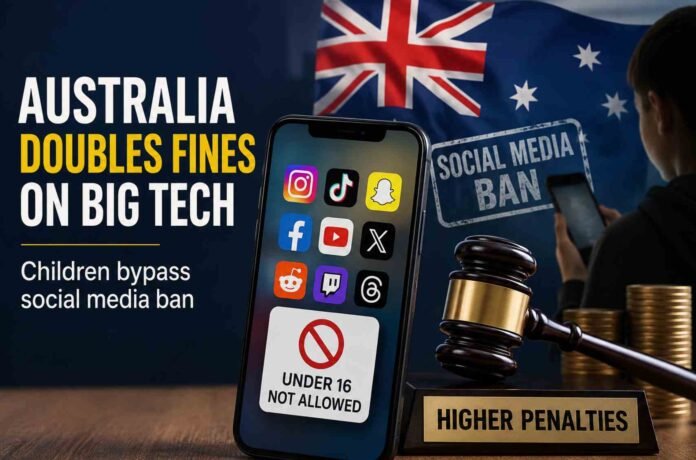
- Australia plans to double fines for social media companies that fail to stop users under 16.
- Children are still bypassing the ban using fake accounts and profiles belonging to adults.
- The eSafety Commissioner will receive stronger powers to investigate and demand compliance.
- The government says major tech companies must do more to enforce age restrictions.
Australia Tightens Rules as Under-16 Social Media Ban Faces Challenges
Australia is preparing to impose much tougher financial penalties on social media companies that fail to prevent children from accessing their platforms. The government says too many under-16 users continue to slip through existing safeguards despite the nationwide ban introduced late last year.
Under proposed legislation, the maximum penalty for repeated and systemic failures would increase from 49.5 million Australian dollars to 99 million Australian dollars. Officials argue that the higher fines are necessary because some of the world’s biggest technology companies have not taken enough meaningful action to enforce the rules.
Prime Minister Anthony Albanese said the government remains committed to protecting children online and believes social media platforms have not fully met their responsibilities. According to him, companies need to do far more than introduce basic safeguards if they want to comply with Australian law.
Children Continue Finding Ways Around the Restrictions
Australia’s social media ban officially came into effect on December 10, making the country one of the first to prohibit children under the age of 16 from using major social networking platforms.
However, enforcing the restrictions has proved more difficult than expected.
Many young users have reportedly continued accessing social media by creating accounts with false birth dates, borrowing accounts from older family members or friends, or signing in through private browsing methods. These workarounds have made it harder for platforms and regulators to ensure the ban is being properly enforced.
A recent peer reviewed study published in the British Medical Journal also questioned how effective the restrictions have been so far. Researchers tracked more than 400 children before and after the policy came into force and found that many were still able to access social media despite the new rules.
The findings suggested there was not enough evidence to show a major decline in social media use among teenagers during the first few months of the ban.
Government Wants Greater Accountability From Big Tech
Australian officials say the new legislation is not only about increasing financial penalties. It also aims to strengthen the powers of the country’s eSafety Commissioner.
If approved, the regulator will be able to demand documents, technical evidence and compliance records from social media companies, app stores and businesses providing age verification services. These additional powers are designed to help authorities determine whether companies are genuinely attempting to block underage users or simply meeting the minimum legal requirements.
Communications Minister Anika Wells said several platforms appear to be doing only the bare minimum to satisfy regulators. She argued that some companies are relying on limited measures instead of investing in stronger systems capable of preventing children from creating or maintaining accounts.
According to government figures, more than five million accounts linked to under 16 users have already been blocked since the rules came into force. Even so, officials believe there is still considerable room for improvement.
Australia Could Shape Future Online Safety Laws Worldwide
Australia’s approach is being closely watched by governments around the world. Several countries, including the United Kingdom, Indonesia, New Zealand and the United Arab Emirates, are considering similar restrictions as concerns grow over children’s safety, online wellbeing and excessive social media use.
Technology companies currently use a combination of artificial intelligence based age estimation and identity verification methods to confirm users’ ages. Australian authorities believe these systems need to become more reliable if age based restrictions are to work effectively.
The proposed increase in penalties sends a clear message that compliance is no longer optional. If the legislation is approved, social media companies operating in Australia could face some of the toughest enforcement measures seen anywhere in the world.
Follow TechBSB For More Updates