
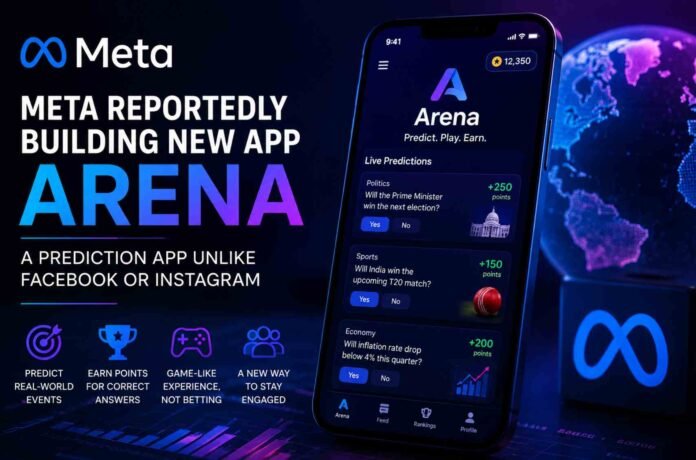
- Meta is reportedly working on a standalone prediction based app internally called Arena
- The app may let users forecast real world events and earn points for correct answers
- Unlike platforms such as Polymarket or Kalshi, Arena is said to avoid real money betting
- The project hints at Meta exploring new digital products outside Facebook, Instagram and WhatsApp
Meta may be preparing to enter a category that sits well outside its traditional social media business. According to a new report, the company is developing a standalone app called Arena, a product designed around predicting the outcome of real world events rather than sharing posts, photos, or short videos.
The project is said to be in testing and is reportedly being handled by a small internal team under the broader Meta umbrella. If the report is accurate, Arena could become one of the company’s more unusual experiments in recent years, especially because it appears to have little in common with Meta’s existing platforms such as Facebook, Instagram, Messenger, or WhatsApp.
What makes Arena particularly interesting is the format. Instead of functioning like a standard social network, the app is expected to revolve around predictions. Users may be able to make forecasts on topics such as politics, sports, economics, or major world events, and then earn points when those predictions turn out to be correct.
A prediction app, but not a betting platform
Arena is reportedly being positioned in a space that overlaps with prediction market services like Polymarket and Kalshi, both of which have attracted major attention in recent years. Those platforms allow users to speculate on future outcomes, often tied to politics, finance, sports, or global developments. In many cases, financial stakes are part of the experience.
Meta’s reported approach appears to be different. Rather than involving real money, Arena is expected to use a points based system that works more like a game. That distinction could be crucial. A points driven model would likely be easier to scale globally, and it may also help Meta sidestep some of the legal and regulatory issues that often come with money backed prediction platforms.
At the same time, the concept still taps into the same core appeal that has helped prediction markets gain momentum. People like testing their instincts against unfolding events, especially when the subject matter is timely, competitive, or controversial. Whether it is an election result, a sporting outcome, or a major economic announcement, prediction based products can create a strong loop of engagement when executed well.
Why Meta might be interested in this space
Meta has spent years building products that keep users inside its ecosystem, but most of those experiences are still rooted in communication, content discovery, or advertising. A prediction platform would represent a very different kind of user behavior. It would encourage participation through opinion, analysis, competition, and repeat engagement rather than posting or passive scrolling.
That may be exactly why Arena is worth testing.
Prediction markets and event based forecasting have become more visible over the past few years, not just among consumers but also among investors and analysts. Interest in the category has grown as users look for more interactive ways to engage with current affairs, while platforms in the space continue to gain traction.
Reports have also pointed to rising financial interest in this sector. Analysts at Bernstein reportedly suggested earlier this year that prediction markets could eventually become a trillion dollar category in annual trading volume by the end of the decade. That does not mean Meta is planning to build a full financial product, but it does show why the company may want a foothold in a market that is gaining attention quickly.
For Meta, Arena could serve multiple purposes at once. It could test demand for a new kind of app, help the company experiment with engagement mechanics beyond social feeds, and potentially open the door to future products that blend gaming, forecasting, community, and AI powered content.
Arena may be part of a broader Meta experimentation phase
The reported development of Arena also suggests that Meta is actively exploring more standalone products rather than relying only on its flagship apps. The company already has an enormous built in audience across its platforms, which gives it a major advantage whenever it wants to launch something new. Even a niche app can gain early visibility if Meta decides to promote it across Facebook, Instagram, or WhatsApp.
That scale matters. Meta said earlier this year that roughly 3.56 billion people use at least one of its apps every day. If the company chooses to direct even a small portion of that user base toward a new product, it can give a fresh service immediate reach that most startups could only dream of.
Arena is reportedly not the only project being tested either. Another product said to be in development is Meta Photos, a standalone effort that could focus on creating new forms of media using AI tools. If true, that would reinforce the idea that Meta is in an experimental phase, building products that move beyond the company’s usual identity as a social networking giant.
That shift is worth watching. Meta has already invested heavily in AI, mixed reality, and creator tools, but standalone apps like Arena could reveal a more practical side of that strategy. Rather than betting everything on a single futuristic platform, Meta may be trying several smaller ideas at once and watching closely to see which ones stick.
Nothing official yet, but the idea makes strategic sense
It is worth stressing that Meta has not publicly announced Arena, and the company has yet to confirm the app or explain what form it could eventually take. Like many internal projects, it may change significantly before launch, or it may never reach the public at all.
Still, the idea itself feels believable.
Meta has the scale, engineering resources, and consumer reach to test a product like this without much friction. A prediction app built around points instead of money also gives the company a way to enter a fast growing category without immediately inheriting the full complexity of financial regulation. If the app proves sticky, it could become another example of Meta building a new consumer habit around participation rather than publishing.
For now, Arena remains a reported experiment. But if Meta does move forward with it, the app could become one of the company’s most unusual launches in years and perhaps one of the clearest signs yet that it wants to be more than just the company behind Facebook and Instagram.
Follow TechBSB For More Updates