
- OpenAI warns negative AI narratives could limit economic and social benefits
- Public trust in AI is declining due to job loss fears and unmet promises
- Industry admits it has overhyped outcomes, damaging credibility
- Long term vision includes economic growth, safety nets, and scientific breakthroughs
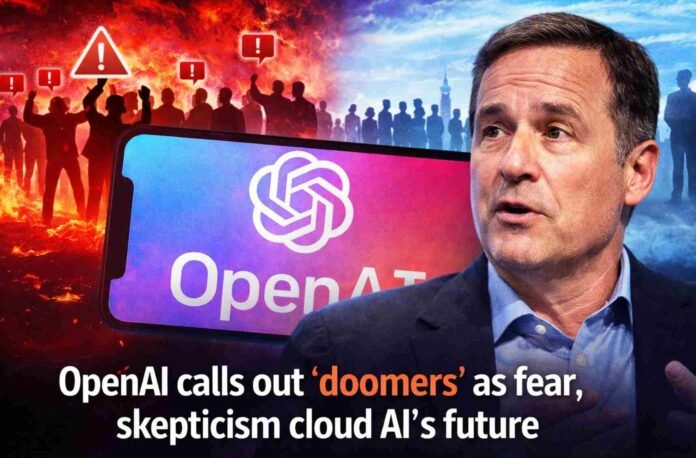
OpenAI is attempting to reset the public conversation around artificial intelligence, as skepticism continues to grow and confidence in the technology weakens. Chris Lehane, the company’s Vice President of Global Policy, has openly criticized what he describes as overly negative narratives surrounding AI, warning that fear driven discourse could come at a real cost to society.
Speaking candidly, Lehane stressed that the stakes are far higher than many assume. This is not a theoretical debate or a passing trend. In his view, AI represents a foundational shift with the potential to reshape economies, livelihoods, and daily life. Yet despite that promise, he acknowledged that the industry has struggled to communicate its benefits in a convincing and grounded way.
At the core of the issue is a widening gap between expectation and reality. On one end of the spectrum are those who portray AI as a near utopian force that will free people from work and unlock limitless creativity.
On the other are critics who warn of mass unemployment, societal disruption, and long term risks that could outweigh any short term gains. Lehane argues that both extremes distort the conversation, making it harder for the public to engage with what AI can realistically deliver.
A credibility problem the industry helped create
Lehane did not shy away from placing some of the blame on the AI sector itself. Overpromising future breakthroughs without delivering tangible results has contributed to growing mistrust. Grand claims about rapid transformation have often failed to materialize, leaving many people unconvinced and increasingly wary.
This skepticism is reflected in recent public opinion data. Surveys suggest that only a small portion of people believe AI will have a net positive impact in the coming decades. Concerns are not abstract either. They are tied to real world anxieties around job security, rising costs, and the broader social consequences of rapid automation.
Those concerns are not without basis. Several major companies have already begun restructuring their workforces in response to AI adoption, with some roles being reduced or replaced altogether. For many workers, this reinforces the perception that AI’s benefits are unevenly distributed, favoring corporations while leaving individuals to absorb the disruption.
Economic promise versus present day disruption
Despite the criticism, OpenAI maintains that the long term economic upside of AI remains substantial. Lehane pointed to the potential for AI to generate new forms of wealth and productivity, which could in turn support stronger social systems.
Among the ideas being discussed are adaptive safety nets designed to better support workers in a changing economy. These could be funded through shifts in how governments collect revenue, including greater emphasis on capital gains and corporate income tied to AI driven growth. The goal, at least in theory, is to ensure that the gains from automation are shared more broadly rather than concentrated at the top.
Beyond economics, the company continues to highlight AI’s potential to accelerate progress in critical areas such as healthcare, agriculture, and energy. From tackling complex diseases to improving food production under climate pressure, these are the kinds of outcomes proponents believe could redefine AI’s role in society.
Winning over a skeptical public will not be easy
Even with those ambitions, rebuilding trust may prove to be one of the industry’s toughest challenges. The narrative surrounding AI is no longer shaped solely by innovation, but by lived experience. Job losses, rising infrastructure demands, and emerging concerns around mental health impacts are all shaping how people perceive the technology.
Lehane’s comments reflect an awareness that messaging alone will not be enough. Delivering clear, measurable benefits to everyday people will be critical if AI companies hope to shift public opinion. Without that, the gap between promise and perception is likely to widen further.
For now, the debate remains unresolved. AI continues to advance rapidly, but the question of who truly benefits and at what cost is becoming harder to ignore. Whether the industry can move beyond hype and fear toward something more grounded may ultimately determine how widely its advantages are accepted.
Follow TechBSB For More Updates

