
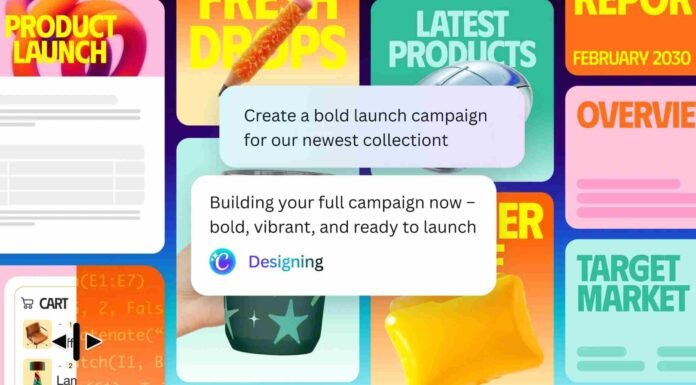
- Canva’s AI assistant now creates editable layered designs from simple text prompts
- New integrations allow the assistant to use emails, files, and meetings as context
- Scheduling and web research features push Canva toward autonomous workflows
- Faster and cheaper AI models improve performance across image and video tools
Canva is pushing deeper into the idea that design should feel less like manual work and more like directing an intelligent system. Its latest update to the Canva AI assistant reflects that shift, turning simple text prompts into fully editable designs while quietly handling the heavy lifting in the background.
At its core, the update embraces a broader trend shaping the AI industry right now. Instead of acting as a single tool, AI assistants are evolving into orchestrators.
You describe the outcome, and the system decides how to get there, selecting the right tools, applying context, and presenting usable results. Canva’s approach fits neatly into that vision, particularly for users who need speed without sacrificing control.
From prompts to polished designs
The standout feature is the assistant’s ability to generate layered, editable designs from natural language prompts. Rather than producing a flat, final output, Canva builds designs in structured layers, giving users room to refine individual elements such as text, images, and layout.
This detail matters. Many AI design tools generate impressive visuals, but they often fall short when users want to tweak specifics. Canva is clearly aiming to bridge that gap by combining automation with flexibility. The result is a workflow that feels less rigid and more collaborative.
The assistant can also generate multiple design options from a single prompt, helping users compare directions quickly. That’s particularly useful for marketers, social media teams, and small businesses that need to iterate fast without starting from scratch each time.
Expanding beyond design into workflows
Canva is not limiting its AI ambitions to design alone. The company is steadily turning its platform into a broader productivity hub by integrating with tools like Slack, Gmail, Google Drive, Calendar, and Zoom. With user permission, the assistant can pull context from emails, files, and meetings to inform its outputs.
There is also a new web research capability, allowing the assistant to gather information online and incorporate it into tasks. This signals a shift toward more autonomous workflows, where the AI doesn’t just execute instructions but actively fills in missing pieces.
Another addition is task scheduling. Users can ask the assistant to set up recurring tasks, which are prepared as drafts for review before publishing. While not fully automated, this strikes a balance between convenience and oversight.
Competitive pressure is heating up
Canva’s move comes at a time when competitors are accelerating their own AI strategies. Adobe has introduced a Firefly AI assistant that works across its ecosystem, while Figma is integrating AI agents into its platform.
Despite this growing competition, Canva appears confident in its positioning. According to its leadership, many small businesses already rely on Canva as both the starting point and the final destination for their creative workflows. Even when external tools are involved, Canva aims to own the final stage where designs are refined, approved, and published.
This focus on the “last mile” could prove to be a strategic advantage. While other platforms may excel at generating assets, Canva is betting that users still want a centralized space to finalize and deploy their work.
Faster models and broader capabilities
Alongside workflow improvements, Canva is also upgrading its underlying AI models. The company claims significant gains in speed and cost efficiency. Its image generation model is now reportedly five times faster and dramatically cheaper to run, while its image to video system has also seen notable performance improvements.
The platform’s AI code generator has been updated to support HTML imports, and users can now create spreadsheets using text prompts. These additions reinforce Canva’s goal of becoming an all in one creative and productivity platform rather than just a design tool.
With its enterprise business growing rapidly and a potential public listing on the horizon, Canva is clearly investing heavily in AI as a long term differentiator.
A gradual rollout with big implications
The updated Canva AI assistant is currently launching in a research preview phase, with a wider release expected soon. While still early, the direction is clear. Canva is not just adding AI features. It is reshaping how users interact with design tools altogether.
If the approach works, the future of design may look less like clicking through menus and more like describing what you want and refining what the AI delivers.
Follow TechBSB For More Updates

