
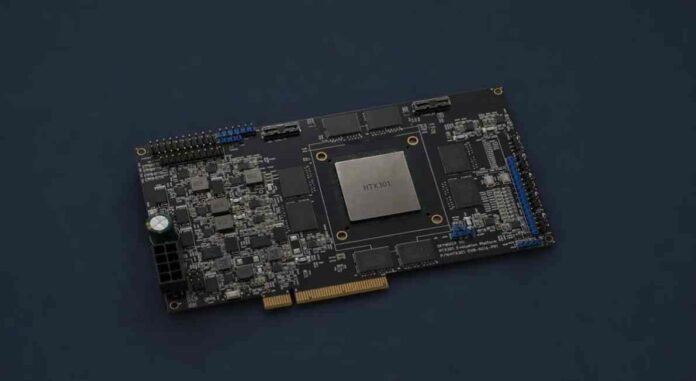
- Skymizer unveiled the HTX301 PCIe AI accelerator targeting enterprise AI inference.
- The card uses older 28nm chips and LPDDR4/5 memory instead of expensive HBM.
- Skymizer claims the accelerator can run 700B parameter LLMs at only 240W.
- Independent testing at Computex will determine whether the performance claims hold up.
The AI hardware race has largely been dominated by massive GPUs from companies like NVIDIA and Advanced Micro Devices, but a lesser known Taiwanese startup believes it has found a radically different path forward.
Skymizer has introduced the HTX301, a PCIe AI accelerator that appears to challenge conventional thinking around modern AI infrastructure. Instead of relying on cutting edge fabrication processes, expensive HBM memory, or enormous power budgets, the company is leaning on older technology to deliver surprisingly ambitious results.
According to Skymizer, the HTX301 can run language models with as many as 700 billion parameters on a single PCIe card while drawing only 240 watts of power. That claim alone is enough to raise eyebrows in an industry where enterprise AI accelerators regularly consume between 500W and 1,000W.
The company says its architecture removes the need for hyperscale GPU clusters in many enterprise inference workloads. If those claims survive independent testing, the HTX301 could become one of the more disruptive AI hardware announcements of the year.
Old Technology, Unusual Design
What makes the HTX301 stand out is not just its claimed performance, but the technology stack behind it. The accelerator reportedly uses mature 28nm chips alongside LPDDR4 and LPDDR5 memory rather than the high bandwidth memory solutions favored by modern AI accelerators.
That choice significantly reduces manufacturing costs and thermal demands. The card integrates six HTX301 chips and offers a massive 384GB memory capacity in a standard PCIe form factor.
Skymizer’s HyperThought platform powers the accelerator, using custom LPU IP specifically tuned for large language model inference. The company also claims advanced compression techniques improve efficiency for both model weights and KV cache operations.
In internal benchmarks, Skymizer says the HTX301 outperformed open source llama.cpp implementations by roughly 9% to 17.8%. The company also claims the card can deliver 30 tokens per second while using only 0.5 TOPS at 100GB/s bandwidth.
Those numbers may sound unconventional compared to the raw TFLOPS race pushed by larger competitors, but Skymizer appears focused on practical inference efficiency rather than brute force compute.
Enterprise AI Without the Data Center Overhaul
One of the biggest barriers to enterprise AI adoption is infrastructure cost. Deploying modern AI servers often requires extensive upgrades to cooling systems, rack density, and power delivery.
Skymizer believes the HTX301 changes that equation. Because the accelerator operates within a modest 240W envelope, it can fit into existing air cooled servers without forcing companies to redesign their data centers.
That could make the card especially attractive for organizations wanting on premises AI deployments without depending entirely on cloud providers. Running large language models locally also addresses growing concerns around data privacy, sovereignty, and unpredictable cloud expenses.
The company says the accelerator is designed for agentic AI workloads, coding assistants, workflow automation, and industry specific inference tasks. By avoiding hyperscale infrastructure requirements, businesses could theoretically scale AI deployments more affordably.
This approach also arrives at a time when enterprises are increasingly questioning the long term economics of cloud based AI inference.
Big Promises Still Need Proof
Despite the attention surrounding the HTX301, the real test will come when independent reviewers get access to hardware. Skymizer plans to showcase the accelerator at Computex, where analysts and engineers will have the opportunity to evaluate the company’s claims more closely.
The AI industry has seen no shortage of startups promising to disrupt Nvidia’s dominance, only to struggle once products face real world workloads. That makes external validation critical.
The comparison with current enterprise hardware is also notable. AMD’s latest Instinct MI350P PCIe accelerator delivers enormous AI throughput with 144GB of HBM3E memory, but at a significantly higher power draw. Nvidia’s RTX PRO 6000 Blackwell reportedly consumes around 600W, more than double Skymizer’s stated requirement.
Still, raw performance comparisons may not tell the full story. Skymizer’s pitch centers on efficient inference, lower operational costs, and easier deployment rather than chasing maximum benchmark numbers.
If the HTX301 performs anywhere close to advertised specifications, it could open a new category of AI accelerators built around efficiency first design principles. If not, it risks joining the growing list of ambitious AI startups that failed to deliver on bold promises.
Follow TechBSB For More Updates

