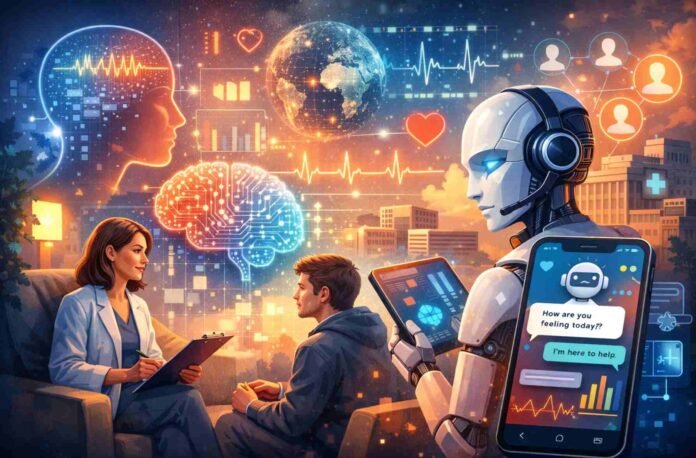
- AI expands access to mental health support through always on digital platforms.
- Screening and triage processes are faster, helping clinicians prioritize urgent cases.
- Personalized digital therapy adapts to user behavior and supports hybrid care models.
- Ethical oversight and human judgment remain essential in diagnosis and treatment.
Artificial intelligence is no longer a futuristic concept in psychology. In 2026, it is a working layer inside hospitals, therapy platforms, insurance systems, and even personal wellness apps. What began as experimental chatbots and data tools has evolved into an ecosystem that supports clinicians, speeds up screening, and expands access to care.
The global AI mental health market is expected to exceed eight billion dollars this year. More than 40 percent of digital health platforms now integrate some form of AI driven assessment or therapeutic support. That growth reflects both technological progress and a pressing need. According to global health estimates, nearly one in eight people lives with a mental health condition.
At the same time, many regions continue to report a shortage of trained therapists, leaving patients waiting weeks or months for appointments.
AI is stepping into that gap. Not as a replacement for professionals, but as a bridge between demand and limited clinical capacity.
Always On Support and Faster Screening
The most visible shift in 2026 is the rise of AI powered mental health platforms that operate around the clock. These systems provide conversational support, guided exercises, and structured coping tools within seconds. For many users, this becomes the first point of contact.
Usage data from large app providers highlights how significant this shift has been. More than 60 percent of users access support tools outside standard office hours. Nearly 85 percent of first time users report that they had never previously spoken to a mental health professional. Response times average under five seconds, compared to days or even weeks for traditional appointments.
While these tools cannot replace therapy, they offer immediate engagement during moments of distress. That immediacy alone has reduced barriers for people who may feel hesitant or unable to seek in person care.
Hospitals are also integrating AI into triage and assessment processes. By analyzing speech patterns, questionnaire responses, and behavioral signals, AI systems can flag potential high risk cases.
In emergency departments testing such systems, assessment times have reportedly dropped by 20 to 30 percent. That efficiency allows clinicians to focus on urgent and complex cases rather than spending hours on initial screenings.
The benefit here is not automation for its own sake. It is time saved and earlier identification of those who need immediate intervention.
Personalized Digital Therapy at Scale
Another major transformation lies in personalization. Digital therapy programs in 2026 are no longer static modules. They adapt based on how a user feels, behaves, and responds over time.
If a person reports difficulty sleeping, the platform may prioritize sleep hygiene exercises. If stress levels rise across weekly check ins, relaxation techniques and grounding practices may surface more frequently. These systems track engagement patterns, send reminders to reduce drop off, and generate concise progress summaries for therapists.
This adaptive structure means one therapist can oversee more clients without sacrificing quality. It also works particularly well when combined with traditional therapy sessions. The digital platform handles routine exercises, mood tracking, and reinforcement. The human therapist focuses on deeper exploration, ethical judgment, and complex case management.
In practice, this hybrid model is proving effective. Patients receive continuous support between appointments. Clinicians gain clearer insight into patterns that might otherwise go unnoticed.
Research Power and Data Driven Insight
AI’s ability to analyze large datasets has also reshaped mental health research. By reviewing anonymized patient records and app interactions, machine learning systems can detect patterns in mood changes, treatment engagement, and symptom clusters.
Researchers use these insights to identify emerging mental health trends, compare therapy approaches, and understand how symptoms vary across regions or age groups. What once required months of manual record review can now be processed in a fraction of the time.
That said, experts consistently emphasize that data interpretation must remain human led. AI can identify correlations, but clinical expertise is essential to understand context, causation, and ethical implications.
Ethical Boundaries and Real World Concerns
With growth comes scrutiny. As AI becomes embedded in mental healthcare, ethical questions grow louder.
Data privacy remains a top concern. Psychological information is deeply personal, and breaches can have lasting consequences. Algorithm bias is another challenge. If training data lacks diversity, recommendations may not serve all populations equally.
There is also the risk of overreliance. Automated tools may be convenient, but complex diagnoses and treatment decisions require human oversight. Clear communication is essential so users understand what AI can and cannot do.
Regulatory bodies in several countries are reviewing digital health standards to address these issues. Professional associations maintain a consistent position. AI should assist licensed professionals, not replace them.
A Balanced Future
In 2026, AI in mental health is best understood as an amplifier. It accelerates screening, personalizes digital exercises, and provides immediate support. It reduces administrative burden and uncovers patterns in data that inform research and care strategies.
Yet the foundation of mental healthcare remains human. Diagnosis, ethical reasoning, and treatment planning depend on trained professionals who can navigate nuance and complexity.
The most reliable systems are those that combine technological efficiency with clinical expertise. This balance ensures expanded access without sacrificing trust.
Mental healthcare is becoming more connected, more responsive, and more data informed. Technology is shaping the tools. Humans are still leading the care.
Follow TechBSB For More Updates