
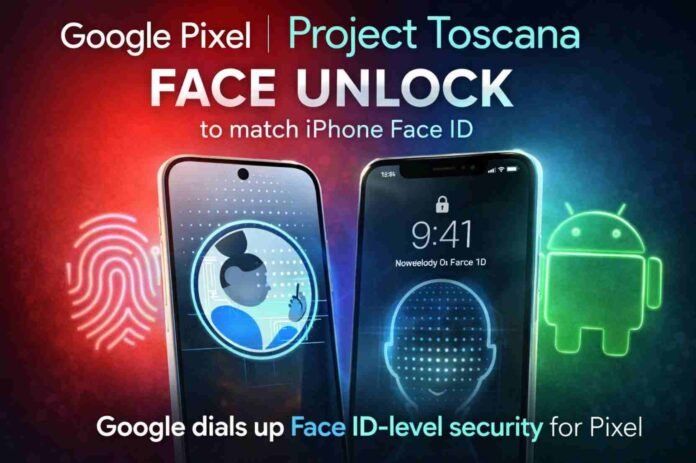
- Project Toscana aims to bring hardware-based face unlock to future Pixel phones and Chromebooks
- The system is said to match Face ID speed and work in various lighting conditions
- It may use infrared technology within a single-hole punch camera design
- Google appears to be revisiting lessons learned from the Pixel 4 era
Google may be ready to revisit one of its boldest ideas. A new internal initiative known as Project Toscana is reportedly in development, and it points to a serious hardware upgrade for face unlock on future Pixel phones and even Chromebooks.
If the reports are accurate, Google is aiming to deliver a system that performs on par with Apple’s Face ID in speed and reliability, while avoiding the bulky hardware compromises that defined earlier attempts.
For years, biometrics have been central to the smartphone experience. Most Android devices rely heavily on fingerprint sensors, whether mounted under the display or embedded in the power button.
Google, however, has consistently shown an interest in facial recognition. The Pixel 4 famously abandoned fingerprint scanning altogether, opting instead for a sophisticated infrared based face unlock system that closely mirrored Apple’s approach.
It was ambitious, fast, and secure. It also arrived at an unfortunate moment, launching shortly before widespread mask wearing reshaped everyday life.
Since then, Google has rebuilt its face unlock strategy more cautiously. The Pixel 7 series reintroduced facial recognition, but it was camera based and limited in scope.
It could unlock the device, but it lacked the security certification required for sensitive apps such as banking. The Pixel 8 series closed that gap, bringing stronger integration and improved security. Even so, the current implementation struggles in low light and relies heavily on favorable conditions.
Project Toscana appears to be Google’s answer to those limitations.
A hardware upgrade without visible compromise
According to reports, Project Toscana centers on a new hardware solution designed to fit within a single hole punch camera cutout.
That detail alone is significant. Apple’s Face ID relies on a cluster of sensors and projectors housed in a prominent notch or Dynamic Island. If Google can deliver similar performance without expanding the visible footprint, it would represent a meaningful engineering achievement.
Early claims suggest that the system performs just as quickly as Face ID and remains reliable across various lighting conditions. There is speculation that infrared technology is involved, potentially enabling accurate depth mapping even in the dark.
Previous rumors surrounding the Pixel 11 hinted at support for an under display infrared camera system powered by the next generation Tensor chipset. Project Toscana may be the realization of that groundwork.
The promise is straightforward. Face unlock that works securely, instantly, and consistently, whether you are outdoors in bright sunlight or checking your phone in a dim bedroom.
Learning from the Pixel 4 experiment
The Pixel 4 remains one of Google’s most distinctive devices. Its face unlock hardware was sophisticated, arguably ahead of its time in the Android ecosystem. However, it came at a cost.
The sensor array was expensive and required a larger forehead bezel to accommodate the necessary components. In a market increasingly obsessed with edge to edge displays, that design choice proved controversial.
Cost may also have played a role in Google’s retreat from dedicated facial hardware. Advanced biometric sensors are not cheap, and Pixel devices have traditionally balanced premium features with careful pricing.
Reintroducing such technology would only make sense if Google has found a way to reduce component costs or integrate them more efficiently into existing hardware.
Project Toscana suggests that Google believes the timing is right to try again. The company has had several generations to refine its machine learning capabilities and custom silicon through the Tensor platform.
Those improvements could allow more of the heavy lifting to be handled on device, improving both security and responsiveness.
Beyond phones, a wider ecosystem play
Perhaps the most intriguing aspect of Project Toscana is its reported expansion beyond smartphones. Chromebooks could also benefit from the upgraded face unlock system. That move would align with Google’s broader ecosystem ambitions, creating a more seamless biometric experience across devices.
A secure and fast facial recognition system on Chromebooks would simplify logins, support enterprise environments, and strengthen Google’s position in education and business markets.
It would also help unify the Pixel brand identity, tying phones and laptops together through shared security technologies.
There are still many unanswered questions. How secure will the new system be compared to fingerprint authentication. Will it coexist with under display fingerprint sensors or replace them entirely. And perhaps most importantly, can Google deliver this without raising prices significantly.
For now, Project Toscana sounds like a renewed commitment to making face unlock not just a convenience feature, but a flagship level biometric solution. If Google gets it right, the next generation of Pixel devices could offer one of the most advanced and seamless authentication experiences on Android.
Follow TechBSB For More Updates

