
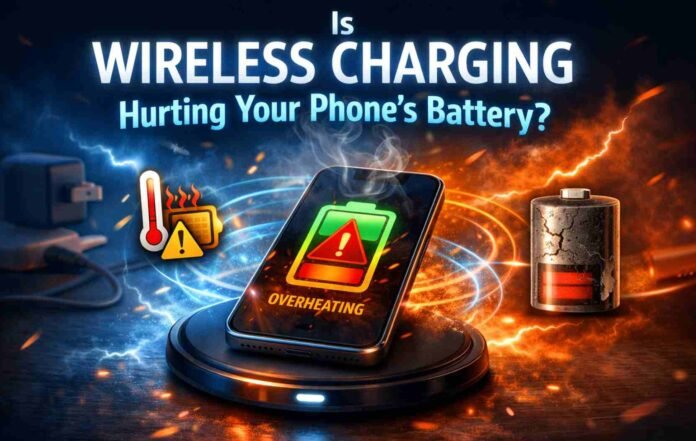
- Wireless charging does not destroy your battery, but it creates slightly more heat than wired charging.
- Heat can speed up battery aging, yet modern phones are built to manage it safely.
- Using certified chargers and keeping your phone cool reduces any long term impact.
- The real world battery difference between wired and wireless charging is small for most users.
Wireless charging has quickly moved from novelty to everyday convenience. There is something satisfying about placing your phone on a pad and watching it power up without fumbling for cables.
No tangled cords, no worn out charging ports, and far less clutter on your bedside table. With charging pads now appearing in cars, furniture, and public spaces, going cable free feels like the natural next step in smartphone evolution.
Still, many users remain skeptical. Wireless charging often feels slower than plugging in, and your device can get noticeably warm while it charges. That warmth has fueled a common concern: is wireless charging quietly damaging your battery over time?
Experts say the fear is understandable, but mostly misplaced.
The Myth That Won’t Go Away
One of the biggest worries surrounding wireless charging is heat. When a phone warms up, it is easy to assume the battery is being stressed or degraded. Add in the invisible nature of electromagnetic power transfer, and the process can sound harsher than traditional wired charging.
Some people even believe the magnetic field floods the battery with excess energy. In reality, that is not how modern charging systems work.
Wireless charging relies on electromagnetic induction. A coil inside the charging pad generates a magnetic field when electricity flows through it. Your phone contains its own coil, which captures that energy and converts it back into electrical current to charge the battery.
The process is safe by design. However, it is not quite as efficient as using a cable.
What Experts Actually Say
Specialists agree on one key point: wireless charging will not “kill” your phone’s battery.
The main difference between wired and wireless charging is efficiency. A wired connection sends electricity directly into the device, typically reaching around 95 percent efficiency. Wireless charging usually operates closer to 70 to 80 percent under normal conditions.
Where does the lost energy go? Mostly into heat. And heat, over long periods, can accelerate the natural aging process of lithium ion batteries.
That said, modern smartphones are built with protective systems that monitor temperature, regulate power flow, and prevent overcharging. Certified chargers follow strict safety standards that ensure devices communicate with the charger and adjust voltage when necessary.
In everyday use, the impact is minimal. Even frequent wireless charging is unlikely to cause noticeable battery decline for the average user.
Why Heat Matters More Than the Charging Method
If there is one factor worth paying attention to, it is temperature rather than the charging technology itself.
Batteries naturally degrade over time, but excessive heat can speed that process. Wireless charging generates more warmth because of the extra energy conversion step, yet the difference is rarely dramatic unless conditions make the device hotter than it should be.
Simple habits can make a meaningful difference. Charge your phone on a flat, hard surface where heat can dissipate easily. Avoid placing it on cushions, blankets, or other materials that trap warmth. If your device feels unusually hot, remove it from the charger for a short break.
Alignment also matters. When the coils inside the phone and charger line up correctly, energy transfers more efficiently and produces less heat.
Equally important is using a compatible, certified charger. Quality charging pads include safeguards such as temperature control, automatic shutoff, and foreign object detection. These features help prevent the kind of overheating that could shorten battery lifespan.
Wired vs Wireless: Which Should You Choose?
There is no universal “best” method, only what suits your routine.
Wired charging remains the faster and more efficient option, making it ideal when you need a quick power boost before heading out. Wireless charging shines in convenience. It is perfect for overnight top ups, office desks, or shared charging stations where repeatedly plugging and unplugging would be a hassle.
For most people, mixing both methods is the smartest approach. Use a cable when speed matters and wireless charging when ease takes priority.
The bigger picture is reassuring. Smartphone batteries are consumable components designed to last several years. By the time wireless charging has any measurable effect, many users are already considering an upgrade.
So while wireless charging may warm your phone slightly and operate with less efficiency, it is not secretly sabotaging your battery. Treat your device with basic care, keep temperatures in check, and you can enjoy cable free charging without worry.
Follow TechBSB For More Updates

