
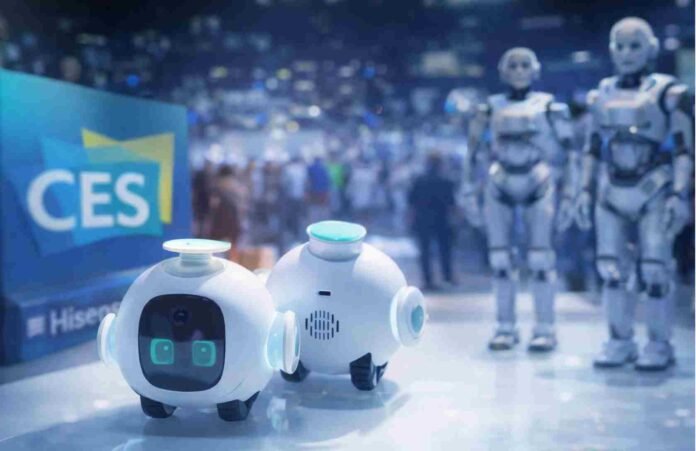
- China dominated the CES floor with commercially ready humanoid robots
- Chinese firms are scaling faster and cutting training costs through simulation
- Lower prices give Chinese robots a strong market advantage
- The show echoed concerns about the US falling behind in robotics volume
At this year’s Consumer Electronics Show in Las Vegas, the future did not whisper. It moved, bowed, played table tennis, swept floors, and even practiced martial arts.
The overwhelming presence of humanoid robots built by Chinese companies turned the world’s most influential tech exhibition into something more than a showcase. It became a statement.
For years, concerns about China pulling ahead in next generation technologies have surfaced in policy debates and earnings calls. This time, those concerns were not theoretical. They were walking the show floor.
Elon Musk has previously warned that while American companies may still lead in cutting-edge performance, China could end up dominating the broader humanoid robotics market. CES offered a vivid illustration of what he meant. Booth after booth featured Chinese made robots demonstrating not concepts, but deployable capabilities.
What stood out was not just what these machines could do, but how close many of them appeared to commercial readiness.
Chinese Robots Take Center Stage at CES
Visitors to CES could hardly avoid the sight of human-like robots developed by Chinese firms. These machines were not hidden in experimental corners. They occupied prime real estate across the exhibition floor.
Some robots played table tennis with surprising coordination. Others handled routine cleaning tasks, navigated crowds, or demonstrated martial arts routines designed to highlight balance and motion control. Together, they conveyed a clear message. China’s humanoid robotics industry is no longer emerging. It is arriving.
Industry analysts noted that Chinese developers did not rely on flashy marketing alone. Many demonstrations focused on repeatable, practical actions rather than one-off stunts. This reinforced the sense that these products are moving steadily toward real-world deployment.
The contrast with many Western robotics displays was noticeable. American companies often emphasized future roadmaps and long-term visions. Chinese exhibitors emphasized what works now.
Simulation, Scale, and Speed
One of the strongest themes to emerge from the show was how Chinese robotics firms are shortening the path from lab to market.
Several companies showcased advanced simulation platforms designed to train robots faster and at lower cost. These systems allow robots to learn complex tasks in virtual environments before transferring those skills to physical machines. The result is quicker iteration and reduced development expense.
Executives from Chinese firms openly discussed plans to expand overseas, targeting regions facing labor shortages and aging populations. Markets like Japan and the United States were cited as natural next steps, not distant ambitions.
Behind these ambitions is scale. Chinese humanoid robot makers accounted for the majority of global shipments last year. While US firms may still compete at the top end, China is winning on volume, manufacturing capacity, and speed of rollout.
That scale advantage compounds quickly. The more robots produced, the more data is gathered. More data improves training. Better training lowers costs. Lower costs expand demand. It is a cycle that favors those who can move fastest.
Price Pressure and the Manufacturing Edge
Cost remains one of the most decisive factors in determining which technologies achieve mass adoption. Here, Chinese companies hold a clear advantage.
Several humanoid robots on display were priced well below Western equivalents. Entry-level models are already available for a fraction of what American companies have projected for similar machines. For businesses considering automation, that price gap is difficult to ignore.
Analysts point out that China’s dominance in manufacturing supply chains plays a critical role. From motors and sensors to batteries and processors, Chinese firms benefit from domestic ecosystems that reduce dependency and cost.
This advantage may prove especially important as humanoid robots move beyond factories into service roles, logistics, healthcare support, and eventually households. In these markets, affordability often matters more than cutting-edge performance.
Research firms project that humanoid robot shipments will rise sharply over the next decade, driven by advances in artificial intelligence, dexterous manipulation, and autonomous learning. China’s early lead in production and pricing could shape who captures the largest share of that growth.
A Broader Technological Signal
CES has always been a barometer of technological momentum. This year, it reflected more than innovation. It reflected confidence.
China’s humanoid robotics industry is no longer content to compete quietly. It is presenting itself on America’s most visible tech stage, signaling readiness to play a global role.
For the United States, the implications are complex. Leadership in breakthrough research still matters. But as CES made clear, leadership in scaling, pricing, and deployment may matter just as much.
The humanoid robot race is not only about who builds the smartest machine. It is about who can deliver it to the world first, and at a price the market will accept.
Follow TechBSB For More Updates