
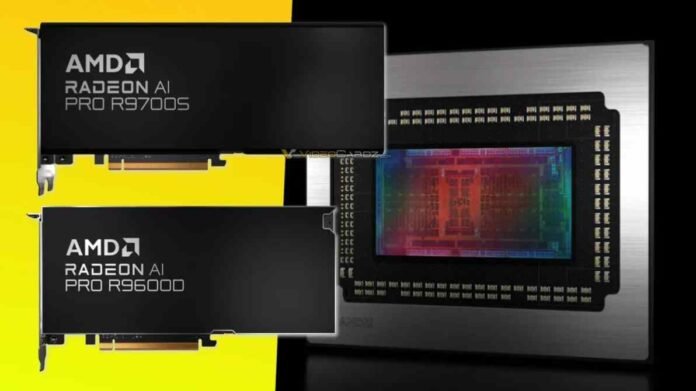
- Passively cooled 300W GPU designed for silent operation in rack scale and multi GPU environments
- Delivers 47.8 TFLOPS FP32 compute with 32GB GDDR6 and PCIe 5.0 support
- Built on RDNA 4 Navi 48 with full ROCm and professional software compatibility
- Requires strong system level airflow and is unsuitable for typical desktop cases
AMD has expanded its professional GPU lineup with the launch of the Radeon AI Pro R9700S, a card that challenges long held assumptions about cooling, acoustics, and performance in workstation and enterprise environments.
On paper, it looks almost contradictory. A 300 watt GPU with no onboard fans, designed to run silently, yet powerful enough to deliver nearly 48 TFLOPS of FP32 compute.
In practice, it reflects a very deliberate shift toward rack scale AI and dense multi GPU deployments where noise is irrelevant and airflow is handled at the system level.
This is not a consumer graphics card and it is not trying to be one. The R9700S is aimed squarely at professional users running inference, training, and data heavy AI workloads in controlled environments.
AMD’s message is clear. Silence does not have to mean compromise, as long as the platform around the GPU is designed correctly.
Hardware That Prioritizes Compute Over Comfort
At the heart of the Radeon AI Pro R9700S is the Navi 48 GPU based on AMD’s RDNA 4 architecture. The configuration mirrors the standard R9700, with 64 compute units and 4096 stream processors.
Boost clocks reach up to 2920 MHz, translating to a peak FP32 throughput of 47.8 TFLOPS. That places it firmly in the territory required for serious AI and machine learning workloads rather than visualization or gaming.
Memory is another key strength. AMD equips the card with 32GB of GDDR6 on a 256 bit bus, supplemented by 64MB of Infinity Cache.
This combination is clearly tuned for large models and data sets that would quickly overwhelm lower capacity GPUs. PCIe 5.0 x16 support ensures the card can move data efficiently between CPU, system memory, and other accelerators, which is critical in modern AI pipelines.
Power delivery comes via a single 12V 2×6 connector, and despite the passive cooling design, the card retains a full 300 watt thermal design power.
This is not a downclocked or efficiency limited variant. AMD is maintaining performance targets and relying on chassis level airflow to do the thermal work.
Passive Cooling Built for Racks, Not Desks
The defining feature of the R9700S is its silent, passively cooled design. The “S” designation signals the removal of any onboard fan or blower, replacing it with a large heatsink engineered to work in high airflow environments.
This approach is common in data center accelerators, but far less so in workstation class GPUs with this level of power draw.
In dense racks where multiple GPUs are installed side by side, onboard fans often become a liability. They add noise, consume power, and can interfere with carefully planned airflow paths.
By shifting cooling responsibility to the system, AMD is aligning the R9700S with enterprise deployment realities. When paired with properly designed racks and server grade airflow, passive cooling can be both quieter and more reliable over time.
That said, this design is unforgiving. Drop the card into a standard desktop case with poor airflow and it will struggle.
AMD is clearly targeting OEMs, system integrators, and enterprises that understand thermal management at scale. For those users, silence is a byproduct of efficiency rather than a primary goal.
Software, Use Cases, and Real World Considerations
From a software perspective, the R9700S fits cleanly into AMD’s professional ecosystem. It supports Linux ECC memory options, integrates with AMD Software PRO Edition, and is fully compatible with ROCm for AI and compute workloads.
This makes it viable for tasks such as generative AI inference, training large language models, and offloading heavy parallel workloads from CPUs.
AMD has also introduced the Radeon AI Pro R9600D alongside it, offering fewer compute units but the same memory capacity. While the R9600D may appeal to more cost-conscious deployments, the R9700S remains the better choice for throughput-intensive workloads.
Early adoption has already appeared in prebuilt workstations, including systems pairing the GPU with Ryzen 9000 series CPUs and ample DDR5 memory.
These configurations highlight AMD’s broader strategy of offering end-to-end platforms rather than isolated components.
The biggest open question is sustained thermals under continuous load. A 300 watt passive GPU can work exceptionally well in a well designed rack, but it leaves no margin for error.
Enterprises considering multi GPU deployments must invest in airflow, monitoring, and system level cooling to avoid throttling or instability.
Follow TechBSB For More Updates