- Strong vacuuming and mopping performance with thoughtful hardware design
- Bagless self emptying dock is a genuine advantage
- Navigation is much improved over previous Dyson robots
- The app feels confusing and underdeveloped for the price
Dyson does not enter categories quietly. When the company makes a move, it usually does so with confidence, strong industrial design, and a belief that its engineering can outclass the competition.
That is why expectations around the Dyson Spot+Scrub Ai are so high.
Dyson’s previous attempt at a robot vacuum failed to justify its price, lacked basic features, and quietly disappeared from serious buying conversations. This new model is clearly designed as a reset.
On paper, Dyson finally delivers what shoppers expect at this level. Vacuuming and mopping are both present. There is a self-emptying base station. There is object recognition powered by artificial intelligence.
There is even Dyson’s signature cyclone system adapted for a robot. For once, it feels like Dyson has actually studied the market rather than ignoring it.
After several days of use, the hardware story is largely positive. The software story is not.
Hardware that finally feels competitive
The Spot+Scrub Ai immediately makes a stronger first impression than Dyson’s previous robot. The base station is substantial yet well-finished, and notably bagless.
Instead of proprietary dust bags, you empty the collector manually, just like a Dyson stick vacuum. This will appeal to anyone tired of paying a premium for consumables for their appliance.
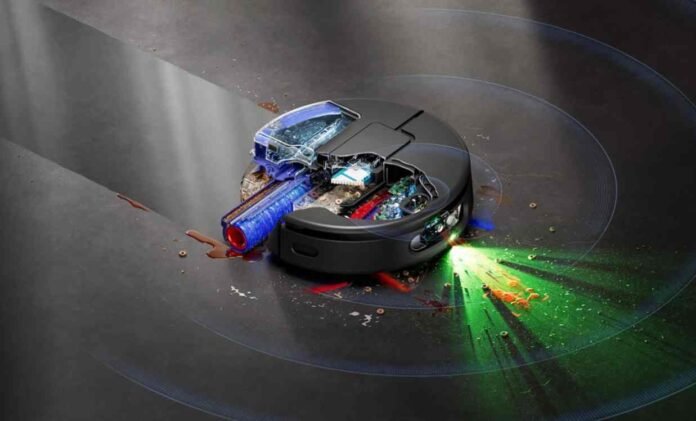
The mopping system is also thoughtfully designed. Rather than dragging a static pad across the floor, Dyson uses a powered roller mop fed by an onboard water tank.
The dock washes and dries the mop automatically using warm water, which should help with hygiene and odor over time. Corner reach is better than expected, and the robot applies extra pressure when it detects stubborn dirt.
Navigation is another area of improvement. The robot moves confidently, avoids furniture more reliably than Dyson’s last effort, and rarely looks lost. In day to day cleaning, it behaves like a mature product rather than a first generation experiment.
All of this makes the price easier to understand, even if it remains firmly in luxury territory.
A premium app that feels unfinished
Unfortunately, the companion app undermines much of that goodwill. It is stable and visually clean, but logic and clarity are lacking. For a product that costs well over a thousand pounds, the software experience should feel effortless. It does not.
Mapping is the biggest frustration. During initial scans, the robot struggled to recognize obvious doorways, even where flooring changes and thresholds exist.
Editing the map afterward is possible, but the tools are unintuitive and less precise than those offered by competitors that cost significantly less.
Room labeling introduces further confusion. Although rooms can be named, those names often disappear when selecting cleaning zones.
Instead, rooms are represented by numbers and near identical icons. In symmetrical homes, this makes it far too easy to select the wrong area, raising the risk of mopping carpet instead of tile.
The object detection system adds icons to the map after cleaning, but they are unlabeled and inactive. You can see that something was detected, but not what or why it mattered. Rival brands at least attempt identification or provide images, even if those guesses are imperfect.
None of these issues are catastrophic. All are solvable with software updates. But at launch, they leave the app feeling unfinished and out of step with the polish of the hardware.
Promising performance with unanswered questions
Where it counts most, cleaning performance appears strong. Suction is excellent, debris pickup is consistent, and navigation rarely falters. The robot adapts well to mixed flooring and handles edges and corners better than many rivals.
The most intriguing feature is its claimed ability to identify dirt and scrub more aggressively when needed. Early signs suggest this works, but it will take longer term testing to confirm whether it is genuinely intelligent or simply reactive.
There are also small disappointments that feel unnecessary. Mopping detergent is required but not included, despite the premium price. The transparent dust bin, while very Dyson, puts your household dirt on display whether you want it or not.
Early verdict
The Dyson Spot+Scrub Ai feels like the robot vacuum Dyson should have launched years ago. The hardware is confident, capable, and competitive with the best in the category. The bagless dock and roller mop are genuine strengths.
But the app does not yet match the ambition of the machine. For a company that prides itself on engineering excellence, the software experience should be sharper, clearer, and more intuitive.
Until that happens, the Spot+Scrub Ai remains an impressive robot held back by a disappointing digital brain.
Follow TechBSB For More Updates