
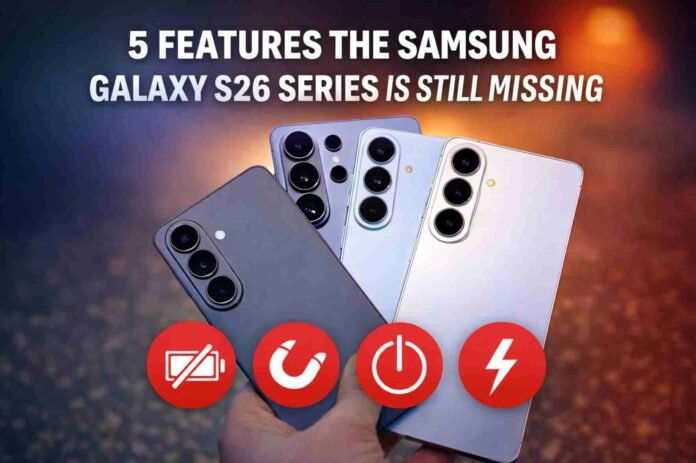
- No silicon carbon battery, capacity stuck around 5,000mAh
- No built in magnets, only magnet cases available
- No powered off tracking via Google Find Hub
- Charging speeds still behind key Android rivals
After months of speculation, teasers, and breathless leaks, the Samsung Galaxy S26 lineup has finally landed. As always, expectations were sky high. And as always, reality feels a little more restrained.
On the surface, the Galaxy S26, S26 Plus, and S26 Ultra refine what Samsung already does well. Displays are excellent. Performance is predictably strong. The Ultra introduces a clever Privacy Display feature that adds a layer of differentiation. But once the excitement settles, a pattern becomes clear. This is a series focused more on iteration than ambition.
In fact, there are several features that either never materialized or feel conspicuously absent when compared to rivals. Here are five things the Galaxy S26 series is still missing.
#1 Silicon carbon batteries that match the competition
Battery tech is quietly becoming one of the most exciting areas of smartphone innovation. Brands like OnePlus and Xiaomi have embraced silicon carbon batteries, pushing capacities far beyond the 5,000mAh ceiling that once seemed standard.
Some recent flagship devices are now flirting with 7,000mAh and even higher, without dramatically increasing thickness. That is a tangible upgrade. Longer endurance without bulk is the kind of progress users actually feel every day.
By contrast, the Galaxy S26 Ultra sticks with a 5,000mAh cell. That figure is not bad in isolation, but it no longer looks ambitious. When competitors are squeezing in dramatically larger batteries, Samsung’s approach feels conservative.
The company has suggested it is exploring silicon carbon technology for future models. That is encouraging. But for now, Galaxy S26 buyers are left with battery capacities that feel more 2023 than 2026.
#2 Built in magnets for a true accessory ecosystem
Magnetic ecosystems are no longer just an Apple talking point. The convenience of snapping on chargers, wallets, stands, and mounts has proven its value.
There were persistent rumors that the Galaxy S26 series would include built in magnets, opening the door to a cleaner, more integrated accessory system. Instead, Samsung opted for magnet equipped cases.
That solution works, but it is not the same. It adds cost. It adds bulk. And it forces users into specific case choices. Anyone who prefers to use their phone without a case or with a third party design is out of luck.
Google has already embraced built in magnets in its recent Pixel lineup. Samsung’s decision to hold back feels cautious. Given the company’s scale and accessory ecosystem, this was an opportunity to create a seamless magnetic experience across its devices.
#3 Powered off tracking through Google Find Hub
Losing a phone is stressful. Losing one that is switched off can feel hopeless.
Google’s Find Hub network allows certain devices to be located even when powered down. It is a subtle feature, but a meaningful one. The phone continues to broadcast a signal that helps it be tracked after shutdown.
The Galaxy S26 models do not support this functionality. Samsung’s SmartThings Find can locate a device offline, but only if it is still powered on. Once the phone is switched off, the trail goes cold.
In practical terms, that could make a difference in theft scenarios or simple misplacement. This is not a flashy upgrade that sells phones in store displays, but it is the kind of thoughtful feature that builds long term loyalty.
#4 A bold color option that breaks the mold
Flagship phones increasingly look alike. Flat frames, slim bezels, large camera modules. Color is one of the few areas where brands can inject personality.
Early whispers suggested the Galaxy S26 series might introduce a vibrant orange finish. Instead, the lineup sticks to safe territory. Black. White. Sky Blue. Cobalt Violet. A couple of online exclusives in Silver Shadow and Pink Gold.
None of these are unattractive. But none of them truly pop either.
When competitors are experimenting with bold finishes and statement shades, Samsung’s palette feels reserved. A striking colorway would have added instant visual identity and helped the S26 stand out in a crowded flagship market.
#5 Charging speeds that still trail behind
Samsung did make some progress here. The Galaxy S26 Ultra now supports 60W wired charging, up from the previous 45W. Wireless charging has also improved on select models.
That is welcome. But it is not groundbreaking.
Several rivals now offer 100W or even 120W wired charging, along with significantly faster wireless speeds. The result is dramatically shorter charging times. In some cases, a near full top up in under half an hour.
The standard Galaxy S26 remains capped at 25W wired charging. That feels especially underwhelming in 2026.
Fast charging is one of the easiest quality of life improvements to appreciate. The less time tethered to a wall, the better. On this front, Samsung still appears cautious rather than cutting edge.
A refined flagship that could have been braver
The Galaxy S26 series is not a misstep. It is polished, powerful, and predictably premium. For many users upgrading from older devices, it will feel fantastic.
But compared with what rivals are attempting, this generation feels safe. Larger next generation batteries, integrated magnets, powered off tracking, bolder design choices, and ultra fast charging would have transformed the S26 from refined to truly forward thinking.
Instead, it feels like Samsung is waiting for the next big leap rather than leading it.
Follow TechBSB For More Updates