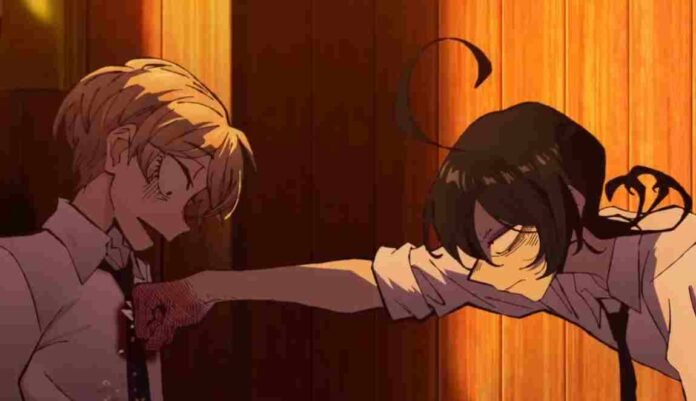
- A dystopian coming of age anime wrapped in twisted Christmas mythology
- Childhood is idealized to the point of cruelty, adulthood treated as failure
- Absurd visuals mask deeply human emotional conflicts
- Challenging, unsettling, but emotionally rewarding for patient viewers
There are Christmas stories designed to soothe, and then there are Christmas stories that crawl under your skin and stay there. Sanda belongs firmly in the second category. It is strange, unsettling, occasionally absurd, and unexpectedly tender.
It is also one of the most emotionally honest coming of age anime to land on streaming in recent memory.
At first glance, the premise sounds like a dare rather than a pitch. In a near future where declining birth rates have pushed society into panic, childhood has become sacred and adulthood something to be feared.
Aging is treated like a curse. Puberty is a threat. And Santa Claus, long erased from public memory, exists as a supernatural inheritance bound to a single bloodline. When triggered, a 14 year old boy transforms into a towering, musclebound incarnation of Saint Nick, powered by children’s belief and armed with ski blade feet.
It should not work. Yet somehow, it does.
Childhood as a Cage, Not a Sanctuary
What elevates Sanda beyond novelty is its worldview. This is not a story about saving Christmas. It is a story about a society so terrified of extinction that it freezes its children in time, refusing to let them grow.
Kids are shielded from consequences, from sleep, from responsibility, all in the desperate hope that innocence can be preserved forever.
The result is horrifying. Children become capable of shocking cruelty because they are never allowed to mature. Adults, meanwhile, mutilate themselves in grotesque attempts to reclaim youth. The show’s horror elements are not decorative.
They are thematically precise, reinforcing the idea that denying natural growth leads to moral and physical decay.
At the center of it all is Kazushige Sanda, a boy already overwhelmed by adolescence before he becomes burdened with the literal weight of myth.
His Santa form is not a power fantasy. It is a liability. Each transformation pulls him further from his peers and closer to an identity he does not fully understand or want.
The Absurdity Hides Something Painfully Human
Sanda is often ridiculous. The Santa design is intentionally excessive. The action is violent in a way that borders on cartoonish. But beneath the noise is a quiet sadness that feels deeply familiar to anyone who remembers being fourteen and confused by their own emotions.
Much of that emotional weight comes from the supporting cast. Several characters are caught in the liminal space between childhood and adulthood, wrestling with feelings they have no language for in a society that refuses to acknowledge their existence.
Romantic confusion, identity anxiety, and fear of rejection run through the series like a low hum.
These moments recall the best work of creator Paru Itagaki, whose earlier success Beastars also explored adolescence through metaphor and discomfort.
Here, those ideas are sharper and more intimate, animated with loose, expressive energy by Science Saru, a studio equally comfortable with chaos and stillness.
Not Comfort Viewing, But Worth the Risk
This is not an easy recommendation. Sanda is violent, morbid, and frequently upsetting. It asks uncomfortable questions about how societies project their fears onto the young. It will alienate viewers looking for warmth and familiarity from seasonal entertainment.
But for those willing to sit with its discomfort, Sanda offers something rare. It treats adolescence not as a joke or a checklist of tropes, but as a fragile, frightening transition that deserves honesty.
The Christmas imagery, twisted as it is, becomes a symbol of hope corrupted and cautiously reclaimed.
Sanda may never become a mainstream hit. Its tone is too strange, its ideas too sharp. Yet that is precisely why it matters. Long after the decorations come down, its questions linger.
What happens when we refuse to let children grow. Who pays the price for our nostalgia. And how much belief does it really take to become who you are.
Follow TechBSB For More Updates