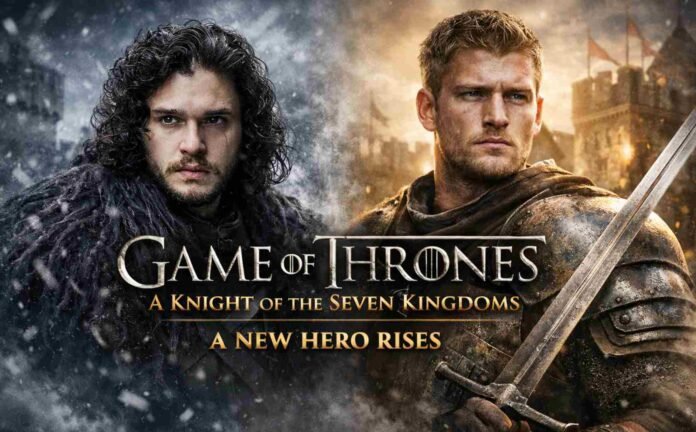
- HBO introduces Ser Duncan the Tall as the new moral center of the franchise
- Duncan shares Jon Snow’s honor driven personality and outsider origins
- The series leans into classic Westeros themes of duty and humility
- Jon Snow’s return remains unlikely, making Duncan the future face of the saga
For many fans, Jon Snow was the emotional backbone of Game of Thrones. From his early days as a quiet outsider at Winterfell to his rise as a leader shaped by duty rather than ambition, Jon embodied the moral center of a brutal world. Even years after the series’ divisive finale, his absence still lingers over the franchise.
With A Knight of the Seven Kingdoms arriving soon, HBO is not resurrecting Jon Snow, but it is clearly filling the space he left behind. That responsibility now falls to Ser Duncan the Tall, played by Peter Claffey.
While Duncan is not a replacement in a literal sense, he occupies a familiar narrative role: the honorable man navigating a corrupt world while clinging to a personal code.
The timing is no accident. As the franchise looks to reengage longtime fans, Duncan offers something comfortably recognizable without repeating the past.
Why Duncan the Tall Feels Familiar
On the surface, Jon Snow and Duncan the Tall could not be more different. Jon was brooding, dark haired, and restrained. Duncan is physically imposing, fair haired, and openly earnest. But personality, not appearance, is where the connection becomes obvious.
Both characters are defined by an internal sense of right and wrong rather than political calculation. Jon repeatedly chose duty over power, even when leadership was pushed onto him.
Duncan, according to both the source material and the show’s trailer, approaches knighthood the same way. He believes the vows matter, even when the world around him treats them as empty words.
In the opening moments of the trailer, Duncan speaks about defending the weak and honoring his oath, not as lofty ideals, but as obligations he fully expects to die for if necessary. That mindset echoes Jon’s decision to join the Night’s Watch, not for glory, but because he believed it was the right thing to do.
This shared moral seriousness is likely why viewers will instinctively compare the two characters. In a franchise known for moral compromise, both men stand out by refusing to bend.
An Outsider’s Journey in Westeros
Another parallel lies in where both characters begin. Neither Jon nor Duncan starts with status, protection, or a clear place in the world.
Jon Snow grew up inside Winterfell but never fully belonged there. As Ned Stark’s illegitimate son, he lived with quiet rejection and limited prospects. Joining the Night’s Watch was as much about purpose as it was about escaping a life where he would always be secondary.
Duncan’s position is even more precarious. As a hedge knight, he has no noble backing, no lands, and no guarantee of safety. His knighthood comes from mentorship, not bloodline or ceremony. He survives by moving from place to place, relying on skill, honesty, and stubborn perseverance.
This outsider status shapes both men. It sharpens their empathy and reinforces their belief that honor is not inherited, but earned through action. That theme has always resonated strongly with audiences, and it remains one of the most effective emotional hooks in the Game of Thrones universe.
Skill, Duty, and the Weight of Expectation
Combat ability also plays a role in why Duncan feels like a spiritual successor to Jon Snow. Jon was established early as a capable swordsman, and over time proved himself in increasingly brutal conflicts. Duncan carries a similar reputation, one that was quietly seeded into the original series years ago through passing dialogue.
Yet what truly connects them is not skill, but restraint. Neither man seeks violence for its own sake. Fighting is framed as duty, not identity. When they draw a sword, it is because something needs protecting.
This distinction matters. In a world full of warriors hungry for legacy, characters like Jon and Duncan stand apart because they would gladly trade recognition for peace. That humility is rare in Westeros, and it is precisely what made Jon Snow so beloved.
Duncan the Tall appears poised to inherit that emotional legacy. He is not meant to replace Jon in memory, but to remind audiences why that archetype worked so well in the first place.
Will Jon Snow Ever Return?
Speculation about Jon Snow’s return has never fully faded. A proposed continuation series was discussed for years before quietly dissolving in early development. While nothing is impossible in modern television, the likelihood of a return seems slim.
For now, HBO is looking forward, not backward. A Knight of the Seven Kingdoms offers a chance to revisit the values that once anchored the franchise, without reopening old wounds from its ending.
If Duncan the Tall succeeds, it will not be because he mimics Jon Snow, but because he reflects the same timeless idea: that honor still matters, even when the world insists otherwise.
Follow TechBSB For More Updates