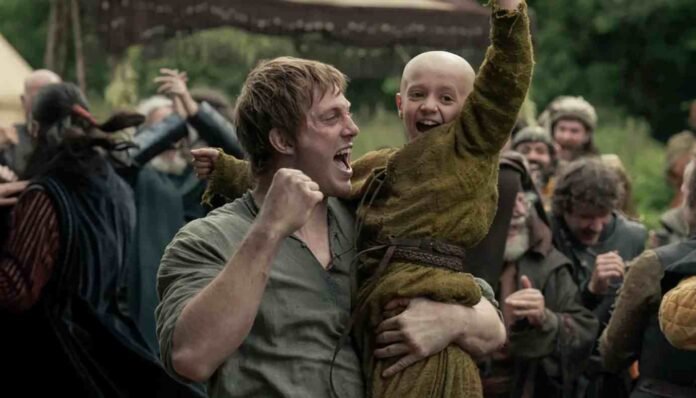
- A Knight of the Seven Kingdoms is a character driven underdog story with real heart.
- Dunk and Egg’s partnership is the show’s biggest strength and its emotional core.
- The tone is funnier and lighter than other Thrones series, but it still turns intense later.
- Short episodes keep it tight, though a few relationships needed more development time.
HBO’s Game of Thrones franchise has been searching for a clean win for a while now. The original series still carries the weight of its famously divisive finale, and while House of the Dragon restored some goodwill, it has not escaped criticism for pacing and narrative hesitation.
That is why A Knight of the Seven Kingdoms feels like a breath of fresh air. It is smaller in scope, warmer in spirit, and far more personal than its predecessors, but it still understands what makes this universe tick.
Set roughly a century before Game of Thrones, the series adapts The Hedge Knight, the first tale in George R.R. Martin’s Dunk and Egg novellas.
The story follows Ser Duncan the Tall, better known as Dunk, a wandering hedge knight who has just lost his mentor. With little more than a sword, a stubborn sense of honor, and a quiet determination to prove he belongs, Dunk heads to Ashford Meadow hoping a tourney win will change his fortunes.
Instead, he meets Egg, a sharp, fearless boy who insists on becoming his squire. It is an encounter that feels almost accidental at first, but quickly reveals itself as the kind of meeting that reshapes lives.
What starts as a modest adventure about survival and self respect steadily transforms into something bigger. Not bigger in the world ending sense, but bigger in emotional impact. It is about identity, loyalty, and the uncomfortable reality of trying to do the right thing in a world that rewards cruelty.
A lighter tone with teeth
One of the show’s smartest choices is its confidence in being different. It does not try to recreate the constant dread of Game of Thrones or the fire and blood spectacle of House of the Dragon. Instead, it leans into a grounded, street level view of Westeros, where the politics are still dangerous, but the focus stays on ordinary people brushing up against extraordinary power.
And yes, it is genuinely funny. Not in a forced, quippy way, but through character driven humor that comes naturally from Dunk’s social awkwardness, Egg’s boldness, and the pair’s constant tug of war dynamic. There are moments of slapstick, sharp comedic timing, and the occasional bit of toilet humor, but it rarely feels cheap. The comedy is used to brighten the world, not soften it.
Still, do not mistake the lighter touch for a lack of tension. The danger is always there, simmering under the surface. Around the midpoint, the tone shifts. The story tightens its grip, the stakes climb, and the show proves it can hit hard when it wants to.
The final stretch brings the kind of emotional punches that remind you this is still Westeros, where pride and power can ruin lives in a heartbeat.
Dunk and Egg are the heart of it
This show lives or dies on its central duo, and thankfully, it thrives. Dunk and Egg are introduced quickly, and that is a blessing. There is no slow, exposition heavy opening that spends half an episode explaining the history of every house banner in the background. The series trusts the audience to catch up through context, and it keeps the spotlight where it belongs.
The chemistry between the two leads is immediate. Dunk is physically imposing but emotionally vulnerable, a man trying to live by ideals that the world keeps mocking.
Egg is clever, impulsive, and constantly pushing boundaries, yet he never feels like a gimmick. Their relationship has the rhythm of a classic odd couple pairing, sometimes tender, sometimes combative, always engaging.
Dunk, in particular, is the kind of protagonist this franchise has not centered in a long time. He is not a schemer. He is not a chosen one. He is not playing a long political game. He is simply trying to be decent, and that decency becomes a liability in a society built on status and intimidation. Watching him navigate that reality gives the series its emotional spine.
The supporting cast adds flavor and menace in equal measure. Several highborn figures orbit the story, and the show uses them effectively as both obstacles and mirrors, reflecting what Dunk lacks in privilege but makes up for in character.
Some antagonistic energy is delightfully theatrical, while other performances bring quieter depth than first impressions suggest.
Small complaints in a strong season
If there is one real frustration, it is that the season occasionally feels like it is moving a little too fast for its own good. With episodes landing around 30 to 40 minutes, the pacing is brisk, and while that suits the source material, it also means certain relationships and character arcs could have used more room to breathe.
You may find yourself wishing for a few extra scenes that deepen bonds, sharpen motivations, or let key supporting characters linger longer.
That said, the shorter runtime also keeps the show lean. There is very little bloat, and the narrative rarely spins its wheels. In fact, some new story elements added around the edges help the world feel fuller, and they generally strengthen the adaptation rather than distracting from it.
By the time the season reaches its final episodes, it becomes clear that this is not just a charming side quest in the Thrones universe. It is a reminder of what made these stories resonate in the first place. Humanity. Consequences. Hope, even when it feels foolish.
Follow TechBSB For More Updates