
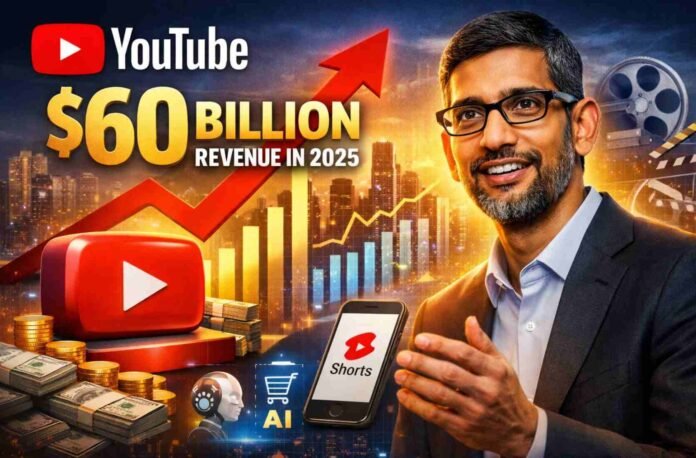
- YouTube earned over $60 billion in 2025 from ads and subscriptions
- Subscriptions now drive growth with 325 million paid users across Google services
- Shorts and AI tools are boosting creator output and revenue efficiency
- YouTube is positioning itself as a full scale alternative to traditional TV
YouTube quietly crossed a historic threshold in 2025. Speaking during Alphabet’s earnings call on February 4, CEO Sundar Pichai confirmed that the video platform generated more than $60 billion in total revenue over the year.
That figure combines advertising income with subscription earnings and places YouTube firmly among the world’s largest media businesses.
To put the scale into perspective, Netflix reported $45.2 billion in revenue for the same year. While the two companies operate under different models, the comparison highlights how far YouTube has evolved from a free video website into a diversified entertainment and commerce platform.
Alphabet rarely discloses YouTube’s total revenue in one number. The last update came in October 2024, when the company revealed the platform had crossed $50 billion over the previous four quarters. The latest announcement shows that momentum has not only continued but accelerated.
Advertising remains a major pillar of YouTube’s business. In the fourth quarter of 2025 alone, ad revenue rose 8.7 percent year on year to $11.4 billion. That steady growth comes even as advertisers experiment with new formats and creators increasingly rely on Shorts and alternative monetisation tools.
Subscriptions Become a Growth Engine
While ads still matter, subscriptions are becoming the real engine of YouTube’s next phase. Pichai said Google now has 325 million paid subscriptions across its consumer services, with YouTube Premium and Google One leading adoption.
YouTube previously disclosed that it had crossed 125 million global subscribers across Music and Premium in March 2025. Since then, the company has expanded its pricing strategy to attract a wider audience.
A key move was the introduction of Premium Lite, a lower cost plan aimed at viewers who want ad free videos in select categories such as learning, gaming and cooking. The trade off is clear.
Music content, Shorts and background playback still carry ads, and downloads are not included. The plan, priced at Rs 89 per month in India, is designed to pull casual users into the subscription ecosystem.
YouTube has also been testing a two person Premium plan in markets including India, France, Taiwan and Hong Kong. The idea is simple. Shared access at a slightly higher price than individual plans but cheaper than family tiers. In India, the pilot pricing stands at Rs 219 for YouTube Premium and Rs 149 for Music Premium.
These experiments come after YouTube raised prices across most subscription tiers in August 2024. Despite the hike, demand has remained strong, suggesting users increasingly see YouTube as a service worth paying for.
AI and Shorts Are Reshaping the Platform
Artificial intelligence is now deeply embedded in YouTube’s creator and viewer experience. Pichai said more than one million channels have already used the platform’s new AI powered creation tools.
At the same time, over 20 million viewers used the Ask feature, driven by Google’s Gemini models, to explore and understand content more deeply.
For creators, these tools promise faster production, smarter editing and new ways to experiment with formats. For viewers, they signal a shift toward more interactive and personalised viewing.
Short form video continues to be a standout success. YouTube Shorts now averages more than 200 billion daily views.
According to Google’s leadership, Shorts is already generating more revenue per watch hour than traditional in stream ads in several major markets, including the United States.
That milestone helps explain why YouTube has doubled down on Shorts without abandoning its long form roots.
YouTube’s Push to Become the New Television
YouTube’s ambitions now go well beyond creator videos and music. The company wants the platform to function as the new television, especially in markets like India.
Viewers watched over 700 million hours of podcasts on living room devices by October 2025, a 75 percent increase year on year. That shift underlines how YouTube is becoming a default screen for long form content in homes.
Shopping is another major focus. Google executives highlighted how creator led recommendations are driving trust and conversions. Shoppable ad formats and improved brand creator matchmaking tools are helping advertisers see better returns.
On the content front, YouTube has made bold moves. It has secured exclusive global streaming rights to the Oscars starting in 2029, ending the ceremony’s decades long run on broadcast television. The platform will stream the main event for free while offering red carpet coverage and behind the scenes content.
Traditional broadcasters are also leaning in. The BBC recently announced plans to produce original content for YouTube aimed at younger, digital first audiences, spanning entertainment, news, children’s programming and sports.
Taken together, these moves show a platform that is no longer just hosting videos but actively reshaping how people watch, shop and subscribe.
Follow TechBSB For More Updates