
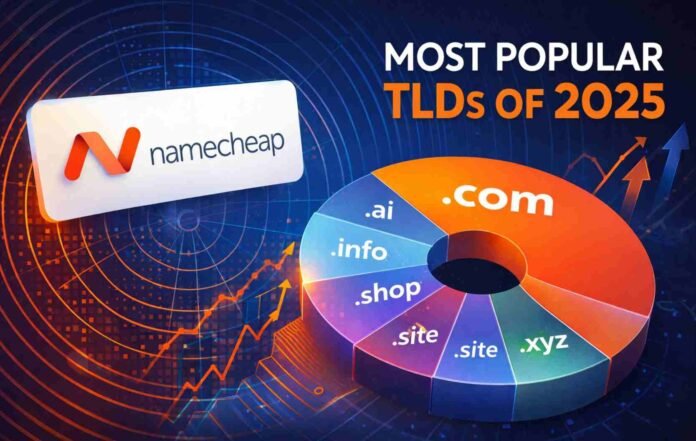
- Dot com regained dominance in 2025 with over 4.6 million registrations
- Dot info, dot shop, and dot site saw strong adoption across industries
- Dot space and dot ai posted the fastest growth rates of the year
- Premium domains continue to command high prices at auction
The domain name industry loves to talk about disruption, but every so often the numbers remind us just how resilient old habits can be. Namecheap’s newly released 2025 Domain Insights and Trends report does exactly that.
Drawing on data from more than 22 million domains, the registrar’s findings paint a picture of a market that is experimenting boldly while still leaning heavily on a familiar favorite.
For all the noise around new domain endings and niche branding opportunities, one truth remains hard to ignore. The classic dot com address is still the backbone of the internet economy.
At the same time, a growing wave of alternative TLDs is quietly reshaping how companies think about identity, relevance, and future proofing.
Dot com stages a comeback despite growing competition
According to the report, dot com was the most registered TLD in 2025 by a wide margin. Between January and December, more than 4.6 million dot com domains were registered, giving it a 40.1 percent share of the market. That figure represents an 11 percent increase year over year, a notable resurgence after non dot com extensions briefly overtook it in overall share during 2024.
The appeal is easy to understand. Dot com still signals legitimacy, familiarity, and global reach in a way no other extension quite manages. For startups, enterprises, and side projects alike, it remains the safest bet when credibility matters most.
What is interesting is not just that dot com is still winning, but that it is doing so in a far more crowded field. There are now hundreds of generic TLDs available, yet many buyers still default to the original choice when it counts.
Alternative TLDs gain traction and define new identities
While dot com dominated the top spot, the real story lies in what followed. Dot info climbed four places to become the second most popular TLD, with nearly 580,000 registrations. Close behind were dot shop, dot site, dot xyz, and dot org, each hovering around the half million mark.
These numbers suggest that businesses and creators are increasingly comfortable stepping outside traditional naming conventions. Extensions like dot shop and dot site are clear, descriptive, and instantly communicative, making them attractive for ecommerce and content driven projects.
Dot xyz continues to benefit from its reputation as a modern and flexible option, particularly among tech focused audiences.
The rise of these alternatives is not about replacing dot com, but complementing it. Many brands now secure multiple TLDs to protect their identity, experiment with campaigns, or localize their online presence.
AI and emerging tech fuel explosive growth in niche domains
Perhaps the most eye catching trend in the report is the rapid growth of newer, more thematic TLDs. Dot space saw the biggest surge of all, growing by an astonishing 404 percent year over year. Registrations jumped from just over 35,000 in 2024 to more than 176,000 in 2025.
Other notable risers included dot app, which posted a steady 12 percent increase, and dot ai, which grew by 55 percent. The popularity of dot ai reflects the continued boom in artificial intelligence tools, startups, and services. For many companies in this space, the extension has become a statement of intent as much as a practical choice.
The aftermarket also highlights how valuable these names can be. Blockchain dot ai topped Namecheap’s auction sales at $405,000, followed by territory dot com and wan dot ai. These figures underline the growing perception of premium domains as digital assets, particularly in fast moving tech sectors.
What domain name details reveal about buyer behavior
Beyond extensions, the report also offers a glimpse into how creative and strategic domain buyers have become. In 2025, 147 one letter domains were registered, a reminder that scarcity still drives demand. At the other extreme, 120 domains hit the maximum allowed length of 63 characters, suggesting experimentation with long, descriptive, or keyword rich names.
Together, these extremes reflect a market that is both playful and calculated. Some buyers chase minimalism and rarity, while others focus on clarity, discoverability, or branding through language.
The bigger picture for businesses and builders
The takeaway from Namecheap’s data is not that one TLD is winning and others are losing. Instead, it shows a maturing market where choice matters more than ever. Dot com remains the default for trust and scale, but alternative TLDs are increasingly shaping how brands stand out and tell their stories online.
As new technologies emerge and digital competition intensifies, domain names are no longer just addresses. They are signals, shortcuts, and sometimes investments in their own right.
Follow TechBSB For More Updates

