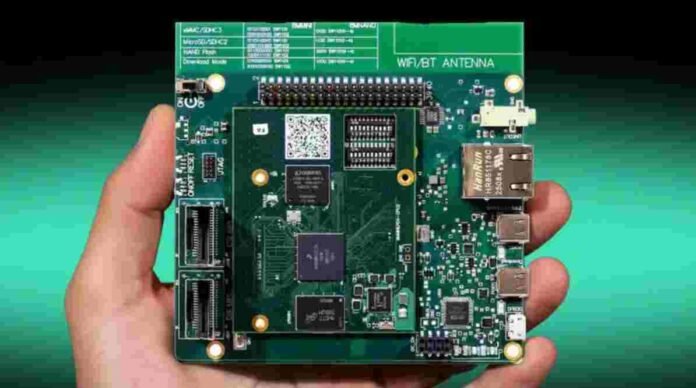
- An AI designed a dual PCB Linux computer with 843 components in one week
- The system booted Debian successfully on the first power up
- Human engineers spent only 38.5 hours supervising and refining
- Physics based optimization replaced imitation of human designs
A small startup has demonstrated just how far AI-assisted hardware design has progressed. Los Angeles-based company Quilter recently revealed Project Speedrun, a fully functional Linux computer designed almost entirely by artificial intelligence.
The system was completed in roughly one week, incorporates 843 individual components across two printed circuit boards, and most impressively, it booted successfully on its very first power up.
For engineers who have lived through months long board spins, late night layout fixes, and endless bring up troubleshooting, that detail alone raises eyebrows.
First boot success is rare even in mature teams with proven reference designs. Achieving it on a fresh, AI driven layout is what makes this project noteworthy rather than just flashy.
How the AI Approach Breaks Traditional Workflows
Traditionally, a complex PCB project follows a predictable and often painful cycle. Engineers begin with setup and architecture planning, move into execution where schematics and layouts are created, then finish with cleanup and debugging once problems inevitably surface.
Each phase introduces opportunities for error, and mistakes made early often surface late, when they are most expensive to fix.
Quilter’s approach compresses and reshapes that cycle. Instead of acting as a drafting assistant trained on existing human designs, the AI was optimized around the physical constraints of electronics themselves.
Signal integrity, power distribution, routing feasibility, and component placement were evaluated against physics based models rather than patterns learned from historical boards.
This distinction matters. Human designed boards often include compromises, legacy habits, and quiet mistakes that get copied forward.
By avoiding imitation and focusing on optimization, the system explored layouts and component arrangements that a human designer might never consider or would dismiss as too unconventional.
Engineers still played a role, but it was notably different from the norm. Human involvement totaled just 38.5 hours, mostly spent supervising decisions, validating assumptions, and refining higher level design intent rather than manually routing traces or fixing repetitive errors.
First Boot Success Is the Real Story
The most important outcome of Project Speedrun is not speed alone. It is reliability. The completed machine booted Debian Linux on the first attempt without requiring board rework or emergency fixes. Anyone with real bring up experience knows how rare this is, particularly on a dense dual PCB system.
This result suggests the AI did more than generate a layout that looked plausible. It respected electrical realities well enough to produce a system that behaved correctly under power, clocked properly, and communicated as intended.
That moves the technology from experimental novelty into something engineers can realistically evaluate for future workflows.
The design process itself reportedly handled the iterative loops that usually consume weeks of human effort.
Instead of engineers manually correcting errors discovered during execution, the AI continuously adjusted the design as constraints evolved, effectively collapsing iteration cycles that normally slow projects to a crawl.
What This Means for Engineers and Startups
The implications extend beyond one successful prototype. If this method proves repeatable, it could significantly lower the barrier to entry for custom hardware development. Small teams could attempt designs that previously required large, specialized groups.
Startups building niche workstations, embedded systems, or compact Linux machines could move from concept to working hardware far faster than today.
That said, caution is warranted. Project Speedrun represents a single data point. More complex systems, higher speed interfaces, and harsh operating environments will test whether this approach scales reliably.
Long term maintainability, manufacturability at volume, and support over product lifecycles are still open questions.
Quilter’s CEO Sergiy Nesterenko has suggested that AI may eventually surpass human engineers in PCB innovation.
That may be true in specific domains, but experienced designers know that hardware failures often come from edge cases rather than averages.
For now, the most realistic future is collaboration rather than replacement, with AI handling optimization and iteration while humans define intent, risk tolerance, and system context.
Follow TechBSB For More Updates