
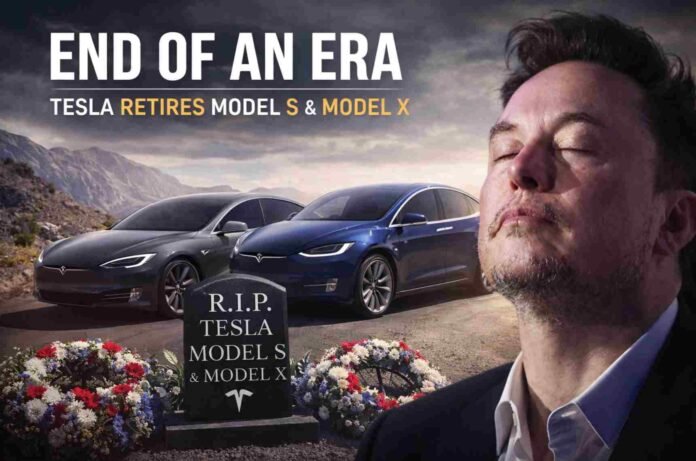
- Tesla has ended custom orders for Model S and Model X
- Falling sales and dominance of Model 3 and Model Y drove the decision
- Company focus is shifting toward autonomy and robotics
- Limited remaining inventory marks the final chance for buyers
Tesla is quietly closing a significant chapter in its history. The company has officially ended custom orders for the Model S and Model X, two vehicles that once defined what modern electric cars could be.
Elon Musk marked the moment with a nostalgic post featuring an image from the early days of Model S production, calling for an official ceremony to honor what he described as “the ending of an era.”
For longtime followers of Tesla, this is more than just a product update. The Model S, introduced in 2012, reshaped public perception of electric vehicles, proving they could be fast, luxurious, and desirable. The Model X followed with bold design choices and ambitious engineering. Together, they positioned Tesla as a pioneer rather than just another automaker.
Why Tesla is moving on
The decision, while emotional, is rooted in practical realities. Demand for both models has steadily declined over the past few years, especially after the arrival of the more affordable and widely appealing Model 3 and Model Y. These newer vehicles quickly became Tesla’s backbone, driving the vast majority of global sales.
Recent figures highlight the shift. Tesla delivered around 1.6 million Model 3 and Model Y units last year, while everything else including Model S, Model X, Cybertruck, and Semi barely crossed 50,000 units combined. That imbalance made it increasingly difficult to justify continued production of the older flagship models.
Tesla had already signaled this transition earlier by grouping Model S and Model X under a broader “Other Models” category in its reporting, effectively sidelining them from the spotlight.
A pivot toward autonomy and robotics
Beyond declining sales, Tesla’s long term strategy is evolving. Musk has been increasingly vocal about steering the company toward autonomy and robotics. The focus is shifting away from traditional passenger vehicles and toward technologies like robotaxis and humanoid robots.
Ending production of Model S and Model X frees up valuable manufacturing space, which Tesla reportedly plans to allocate to its Optimus robot program. This move underlines a broader ambition to redefine the company’s future beyond cars.
However, this pivot raises important questions. While autonomy and robotics promise new revenue streams, Tesla’s identity has long been tied to electric vehicles. Scaling back its most iconic models could be seen as a gamble, especially as competition in the EV market intensifies.
What this means for buyers and the brand
For those still interested in owning a Model S or Model X, the window is closing quickly. Only a limited number of units remain in global inventory, with most located in the United States. Once those are gone, Tesla’s lineup will effectively be reduced to the Model 3 and Model Y for mainstream buyers.
The bigger concern lies in what comes next. Tesla has hinted at future products, even teasing something “cooler than a minivan,” but concrete details remain scarce. Meanwhile, rivals particularly from China continue to push boundaries with faster charging, longer range, and increasingly sophisticated in car technology.
If Tesla wants to maintain its leadership position, it will need to recapture the innovation and excitement that once made the Model S and Model X stand out. Without that spark, even its best selling models could struggle to keep pace in a rapidly evolving market.
A symbolic farewell
The retirement of the Model S and Model X feels symbolic. These were not just cars but milestones that helped accelerate the global shift toward electric mobility. Their departure marks the end of Tesla’s first major chapter and the uncertain beginning of another.
Follow TechBSB For More Updates