
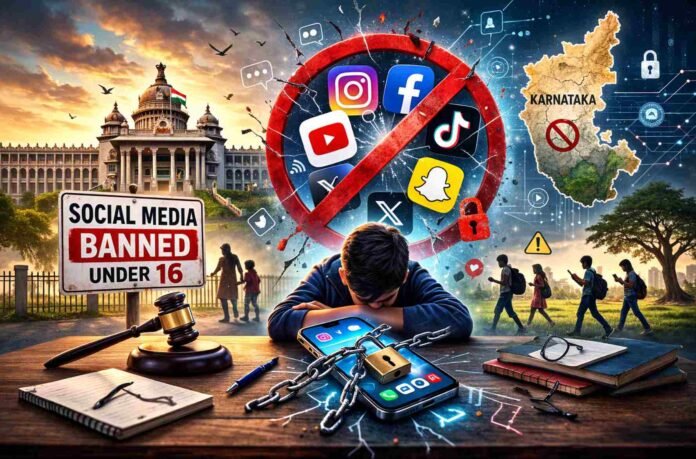
- Karnataka plans to ban social media use for children under the age of 16 to reduce digital addiction and protect young users.
- The announcement was made during the state budget speech, though the implementation timeline has not been revealed.
- The move reflects a global trend, with countries like Australia already introducing similar restrictions.
- Experts are divided, with some supporting age limits while others argue education and parental guidance may be more effective.
India’s technology powerhouse, Karnataka, has announced a major step to regulate digital access among minors. The state government has proposed banning the use of social media platforms for children below the age of 16.
The move makes Karnataka the first state in India to introduce such a policy, reflecting a growing global concern about the impact of excessive screen time and unrestricted online access on young users.
Chief Minister Siddaramaiah announced during his annual state budget presentation. While the policy direction is clear, the government has not yet confirmed when the ban will come into force or how it will be enforced. Still, the announcement has already sparked discussions across India’s technology sector, education community and digital policy circles.
The decision comes at a time when governments around the world are debating how to manage children’s exposure to social media platforms that are often designed to maximize engagement.
Karnataka proposes an age limit for social media access
According to the state government, the primary objective of the proposal is to protect children from the negative consequences of excessive mobile phone and social media usage. Officials argue that increased screen time has been linked to problems such as digital addiction, reduced attention span and exposure to inappropriate content.
During the budget speech, Siddaramaiah explained that restricting social media access for users under 16 is part of a broader effort to address the growing influence of digital platforms on young minds. Authorities believe early intervention could help families maintain healthier technology habits for children.
Karnataka has a population of around 67.6 million people, and a significant portion of that population consists of young citizens. Government data suggests that roughly one quarter of the state’s population falls under the age of fifteen.
With smartphones and high speed internet widely accessible, children are increasingly becoming active users of platforms such as Instagram, YouTube, Snapchat and Facebook.
Officials say the policy is meant to encourage responsible technology usage rather than eliminate digital access entirely. The government is expected to explore mechanisms that verify user age and limit access to certain platforms for minors.
Global trend toward tighter digital rules for minors
Karnataka’s proposal is not emerging in isolation. Across the world, policymakers are examining the role social media plays in shaping the mental health and behavior of young users.
Australia recently became the first country to introduce nationwide restrictions that prevent children under 16 from using social media platforms. European countries including Britain, Denmark and Greece are also reviewing policies that could place stricter limits on minors’ online activity.
The debate has intensified as studies continue to highlight the potential effects of social media on adolescent well being. Experts have raised concerns about cyberbullying, addictive platform design, exposure to harmful content and the psychological pressure created by algorithm driven feeds.
India is one of the world’s largest digital markets, which makes the issue particularly significant. The country has more than one billion internet users and around 750 million smartphones in circulation. For global technology companies, India represents a critical user base. Platforms owned by Meta including Facebook, Instagram and WhatsApp reportedly have their largest audience in India.
Because of this massive scale, any policy change affecting younger users could reshape the country’s digital landscape.
Other Indian states consider similar measures
Karnataka’s decision could set a precedent for other regions in India. Policymakers in several states have already begun discussing whether age based restrictions should be introduced more broadly.
Goa has indicated that it is evaluating similar rules to limit social media use among children. In Andhra Pradesh, a state lawmaker recently proposed legislation that would curb young users’ access to certain platforms.
At the national level, India’s chief economic adviser has also called for policies that address digital addiction through age specific access rules. The proposal has received support from several policymakers who believe India must take a more structured approach to regulating children’s digital exposure.
If more states follow Karnataka’s lead, India could see the emergence of a wider framework governing how minors interact with social media.
Experts question whether bans can work
Despite the growing support for age based digital restrictions, not everyone agrees that bans are the right solution. Some technology experts and child welfare advocates argue that strict age limits may be difficult to enforce.
Children often find ways to bypass restrictions by using incorrect birth dates or fake identification details while creating accounts. Critics believe that without strong verification systems, such bans may prove ineffective.
Instead, some experts recommend a combination of digital literacy education, parental guidance tools and platform level safety features. They argue that teaching children how to use social media responsibly may produce better long term outcomes than outright restrictions.
Supporters of the ban, however, believe it sends an important signal that governments are taking children’s online safety seriously.
Follow TechBSB For More Updates