
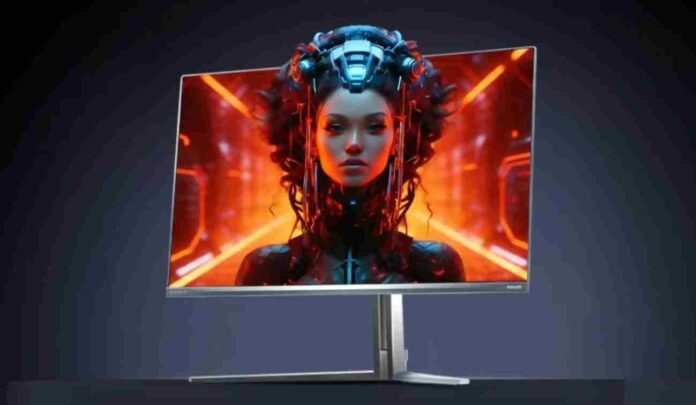
- 32-inch 4K QD-OLED panel with vibrant colors and deep contrast
- 240Hz refresh rate with 0.03ms response time for smooth gameplay
- HDR True Black 400 and factory-calibrated color accuracy
- DisplayPort 2.1, HDMI 2.1, Ambiglow lighting and gaming enhancements
Philips has stepped firmly into the high-end gaming monitor segment with the launch of the Evnia 32M2N8800P, a 32-inch 4K QD-OLED display built for serious gamers and content creators alike. Priced at 5,999 yuan, roughly 860 dollars, the monitor targets users who want cutting-edge panel technology paired with ultra-smooth performance.
This is not just another incremental upgrade. Philips is clearly aiming to compete with top-tier OLED gaming displays by combining Samsung’s latest Quantum Dot OLED panel with a fast 240Hz refresh rate. The result is a monitor that promises both visual richness and elite gaming responsiveness.
A QD-OLED panel built for accuracy and impact
At the core of the Evnia 32M2N8800P is a 31.5-inch QD-OLED panel with a 3840 x 2160 resolution. This third-generation Quantum Dot OLED technology enhances both color vibrancy and contrast, delivering deeper blacks and brighter highlights compared to traditional LCD panels.
The display carries HDR True Black 400 certification, which ensures more accurate HDR performance with better shadow detail. It also pushes brightness up to 1000 nits in small highlight windows, making HDR content pop without washing out darker areas.
Color performance is one of its strongest points. Philips claims 99 percent DCI P3 coverage, 97.5 percent AdobeRGB, and full sRGB coverage. Each unit is factory calibrated with a DeltaE below 2, meaning color accuracy is precise enough for professional work right out of the box.
Performance tuned for competitive gaming
While the visual specs are impressive, Philips has not overlooked gaming performance. The monitor supports a 240Hz refresh rate combined with an ultra-fast 0.03ms gray-to-gray response time. This combination significantly reduces motion blur and ghosting, which is crucial for fast-paced titles like shooters and racing games.
Adaptive Sync support is included to eliminate screen tearing and stuttering, ensuring smooth gameplay across varying frame rates. Additionally, the display meets VESA ClearMR 13000 standards, a certification that highlights its ability to maintain clarity during rapid motion.
Philips has also added a set of gaming-focused enhancements. AI-based shadow boosting helps reveal details in darker scenes, which can be particularly useful in competitive environments. The Smart Sniper feature is designed to improve aiming precision, while low-latency acceleration reduces input lag for faster response times.
Connectivity, design and extra features
The Evnia 32M2N8800P comes equipped with a wide range of connectivity options. It includes a DisplayPort 2.1 port capable of handling 4K at 240Hz, along with two HDMI 2.1 ports that support 4K at 120Hz. This makes it suitable for both high-end gaming PCs and current-generation consoles.
There is also a USB hub setup with one USB-B upstream port and two USB-A 3.2 Gen 1 ports, along with KVM support for switching peripherals between devices. A 3.5mm audio jack is included for convenience.
One of the standout design elements is Ambiglow lighting, Philips’ ambient lighting system that syncs with on-screen content, audio, or motion. It adds an immersive glow around the display, enhancing the gaming atmosphere without being overly distracting.
The monitor features dual 5W speakers, which are adequate for casual use, though most users will likely opt for dedicated audio setups. The ergonomic stand allows for height, tilt, and swivel adjustments, ensuring comfort during long sessions. It also supports VESA mounting and includes a quick-release mechanism and a built-in headphone hook.
A strong contender in the OLED gaming space
With the Evnia 32M2N8800P, Philips is clearly positioning itself among the leaders in premium gaming monitors. The combination of 4K resolution, QD-OLED technology, and a 240Hz refresh rate makes it an appealing option for gamers who refuse to compromise between visual quality and speed.
It also reflects a broader trend in the industry, where OLED panels are becoming more accessible in gaming displays. As competitors continue to push boundaries with larger and faster screens, Philips has delivered a balanced product that excels in both performance and practicality.
Follow TechBSB For More Updates

