
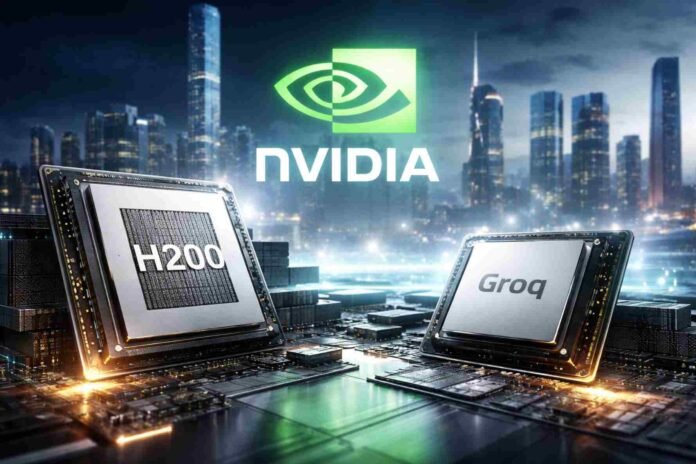
- Nvidia has received approval from China to sell its H200 AI chips after months of delays
- The company is restarting production and already has orders from Chinese customers
- Nvidia is preparing Groq AI chips for China, targeting the fast growing inference market
- The move reflects a broader strategy to navigate US China regulations while maintaining market presence
Nvidia appears to have finally broken through one of the biggest roadblocks in its global AI business. After months of uncertainty and regulatory friction, the company has secured approval from Chinese authorities to sell its H200 artificial intelligence chips, according to sources familiar with the matter.
This development marks a significant shift. China has historically been one of Nvidia’s most important markets, contributing a sizable share of its revenue. But tightening export controls from the United States and cautious regulatory responses from Beijing had effectively stalled shipments of advanced AI hardware.
Now, with both sides seemingly granting the necessary permissions, Nvidia is preparing to restart production and fulfill orders from Chinese customers. CEO Jensen Huang confirmed that the company has already received multiple purchase orders and is ramping up its supply chain accordingly.
Why the H200 matters so much
The H200 is not Nvidia’s most powerful chip, but it sits close to the top of its lineup. That makes it a strategic compromise, powerful enough to drive serious AI workloads, yet potentially acceptable within export limits.
Demand for these chips in China has been strong, particularly from large technology firms and AI startups that need advanced computing power for training and deploying models. Earlier reports suggested that major players had already been given preliminary approval to import the chips, but final regulatory clarity had been missing.
That gap now appears to be closing. Nvidia had previously halted production of the H200 amid uncertainty, but Huang’s recent comments indicate that manufacturing is back on track. For China’s AI ecosystem, this could unlock access to hardware that has been difficult to source through official channels.
Nvidia pivots with Groq for AI inference
Alongside the H200 developments, Nvidia is making another calculated move. The company is preparing a version of its Groq AI chip tailored for the Chinese market.
Unlike chips used to train AI models, Groq is focused on inference. This is the stage where AI systems actually respond to users, generate text, write code, or perform tasks in real time. It is a fast growing segment and one where competition is intensifying.
Interestingly, the Groq chip being prepared for China is not a stripped down version. Instead, it is designed to integrate with different systems, making it flexible enough to operate within regulatory boundaries. Nvidia plans to combine these chips with its upcoming Vera Rubin architecture in markets where restrictions allow, though those specific chips will not be available in China.
The timing is notable. The inference market is becoming increasingly crowded, with Chinese companies already developing their own chips. Nvidia’s move suggests it is not willing to concede ground in this space.
A delicate balance between policy and demand
What makes this situation particularly complex is the dual layer of regulation. Nvidia has needed approval not just from Washington but also from Beijing. Even after securing export licenses from the United States, the lack of clear authorization from Chinese authorities had slowed progress.
Now that both sides appear to be aligned, at least partially, Nvidia can re engage with customers in a market that remains critical to its long term growth.
At the same time, the company is adapting its strategy. Instead of relying solely on its most advanced hardware, it is diversifying its offerings and adjusting products to fit within geopolitical constraints.
This approach reflects a broader reality in the tech industry. Companies are no longer just building the most powerful tools they can. They are designing products that can navigate a fragmented regulatory landscape while still meeting customer demand.
What this means for the AI race
Nvidia’s renewed access to China could have ripple effects across the global AI ecosystem. Chinese firms gain improved access to high performance chips, while Nvidia secures a foothold in a market that is both lucrative and strategically important.
At the same time, competition in AI hardware is only intensifying. Domestic Chinese chipmakers are advancing quickly, particularly in inference. Nvidia’s Groq strategy suggests it is preparing for a future where dominance is no longer guaranteed.
For now, though, the message is clear. Nvidia is back in business in China, and it is moving fast to capitalize on the opportunity.
Follow TechBSB For More Updates