
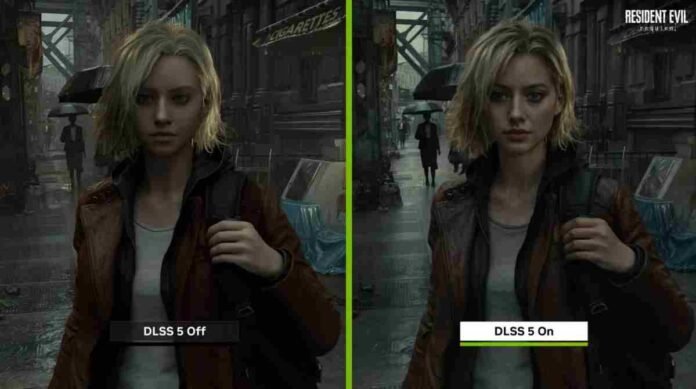
- DLSS 5 focuses on AI driven lighting and visual realism instead of performance
- Early demos show noticeable changes to characters and environments
- Gamers worry about loss of artistic intent and over processed visuals
- High hardware demands raise questions about real world usability
Nvidia used its GTC 2026 stage to introduce DLSS 5, positioning it as a defining leap in real time graphics. The company describes it as a neural rendering system designed to enhance lighting and materials on the fly, pushing visuals closer to cinematic realism.
Unlike earlier versions of DLSS, which focused on performance gains through upscaling and frame generation, this new iteration shifts the spotlight to image quality itself.
The promise is bold. Nvidia claims DLSS 5 blends traditional rendering with generative AI to produce scenes that resemble high end visual effects work. In theory, developers can keep their original assets intact while AI layers in more sophisticated lighting, reflections, and surface detail.
That vision has not landed smoothly.
A different kind of upgrade that changes the look of games
DLSS 5 is not about making games run faster. Instead, it changes how they look. NVIDIA says the technology enhances existing scenes without altering the underlying assets. However, early demonstrations suggest that the impact goes beyond subtle improvements.
In one widely discussed example, character appearance shifted noticeably. Facial tones, makeup, and even hair color appeared different under DLSS 5. While technically this may be the result of altered lighting and shading, the outcome feels like a reinterpretation rather than a refinement.
That distinction matters. Game visuals are not just technical output. They are carefully crafted artistic decisions. Lighting, color grading, and atmosphere are all chosen deliberately by developers. When an AI system begins to reinterpret those choices, even slightly, it raises questions about authorship and intent.
Community reaction turns sharply negative
The response across gaming communities has been swift and often critical. Many players see DLSS 5 as a step too far into AI driven visuals. The most common concern is that it risks overriding the artistic vision of developers in favor of algorithmic enhancements.
Some reactions frame the feature as an unnecessary filter rather than a meaningful improvement. Others point to the so called uncanny valley effect, where hyper realistic visuals feel unnatural or exaggerated. Instead of immersion, the result can feel artificial.
There is also a broader unease about the direction of graphics technology. DLSS started as a performance tool. With each iteration, it has taken on a more active role in shaping what players actually see. DLSS 5 represents the most aggressive shift yet, moving from assistance to transformation.
For some, that crosses a line.
Performance concerns and early limitations
Beyond artistic debates, there are practical concerns too. Nvidia confirmed that its early DLSS 5 demonstrations ran on two high end GPUs, with one dedicated solely to the neural rendering process. That detail has raised eyebrows.
While Nvidia insists the final version will be optimized for a single GPU, the current requirements hint at how demanding the technology is. If the system remains resource heavy, it could limit accessibility even among high end PC users.
This also feeds into skepticism about real world implementation. Early tech demos often represent ideal conditions. Translating that performance into shipping games is another challenge entirely.
A bold vision facing a cautious audience
It is worth noting that not all impressions are negative. Some early hands on previews have praised the level of detail and lighting improvements. In certain scenes, DLSS 5 does appear to add depth and realism that traditional techniques struggle to achieve in real time.
Still, the broader reaction suggests that Nvidia may need to tread carefully. Gamers are not rejecting innovation outright. What they are pushing back against is the idea of AI altering the identity of a game without clear boundaries.
DLSS 5 is still in its early stages, with a release expected later this year. There is time for refinement, both technically and philosophically. Nvidia will likely need to demonstrate not just what the technology can do, but how it can coexist with artistic control rather than compete with it.
For now, DLSS 5 stands as one of the most ambitious and controversial developments in modern graphics.
Follow TechBSB For More Updates

