
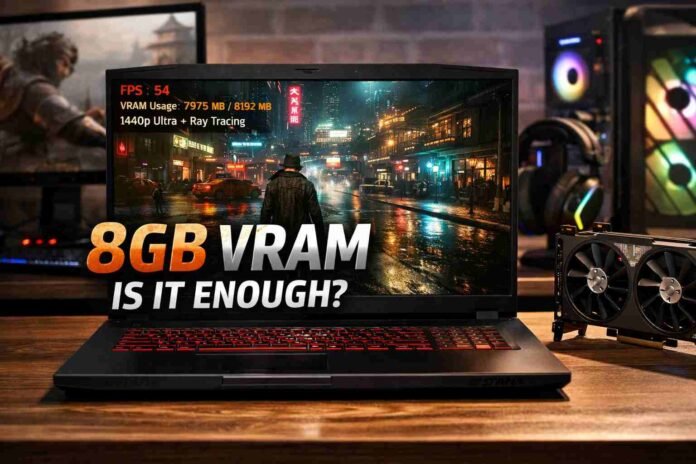
- 8GB VRAM can still perform well in optimized games with upscaling
- VRAM heavy titles expose stutters and instability quickly
- Frame Generation helps only when base performance is already strong
- Future games will increasingly overwhelm 8GB configurations
For years, I have argued that 8GB of VRAM belongs in the past. As games grow heavier, textures get sharper, and rendering techniques become more complex, memory headroom has quietly become one of the most important factors in gaming performance.
That belief was challenged after spending real time with the MSI Katana 15 HX, a modern gaming laptop built around Nvidia’s RTX 5070 laptop GPU and limited to 8GB of VRAM.
On paper, this looks like a mismatch. A new generation GPU paired with a memory configuration many enthusiasts consider outdated. In practice, the story is more nuanced.
What I found was neither a clear win nor a failure. Instead, it revealed exactly where 8GB of VRAM still works, where it struggles, and why it is no longer a safe long term bet.
Real World Performance Tells a More Complicated Story
In games that are well optimized and flexible with memory usage, the Katana 15 HX performs better than expected. Cyberpunk 2077 was the standout example.
Running at 1440p with DLSS set to Balanced and graphics on Ultra, the system averaged around 90 frames per second. Image quality remained clean and stable, and the experience felt smooth throughout.
Turning on ray tracing dropped performance into the mid 50s, which is still respectable given how demanding that engine remains.
Enabling Frame Generation pushed performance higher again, landing comfortably above 100 frames per second without breaking responsiveness. Because the base frame rate was already strong, Frame Generation did not introduce severe artifacts or latency issues.
Other titles reinforced this trend. Shadow of the Tomb Raider ran effortlessly, producing high frame rates at 1440p without relying on Frame Generation. At 1080p, performance gains were even more noticeable, showing that the GPU itself is capable, provided memory limits are not exceeded.
This is where 8GB still holds ground. If you play optimized titles, stick to sensible resolutions, and use upscaling intelligently, performance can feel surprisingly modern.
Where 8GB of VRAM Starts to Fall Apart
The cracks appear as soon as memory demand spikes. Games like Black Myth Wukong, Assassin’s Creed Shadows, and Monster Hunter Wilds quickly push VRAM usage to the edge. In several scenarios, memory allocation hovered just below the 8GB ceiling, leaving no room for overhead.
Once VRAM fills up, performance does not just drop. It becomes inconsistent. Stutters appear. Frame pacing breaks down. In Monster Hunter Wilds, central hubs caused frequent hitching even without Frame Generation enabled.
In Black Myth Wukong, Frame Generation increased VRAM usage without delivering meaningful performance gains, effectively canceling out its benefits.
Assassin’s Creed Shadows was particularly telling. With ray tracing enabled by default, base frame rates were already low. Turning on Frame Generation barely improved performance while pushing VRAM usage dangerously close to the limit.
This is the worst case scenario for an 8GB GPU, where modern features become liabilities instead of advantages.
The takeaway is simple. 8GB works until it does not. And when it fails, it fails hard.
The Bigger Problem Is Not Just Gaming Performance
What concerns me more than any single benchmark is where the market is heading. Memory prices are rising. Manufacturers are cutting costs wherever possible. That combination is already pushing laptops back toward lower RAM and VRAM configurations.
Games today increasingly expect 16GB of system memory as a baseline. Many already run better at 32GB. If we start seeing systems with both 8GB of VRAM and reduced system RAM, performance stability will suffer across the board, not just in extreme cases.
The MSI Katana 15 HX is not a bad product. It is a solid budget gaming laptop that can deliver strong results at 1080p and acceptable performance at 1440p with upscaling. But it is also a reminder that 8GB of VRAM is living on borrowed time.
For current games, careful settings management can keep things playable. For future releases, that margin is shrinking fast.
Final Verdict
8GB of VRAM is no longer comfortable. It is usable, sometimes impressive, but always limited. The MSI Katana 15 HX proves that smart software and a capable GPU can stretch that memory further than expected. It also proves that the ceiling is already visible.
If you buy into 8GB today, you are buying for the present, not the future.
Follow TechBSB For More Updates